



Emergent.sh Review 2026

Emergent.sh AI Tools Plans & Pricing

Emergent.sh Comparison
Expert Review
Pros

Cons

Emergent.sh AI Tools's Offerings
Emergent.sh uses a credit-based pricing model, which means your cost is tied to how much you build, test, and deploy. That makes it flexible for users who want to start small, but it also means costs can become less predictable if you iterate frequently or build larger projects.
-
Free (Beta Access – $0)
The free plan is perfect for experimenting. It includes five monthly credits and 10 daily credits, giving users enough room to test workflows and try out the builder’s core features. Access to community resources is also included. -
Standard ($20/month or $204/year – 17% discount)
The Standard plan provides 100 monthly credits, unlimited small projects, and popular integrations such as Google Sheets and Airtable. It also supports building mobile apps, includes 10 daily credits, and unlocks advanced tools like Save to GitHub and Fork for collaboration. -
Pro ($200/month or $2,004/year – 17% discount)
The Pro plan is designed for larger and more complex projects. It offers 750 monthly credits, premium integrations like Stripe, and early access to beta features. Users also get a 1M token context window, the ability to edit system prompts, custom agent creation tools, and priority support. It runs on a more powerful machine for faster performance and includes advanced GitHub collaboration.
Verdict on Pricing
Emergent.sh’s pricing is highly accessible for those just starting out, thanks to the free tier, while the Standard plan hits the sweet spot for freelancers and small teams. The Pro plan caters to power users tackling complex projects, though the reliance on credits means usage costs can rise quickly for those building at scale.
Emergent.sh review: my quick take
Emergent.sh is an AI app builder for founders, freelancers, and small businesses that want to turn an idea into a working web app without coding the full stack manually. What makes it different is that it does more than generate a front end. It can also handle backend setup, authentication, hosting, databases, and Stripe payments inside one AI-driven workflow.
In my experience, Emergent.sh is best for fast prototyping, internal tools, and early product validation. It is one of the faster platforms for getting from prompt to live app, especially if you want more than a basic mockup. The trade-off is that the platform can be less predictable during generation, and its credit-based model may become limiting if you iterate heavily or build more complex products.
This means Emergent.sh is worth considering if your priority is speed, automation, and launching quickly. If you need deeper control, long-term flexibility, or enterprise-grade reliability, you may eventually want a more mature or more developer-friendly option.
How I evaluated Emergent app builder
I looked at Emergent.sh as a practical tool for SMBs, founders, and solo builders who want to move from idea to working product quickly. I focused on the areas that matter most when choosing an AI app builder: ease of use, speed, output quality, backend setup, launch readiness, pricing, and how suitable it is for real-world business apps.
I also looked at how well the platform handles the parts that often slow teams down, such as deployment, hosting, authentication, payments, and app refinement after the first prompt. The goal of this review is not just to describe features, but to help readers decide whether Emergent.sh is the right fit for the kind of product they want to build.
Who Emergent.sh is best for
Emergent.sh is best for people who want to build and launch functional apps quickly without managing a full development stack. It is especially useful for:
- founders validating a startup idea
- freelancers building client tools or internal systems
- small businesses creating simple operational apps
- non-technical teams that want a working product fast
- solo builders testing SaaS concepts without hiring developers first
The platform is strongest when speed matters more than deep customization. If your goal is to get a usable app live quickly, Emergent.sh is much more relevant than a traditional website builder or a heavier development workflow.
Who Emergent.sh may not be best for
Emergent.sh may not be the best fit for teams that need enterprise-grade reliability, very advanced backend architecture, or full engineering control from the start. It is also a weaker fit for content-heavy websites, SEO-first publishing sites, or complex products that require constant fine-tuning over long development cycles.
If your product depends on highly custom workflows, deep infrastructure control, or predictable scaling at a technical level, you may eventually outgrow what Emergent.sh offers.
Should you choose Emergent.sh?
Choose Emergent.sh if you want to move from idea to working product quickly and you care most about speed, automation, and built-in full-stack functionality. It is especially useful for startup MVPs, internal tools, client portals, and other app-style projects where launching fast matters more than deep engineering control.
Skip it if your project depends on advanced architecture, highly customized workflows, content-heavy site management, or long-term technical scalability from day one. In those cases, Emergent.sh may still be useful for early validation, but it may not be the best long-term platform.
Customer Support
Customer Support
Emergent.sh provides several support options to help users get started and resolve issues. The platform offers clear documentation through its Help Center, which covers everything from troubleshooting to billing. There’s also an active Discord community where users can share tips, ask questions, and connect directly with the team. For more formal assistance, Emergent.sh provides a ticket-based email system via support@emergent.sh, with faster response times available on premium plans.
Support Channels
Documentation & Help Center – Written guides and resources in place of a formal FAQ.
Community Support – An active Discord server for peer-to-peer and team interaction.
Email/Ticket System – Direct support via email for troubleshooting and account issues.
Priority Support
Available to Pro plan users, who receive faster responses and higher priority in the support queue.
What’s Not Offered
Phone Support – Not available.
Live Chat – Not currently offered.
Video Tutorials – Not provided; support relies on written documentation.
Published Support Hours – Not listed; response times vary depending on tickets and community activity.
Verdict
Overall, Emergent.sh delivers solid support for a young platform. While it lacks phone, chat, and 24/7 coverage, its combination of a detailed Help Center, an active community, and ticket-based email support ensures users can usually find the help they need. Community-driven support plays a big role, especially for those on the free or entry-level plans.
Features & Functionality
Writing Features
Emergent.sh takes a very different approach to design compared to traditional website builders. Instead of browsing through hundreds of templates or dragging and dropping elements, you describe what you want, and the platform generates a responsive layout tailored to your idea. While it doesn’t offer an extensive template library, it does provide a small selection of clean starting points, such as dashboards, onboarding flows, and internal tools.
Every build is fully responsive, so your apps and websites look good across desktop, tablet, and mobile without extra work. You can also refine your project further by editing styling in the visual editor or connecting GitHub to add custom code. This balance of AI-driven layouts and manual customization makes it flexible enough for both beginners and advanced users, even though features like blog templates, portfolios, and multi-language support aren’t currently available.
Marketing
Emergent.sh is primarily built for rapid app and website creation, so its marketing features are more limited compared to traditional website builders. You won’t find built-in SEO tools, newsletter functionality, or visitor analytics. Instead, the platform focuses on integrations that extend its capabilities. Out of the box, you can connect with tools like Google Sheets, Airtable, Notion, Slack, and Stripe, making it easy to add functionality or tie your app into existing workflows.
For monetization, Emergent.sh has a clear advantage: payment processing is included by default through Stripe integration, allowing you to set up paid services or products without additional setup. Social integrations are supported through third-party connections, though not in the form of native share buttons or campaign tools. Overall, Emergent.sh covers the basics needed to launch and monetize quickly, but businesses that rely heavily on built-in marketing, analytics, or SEO optimization may need to integrate external platforms to fill those gaps.

Hosting
Emergent.sh handles hosting automatically, so every app you generate is ready to deploy without needing a separate provider. This makes it extremely convenient for fast prototyping and launching, since backend, database, and file storage are bundled in by default. However, Emergent.sh does not offer the kind of traditional hosting perks you might expect from classic website builders. There are no free custom domains, unlimited storage, or unmetered bandwidth options—instead, usage is tied directly to the platform’s credit system.
This means hosting is seamless and included, but also limited by the credits available on your plan. It’s ideal for quickly getting projects live, though businesses seeking traditional hosting flexibility, multiple sites, or guaranteed resources may need to look for external solutions once they scale.
Good For
Emergent.sh is best suited for founders, freelancers, and small businesses that need to get functional apps and websites live quickly without coding. Its standout feature is automatic website and app building from natural language prompts, making it ideal for rapid prototyping and testing ideas. While it isn’t designed for blogging or content-heavy sites, it does support simple online stores thanks to built-in Stripe integration for payments. Overall, Emergent.sh is a strong choice for users who value speed, automation, and integrated backend functionality over traditional content management features.
Best use cases for Emergent.sh
Emergent.sh is most useful when you need a working app quickly and want the platform to handle more than just design. Based on its strengths, these are the use cases where it fits best:
Internal tools
Emergent.sh is a strong option for internal tools because it can generate working interfaces, backend logic, and deployment-ready builds quickly. This makes it useful for admin workflows, internal dashboards, and operational systems that do not need a long custom dev cycle.
Client portals
Because Emergent.sh includes authentication, hosting, and database functionality, it works well for simple client portals. Businesses can use it to create secure spaces where clients log in, view data, upload files, or access services.
Startup MVPs
Emergent.sh is a good fit for startup MVPs because speed is one of its main strengths. Founders can go from concept to working prototype much faster than with a traditional agency or manual development process.
SaaS validation projects
If the goal is to test whether a product idea has demand, Emergent.sh can be a practical early-stage tool. It is especially useful when you want a product that is more functional than a mockup but faster to build than a custom app.
Dashboards and data-driven apps
The platform is useful for dashboards and structured apps that need basic logic, user flows, and backend support. It is a better fit for these than simple website builders because it is designed around app functionality, not just content pages.
Payment-enabled apps
Stripe support makes Emergent.sh useful for products that need subscriptions, payments, or simple monetization workflows. That gives it an advantage over many lighter AI builders that stop at app generation and require extra setup for billing.
Available on
A web application builder that is available for all platforms.
Performance:
Emergent.sh delivers impressive speed when it comes to turning ideas into working products. Simple apps, like a task tracker or client portal, can be generated and deployed in under 10 minutes. More complex builds, such as dashboards or marketplaces, usually take less than half an hour—still much faster than traditional builders. The platform’s multi-agent AI system ensures cleaner code, smoother functionality, and fewer bugs compared to single-agent solutions.
However, performance isn’t without its trade-offs. Because Emergent.sh runs on a credit-based system, intensive builds or repeated iterations can quickly consume available credits. Users have also reported occasional reliability issues during generation or deployment, which can interrupt the flow. Despite these limitations, the platform’s speed and automation make it one of the most efficient AI-powered builders for rapid prototyping and launching.
Ease Of Use:
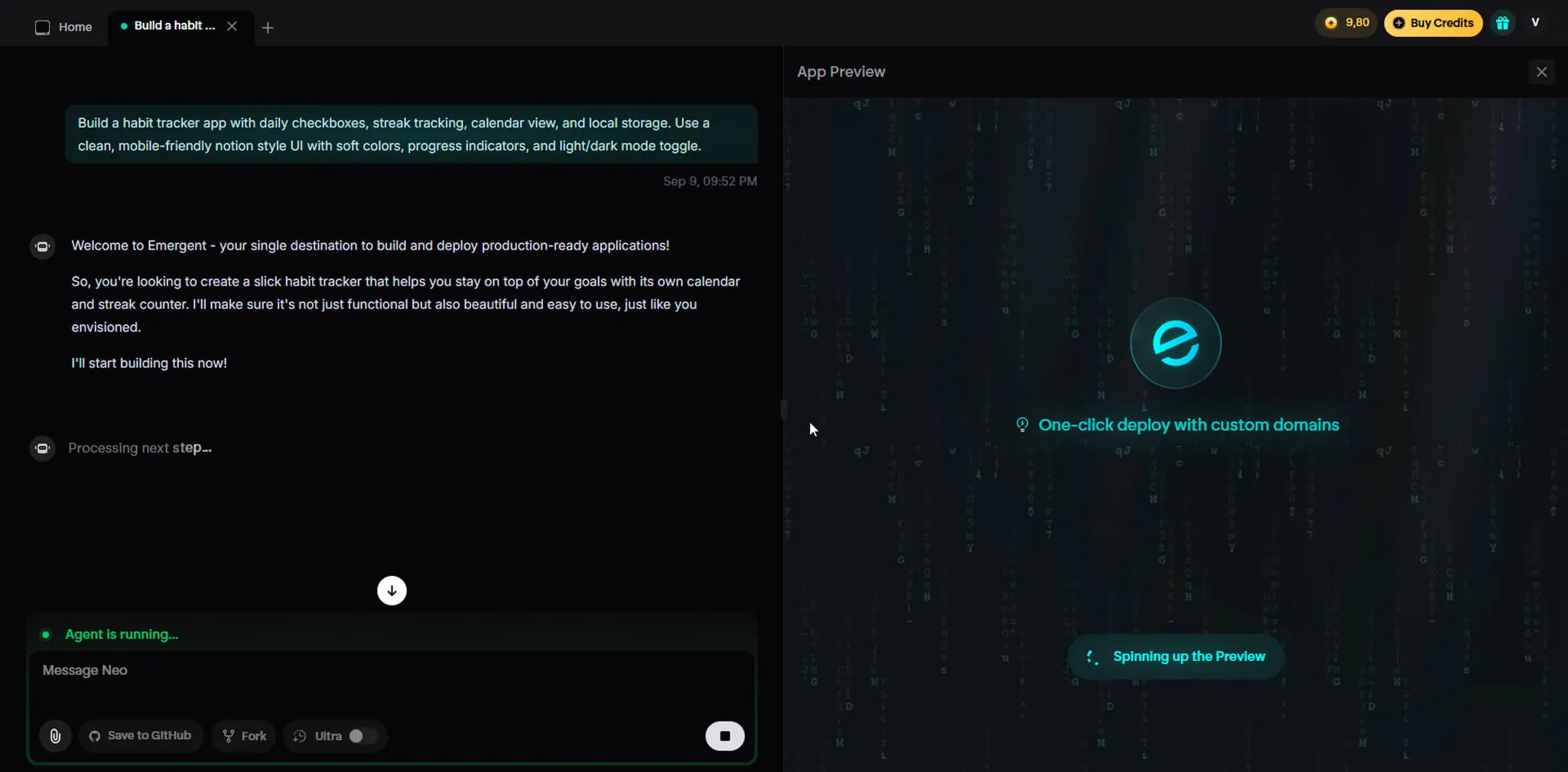
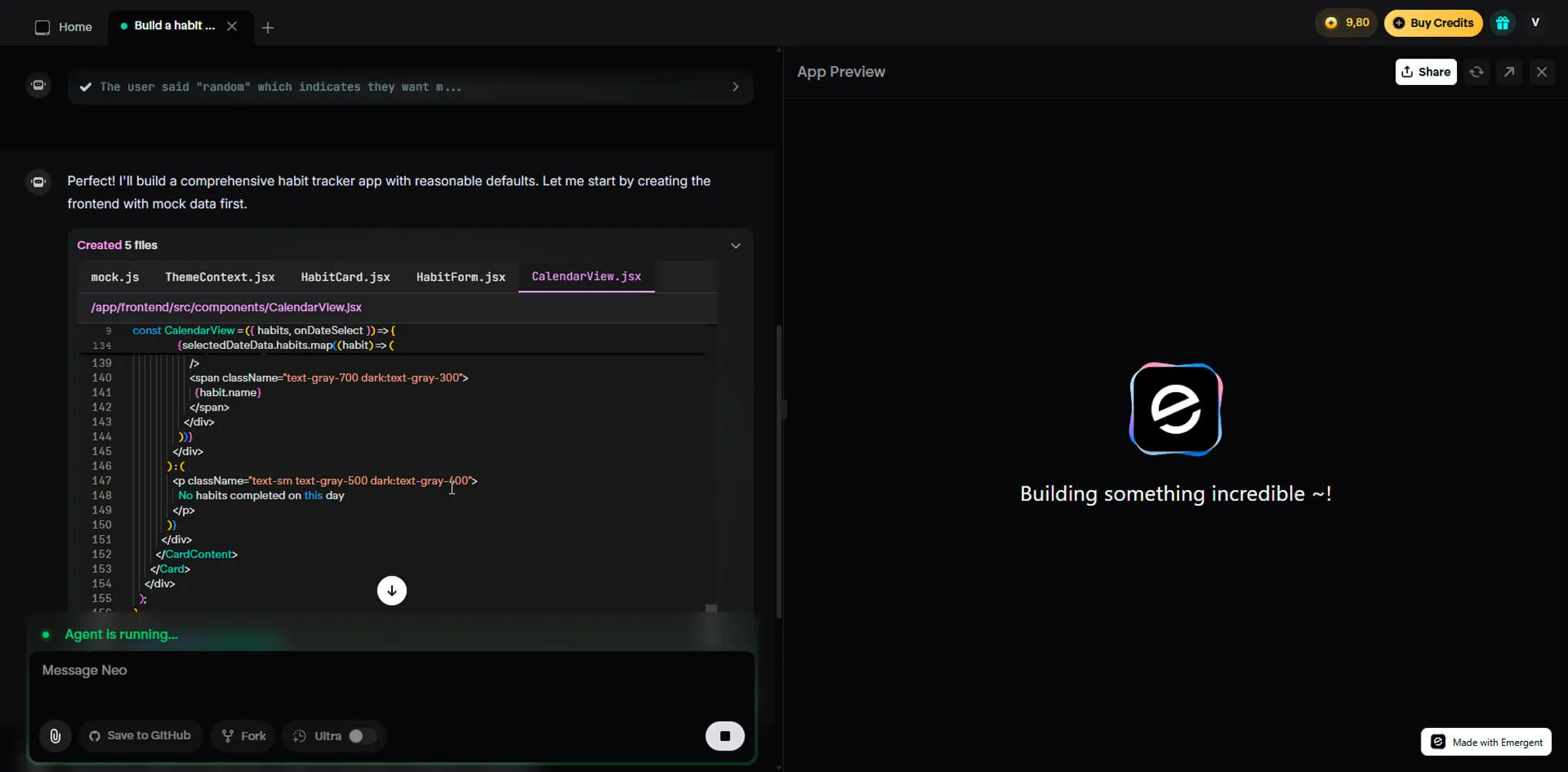
Using Emergent.sh is refreshingly simple. Instead of learning a complex drag-and-drop system, I just typed in my app idea and received a working version—complete with backend and hosting—within minutes. For someone without coding skills, the process feels effortless: describe, refine, and publish. I was able to get a functional tool live in less than 10 minutes. Emergent’s clean interface makes it easy to experiment with different ideas, whether you’re building a simple tracker or a client portal. For more advanced projects, like dashboards or marketplaces, the build time is still impressively short—usually under half an hour. The option to connect GitHub and edit code directly gives technical users extra flexibility without making the experience overwhelming for beginners. The combination of natural language prompts, fast deployment, and intuitive design tools makes Emergent.sh one of the easiest AI website and app builders to use, and an ideal choice for small businesses, founders, and freelancers who want to bring ideas to life quickly without the usual technical hurdles.

Uniqueness:
What makes Emergent.sh stand out is its radical departure from the drag-and-drop model that most website builders rely on. Instead of piecing together templates or components, you describe your idea in natural language and let multiple AI agents handle the heavy lifting—coding, testing, designing, and deploying a full-stack app. This “AI engineer in a box” approach means you get not just a front-end website, but also a working backend with authentication, databases, file storage, and payments integrated out of the box.
Another differentiator is Emergent.sh’s credit-based system, which offers flexibility for experimentation. You only pay for what you build or deploy, rather than committing to a fixed tier of features. Combined with built-in integrations to tools like Google Sheets, Airtable, Slack, and Stripe, Emergent.sh positions itself less as a classic website builder and more as a bridge between rapid prototyping and production-ready applications. This unique combination of AI-driven development and full-stack delivery makes it a pioneer among new-generation builders.
Verdict:
Emergent.sh is one of the most promising AI website and app builders available today. By simply describing your idea, the platform can generate a working application—complete with backend, hosting, and integrations—in a matter of minutes. This makes it an excellent choice for founders, freelancers, and small businesses that want to move fast from concept to launch without heavy technical investment.
That said, Emergent.sh is still an emerging platform. Reliability issues, credit-based limits, and relatively lean customer support mean it isn’t yet the right fit for every long-term or mission-critical project. But if speed, innovation, and ease of use are your priorities, Emergent.sh offers a glimpse into the future of software creation and is well worth trying.
Emergent.sh review: bottom line
Emergent.sh is a fast AI website and app builder that is best for founders, freelancers, and SMBs who want to prototype and launch quickly. Its biggest strengths are full-stack generation, built-in hosting, backend setup, and ease of use. Its biggest limitations are reliability during complex builds, credit usage, and less control than more flexible development-focused tools.
User Review
 Write a Review
- - Unmatched flexibility for real business workflows
- - AI that helps you think, not just execute
- - You can build exactly what you need, not what the tool decides
- - Not instant for beginners — there’s a learning curve