How Much Should a Small Business Spend on SEO Software in 2026?
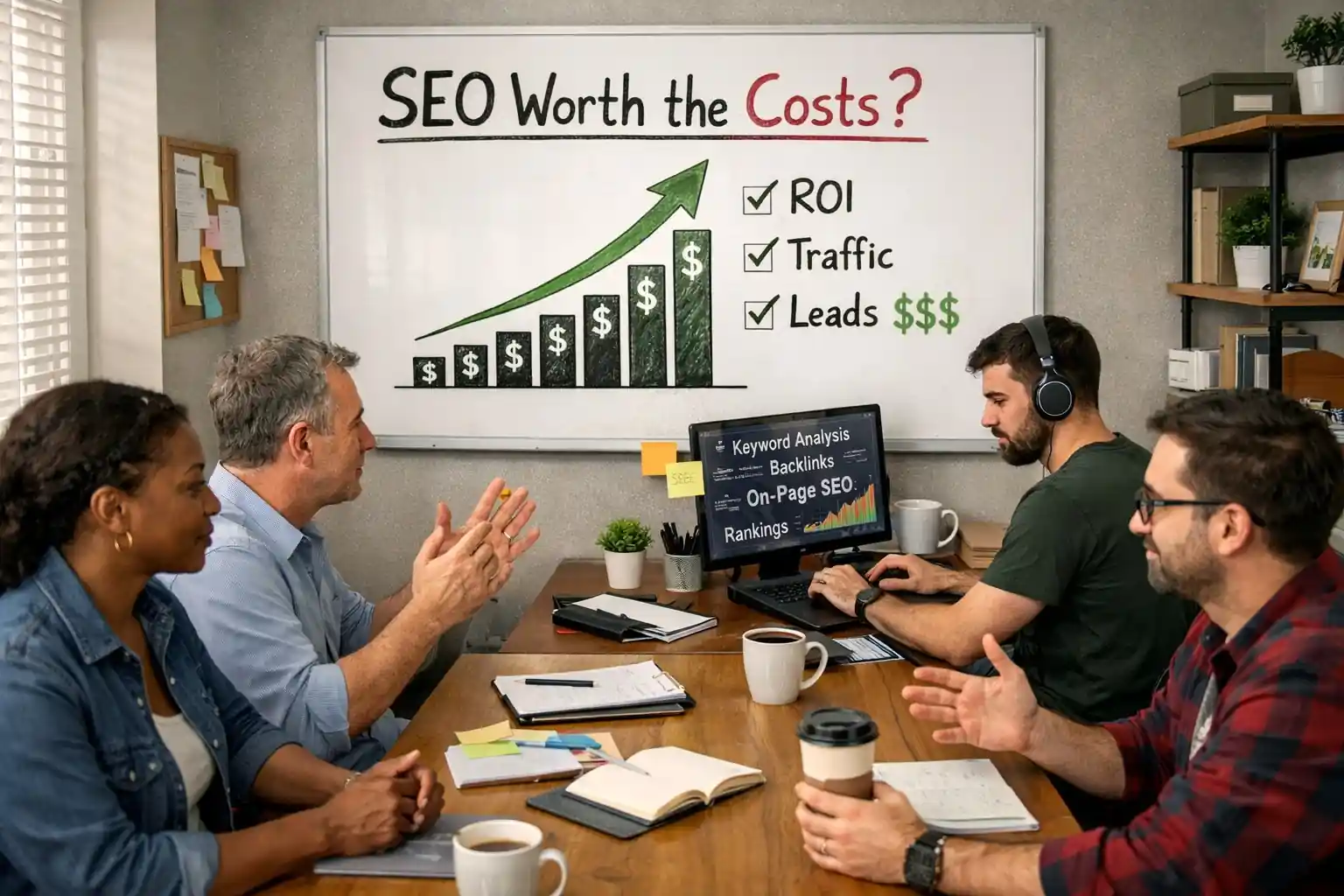


In 2026, the “right” SEO budget depends entirely on whether you are paying with Time or Money.
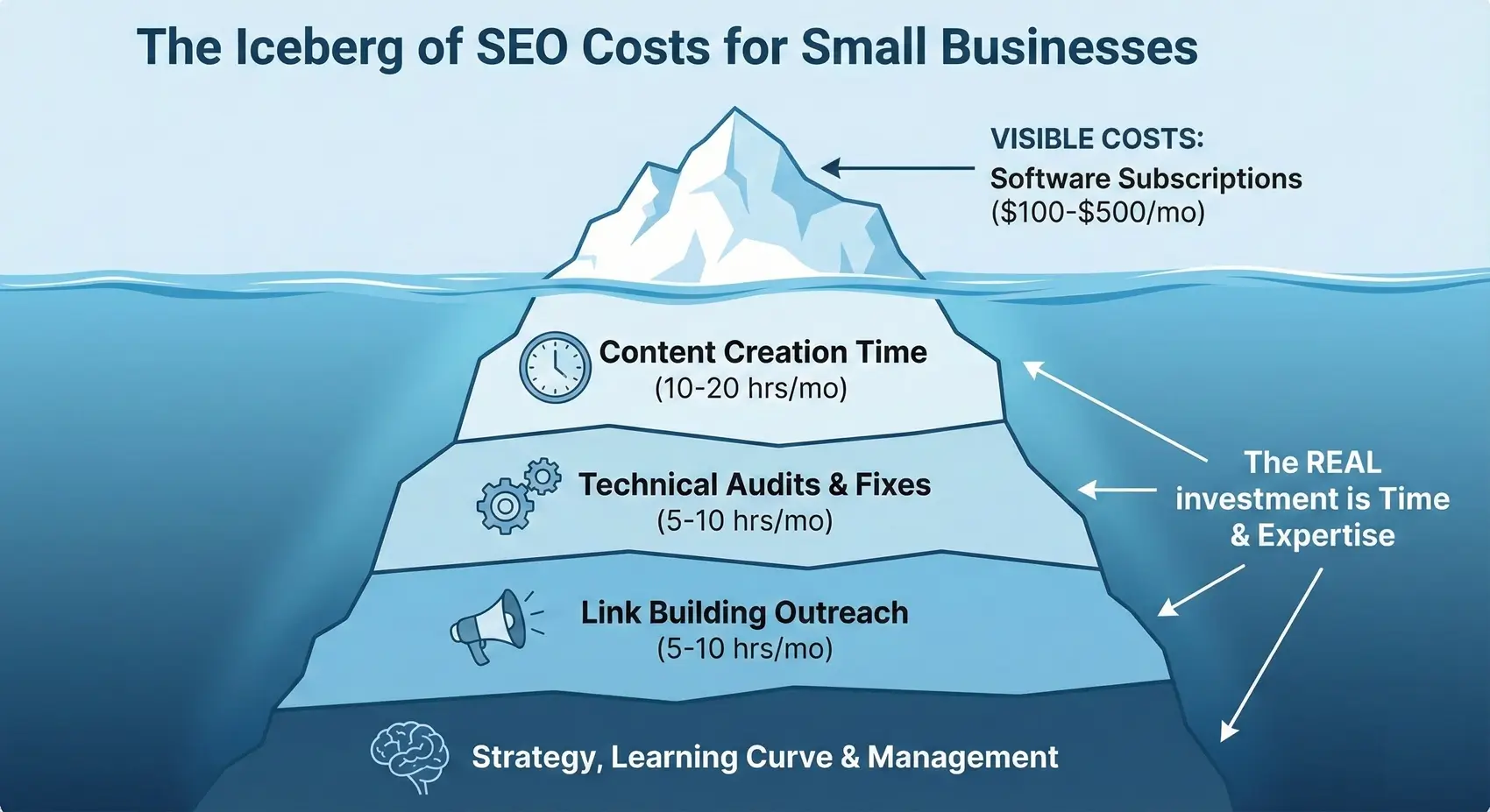
- The DIY Route (Time-Heavy): Expect to spend $100 – $500 per month on a software stack. This buys you the data, but you must do the work (approx. 10–15 hours/month).
- The Agency Route (Money-Heavy): Expect to spend $2,500 – $5,000 per month for a reputable agency to handle strategy, content, and technical fixes.
- The “Danger Zone”: Avoid any service offering “Full SEO” for under $500/month. These “churn-and-burn” services often use automated spam tactics that can permanently damage your domain’s reputation.
- The ROI Reality: Verified industry data for 2025 shows that for every $1 spent on effective SEO, businesses see an average return of $22 over time. This makes SEO one of the highest-yield investments available, provided it is executed correctly.
The “Why”:Viewing SEO as Digital Real Estate
Before we discuss pricing, we must answer the fundamental question: Why spend money on this at all?
Most small business owners view SEO as a marketing expense, like a Facebook Ad or a Billboard. This is the wrong mental model.
SEO is not an expense; it is Asset Building.
The “Rent vs. Own” Analogy
- PPC (Google Ads) is Renting: You pay Google $500 today, and they send you 100 visitors. The moment you stop paying, the traffic stops. You own nothing.
- SEO is Owning: You invest $500 today to write a high-quality guide. That guide ranks on Google and brings you 100 visitors every month for the next 3 years. You have built a “Digital Storefront” that works while you sleep.
The 3 Pillars of SEO Value
- Compounding Traffic: Unlike ads, where costs rise every year, organic traffic gets cheaper over time. Once a page ranks, maintaining it costs a fraction of the initial setup.
- Brand Equity: Ranking #1 for a term like “Best CRM for Startups” signals to the world that you are the market leader. Users trust organic results 53% more than paid ads.
- Exit Value: If you ever sell your business, a website with high organic traffic significantly increases your valuation. Buyers pay a premium for “free customer acquisition channels.”
The Cost Matrix (Software vs. Freelancer vs. Agency)
To understand where your money goes, we have broken down the 2025 market rates.
| Option | Typical Cost | What You Get | Best For |
| DIY (Software Stack) | $100 – $500 / mo | Access to raw data. You analyze it, write content, and fix errors. | Bootstrapped Startups, Solopreneurs, Control Freaks. |
| Freelancer | $75 – $150 / hour | Task execution (e.g., “Write 4 blogs,” “Fix broken links”). | Businesses who know what they need but lack time. |
| In-House Manager | $4,500 – $7,000 / mo | A dedicated employee (plus benefits/taxes). | Mid-Sized companies with constant content needs. |
| Full-Service Agency | $3,000 – $10,000 / mo | A full team (Writer, Tech Expert, Strategist). They handle everything. | Established SMBs with >$1M Revenue. |
| “Cheap SEO” | <$500 / mo | DANGER ZONE. Automated links, spun content, high risk of penalty. | Nobody. Avoid at all costs. |
The “Build Your Own” Budget (3 Pricing Tiers)
If you choose the DIY Route, you need to build a “Tech Stack”—a collection of tools that work together. Do not just buy the most expensive one. Choose the tier that matches your goals.
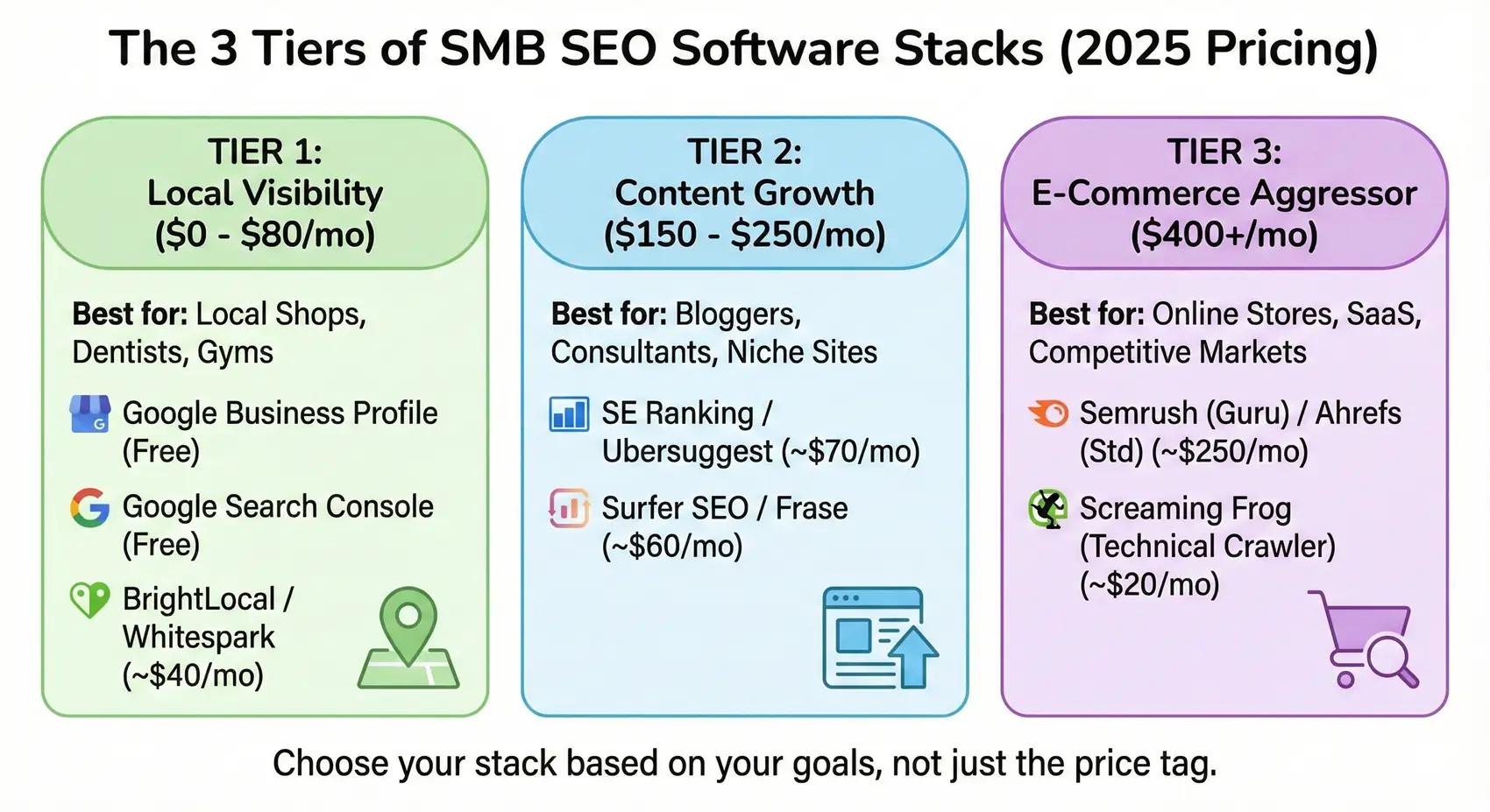
Tier 1: The “Local Visibility” Stack ($0 – $80/mo)
Who is this for? Plumbers, Dentists, Coffee Shops, Gyms.
The Goal: You don’t need national traffic. You just need to dominate the “Near Me” searches in your city.
- Google Business Profile (Free): Your storefront on Maps.
- Google Search Console (Free): Your “Technical Health” monitor.
- BrightLocal or Whitespark (~$40/mo): These tools ensure your Name, Address, and Phone Number (NAP) are identical across 50+ directories (Yelp, YellowPages, Apple Maps).
The Workflow: You log in once a week to reply to reviews, post photos, and ensure your business hours are correct.
Check out our Guide to Free SEO Tools to get started with zero investment.
Tier 2: The “Content Growth” Stack ($150 – $250/mo)
Who is this for? Bloggers, Niche Affiliate Sites, Consultants, Coaches.
The Goal: You need to write articles that rank nationally to attract leads, but you don’t have thousands of pages to manage.
- Primary Tool: SE Ranking or Ubersuggest (~$70/mo). These are mid-tier “All-in-One” suites. They allow you to find keywords, track rankings, and spy on competitors.1
- Optimizer: Surfer SEO or Frase (~$60/mo). An AI Content Optimizer. It analyzes the top 10 results for your keyword and tells you: “Your article is too short. Add a section about Pricing to compete.”
The Workflow: You spend 4 hours researching keywords and 10 hours writing content per month. The tools guide your writing to ensure Google likes it.
Tier 3: The “E-Commerce Aggressor” Stack ($400+/mo)
Who is this for? Online Stores (Shopify), SaaS Companies, Highly Competitive Markets.
The Goal: You are fighting giants (Amazon, TripAdvisor) and need deep, daily intelligence.
- Primary Tool: Semrush (Guru) or Ahrefs (Standard) (~$250/mo). You need the “Content Gap” features to scan 10,000 product pages instantly and see which products your competitors sell that you don’t.
- Technical Crawler: Screaming Frog (~$20/mo).2 Essential for finding technical errors on large websites.
The Workflow: This requires a dedicated person (you or an employee) logging in daily to track ranking fluctuations and fix technical errors.
Not sure which giant to pick? Read our detailed Semrush vs. Ahrefs comparison.
Feature Showdown: Tier 2 (SE Ranking) vs. Tier 3 (Semrush)
Many small businesses struggle to decide between saving money with Tier 2 or splurging on Tier 3. Here is the verified 2025 feature comparison to help you decide.
| Feature | Tier 2 (e.g., SE Ranking) | Tier 3 (e.g., Semrush) | The “Real World” Difference |
| Keyword Database | ~5 Billion Keywords | ~26 Billion Keywords | Tier 3 wins on obscurity. If you are in a tiny niche (e.g., “Industrial Teflon gaskets”), Semrush will find data where SE Ranking might show zero. |
| Historical Data | Limited (~2 years) | Extensive (Since 2012) | Tier 3 wins on strategy. Semrush lets you see exactly when a competitor changed their strategy 5 years ago. |
| Keyword Clustering | Manual / Basic | Automated / AI-Driven | Tier 3 saves time. Semrush automatically groups 1,000 keywords into “Topics” for you. SE Ranking requires manual sorting. |
| Intent Analysis | Basic Labels | Deep “Search Intent” | Tier 3 wins on context. Semrush tells you if a user wants to buy or learn. SE Ranking just gives you the volume. |
| Rank Tracking | High Accuracy | High Accuracy | Tie. For tracking where you rank daily, Tier 2 tools are excellent and often cheaper per keyword. |
| Reporting | Clean, Simple | Complex, Customizable | Tier 2 wins for simplicity. SE Ranking reports are easier for non-experts to read. Semrush is better for heavy data analysis. |
The Verdict: Start with Tier 2. Upgrade to Tier 3 only when you have exhausted all the “easy” keywords and need to find deep, hidden opportunities that your competitors missed.
The Strategy (How to actually use the tools)
Buying the tool is step one. Using it correctly is step two. A good SEO strategy follows a 4-phase loop. Without this strategy, your software subscription is wasted money.
Phase 1: The Audit (Technical Health)
The Question: “Is my website broken?”
The Action: Use your tool (e.g., Ahrefs Site Audit) to scan your website.3
What to fix: Look for “404 Errors” (Broken pages), “Slow Load Times,” and “Missing Meta Descriptions.”
Why it matters: Google will not rank a broken site, no matter how good your content is.
Phase 2: The Cluster (Content Strategy)
The Question: “What are my customers asking?”
The Action: Don’t just guess keywords. Use the “Keyword Magic Tool” in Semrush. Type in your main service (e.g., “CRM Software”).
The Output: The tool will give you 5,000 questions people ask. Group them into “Clusters.”
- Hub Page: “Best CRM Software”
- Spoke Page: “CRM for Small Business”
- Spoke Page: “Free CRM vs Paid CRM”
- Why it matters: This builds “Topical Authority.” Google sees you as an expert on the entire topic, not just one keyword.
Phase 3: The Optimization (On-Page SEO)
- The Question: “Does Google understand my article?”
- The Action: Use a tool like Surfer SEO. It assigns your draft a “Content Score” (0-100).
- The Goal: Do not publish until your score is 80+. This ensures you have used the right synonyms, headers, and word count to match user intent.
Phase 4: The Distribution (Off-Page SEO)
- The Question: “Does the internet trust me?”
- The Action: Use your tool to find “Backlink Opportunities.” See who links to your competitors and ask them to link to your (better) guide.
The “Danger Zone” – Why Cheap SEO Hurts You
You will see ads for “$299/mo SEO Packages.”
Do not buy these. Here is the math on why they are dangerous:
A skilled SEO professional charges $100–$150 per hour.
If you pay an agency $299/month, and they have 30% overhead (profit, taxes, software costs), they have about $200 left for labor.
At $100/hour, that means they are spending 2 hours per month on your website.
What can be done in 2 hours? Nothing valuable.
To show you “results,” these cheap agencies often resort to:
- Black Hat Link Building: Buying 1,000 spammy links from Russia or India. This works for a month, then Google bans your site.
- Fake Reporting: Sending you automated PDFs showing “Rank Increases” for keywords nobody searches for (e.g., “Best Blue Left-Handed Widget in [Tiny Town]”).
The Bottom Line: If your budget is under $500, buy the best SEO software and do it yourself. You care more about your business than a cheap agency ever will.
Can software automate my software expense tracking?
As you build your “Tech Stack” (Hosting, Email, SEO, CRM), your monthly subscriptions can spiral out of control. Small businesses waste thousands annually on “Zombie Spend”—tools they pay for but never use.
Sonary Booster specialize in handling this.
Sonary Booster is a free financial intelligence tool that connects to your business accounts to:
- Audit Your Stack: Instantly see if you are paying for Semrush and Moz at the same time (a common redundancy).
- Track Price Hikes: Get alerted if a software provider quietly raises their rates.
- Calculate Usage: See which team members are actually logging in, so you can cut unused seats.
The Strategy: Before you upgrade to a “Pro” SEO plan, run a scan with Sonary Booster to see if you can reclaim budget from unused tools elsewhere.
The Ultimate SEO Costs FAQ
Q: How long does it really take to rank?
A: For a new website, expect 6 to 12 months to see significant traffic. SEO is not a sprint; it is a marathon.
- Months 1-3: Auditing, fixing errors, writing initial content. (Zero Traffic).
- Months 4-6: Google begins indexing your content. (Traffic Trickle).
- Months 7-12: Rankings stabilize, and compounding growth begins.
Q: Semrush vs. Ahrefs: Which is better for small business?
A: Both are excellent, but they have different strengths.
- Semrush: Better for “All-in-One” marketing.4 It includes social media tools, local listing management, and great PPC data.5 Pick this if you do Ads + SEO.
- Ahrefs: Better for pure SEO and Backlink analysis.6 It has a cleaner interface and stronger web crawling data. Pick this if you are focused 100% on organic content.
Q: Does AI (ChatGPT) kill SEO?
A: No, but it changes it. People are using AI to find answers, but AI still needs sources.
The Shift: You must write “Experience-Based” content. AI can summarize facts, but it cannot review a product it hasn’t touched or share a personal story. Google now prioritizes E-E-A-T (Experience, Expertise, Authoritativeness, Trust).7
Q: Can I just use free tools forever?
A: You can, but you will hit a ceiling. Free tools (Google Search Console) only show you data about your site. They do not show you what your competitors are doing. To beat competitors, you eventually need to see their playbook, which requires paid software.
Q: How do I measure ROI?
A: Use this simple formula:
If you spend $1,000 on SEO and generate $5,000 in sales from organic leads, your ROI is 400%.
Next Steps: Making Your Choice
You now have the data. Here is your immediate action plan:
- Define your budget: Are you in the DIY Tier ($150/mo) or the Agency Tier ($3,000/mo)?
- Audit your expenses: Use Sonary Booster to clear out waste and free up cash for your SEO tools.
- Pick your tool: Start a free trial of Semrush (if you need deep data) or SE Ranking (if you want simplicity).
- Run your first audit: Fix the broken links and start building your digital real estate.