HubSpot Marketing Hub vs. Klaviyo: The best choice for e-commerce abandoned cart automation


Both HubSpot Marketing Hub and Klaviyo have strong abandoned cart automation capabilities, but they are built for fundamentally different businesses.
After working hands-on with both tools, I can tell you this: HubSpot Marketing Hub is the better option for small businesses that want easy execution, creative control, and CRM context in one place, while Klaviyo is the superior specialist for pure e-commerce stores requiring deep behavioral logic.
Choosing the wrong platform doesn’t just cost you a monthly subscription fee — it costs you recovered revenue, team hours, and the compounding ROI of flows you never built.
HubSpot prioritizes user velocity, whereas Klaviyo focuses on granular recovery depth.
This guide breaks down the technical and practical differences to help you choose the right engine for your 2026 sales goals.
Key takeaways
- For automated cart recovery with HubSpot you’ll need the Professional tier (~$800/month), which includes a full CRM and marketing suite.
- Klaviyo offers a free entry point for up to 250 profiles, but costs scale rapidly as your contact list grows.
- Klaviyo supports “Added to Cart” triggers, allowing you to message shoppers before they even reach the checkout page.
- HubSpot features a more intuitive drag-and-drop editor and an integrated AI co-pilot for faster campaign creation.
- Klaviyo provides more advanced “If/Then” branching and predictive analytics for high-volume e-commerce stores.
Quick summary: How they compare in 2026
| Feature | HubSpot Marketing Hub | Klaviyo |
|
The “Vibe” |
A polished marketing studio |
A professional retention engine |
|
Best for |
Lean teams, Hybrid brands, B2B/B2C |
Pure E-commerce, Shopify specialists |
|
Email building |
HubSpot Drag-and-Drop Editor (Intuitive) |
Klaviyo Flow Builder (Logic-heavy) |
|
Cart logic |
Solid (via Carts API / Shopify Sync) |
Specialized (Added to Cart / Checkout) |
|
Segmentation |
Simple, visual, rule-based |
Granular, dynamic, predictive |
|
SMS support |
Growing, but less central |
Fully integrated into recovery flows |
|
AI support |
Integrated Content Assistant |
“Define with AI” for segments |
|
Entry price |
Free CRM; Pro is ~$800/mo |
Free up to 250 profiles |
|
Verdict |
Easier to use well right away |
Better specialist for recovery depth |
My practical take:
- Choose HubSpot if you want one “Marketing Studio” that supports your entire business (CRM + Email + Ads).
- Choose Klaviyo if your store lives or dies by cart recovery and lifecycle revenue.


Starter
Pros
- User-friendly interface
- Easy drag-and-drop editor
- Access to numerous resource materials
Cons
- Free plan is extremely limited
- No separate pricing for email tools only
Free
Pros
- Revenue-Focused
- Deep Data Integration
- Powerful Automations
Cons
- Steep Learning Curve
- Support Limits
Why your abandoned cart platform choice matters more than you think
Many other comparison articles make abandoned cart automation sound like a checkbox feature. It is not. It’s a test of what a platform is fundamentally built to do.
To recover abandoned carts effectively, you need three things working together: the right behavioral data, precise timing, and content that converts. Miss any one of them and your recovery rate suffers.
But for a small or micro business, there’s a fourth factor most ignore: can your team actually use the platform well enough to keep improving it over time? A tool is only as powerful as the team’s confidence in using it month after month. That’s where the real split between HubSpot and Klaviyo becomes clear.
How I tested HubSpot Marketing Hub and Klaviyo
I used both tools hands-on to answer one practical question: Which platform helps a business build abandoned cart automation that is not only powerful but also usable in real life?
My evaluation focused on four areas:
- How natural the editing experience felt.
- The level of control over lists, segments, and rules.
- How realistic each tool was for a micro-business team without technical support
- How useful each tool was beyond abandoned cart emails alone.
My personal experience
HubSpot’s drag-and-drop editor: Built for speed and creative control
HubSpot’s email editor is one of its strongest differentiators for small teams. The drag-and-drop interface is genuinely intuitive; you can build, edit, and refine a campaign without hitting a technical wall.
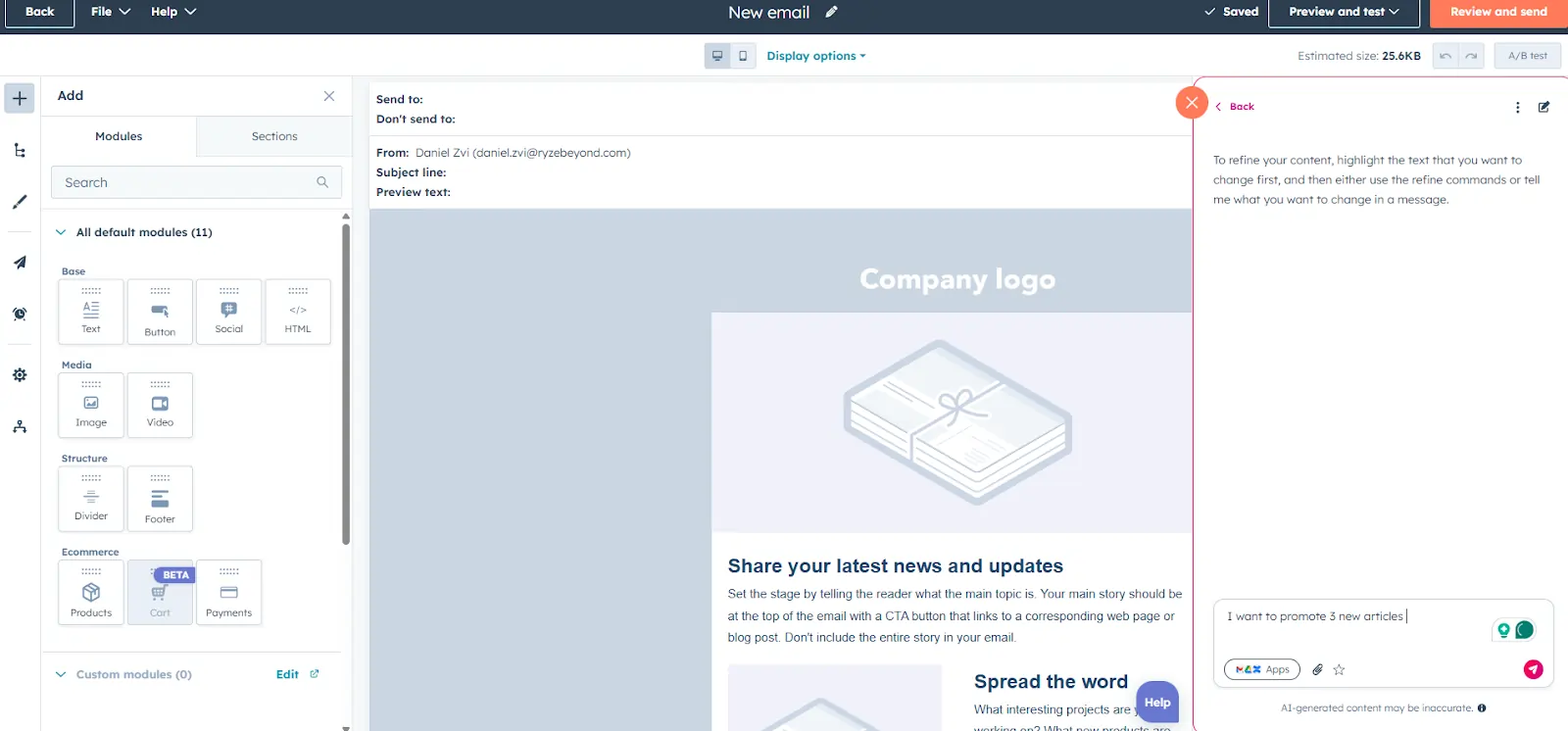
During testing, I used HubSpot’s AI Content Assistant to draft promotional copy for multiple articles simultaneously. The AI is integrated directly inside the editor, meaning I could refine subject lines and body copy without switching tools or tabs. For a small business owner who isn’t a professional copywriter, this workflow is a meaningful advantage.
HubSpot also offers a useful organizational layer: advanced filters that let you identify which emails were generated by AI or co-created. As you scale content production, this kind of visibility becomes important for quality control.
Klaviyo’s Flow Builder: Logic first, depth over speed
Klaviyo’s editor is powerful, but it’s part of a more rigid, logic-driven system. Where HubSpot invites you to design freely, Klaviyo wants you to think through your conditional logic first.
The Flow Builder is the centerpiece of Klaviyo’s abandoned cart setup. It’s designed around “If/Then” branching — handling timing delays, conditional splits based on purchase behavior, and SMS-or-email decision points. For an e-commerce team that wants surgical precision, this depth is exactly what they’re looking for.
The tradeoff is friction. If you want to move quickly without thinking through every technical condition upfront, Klaviyo will slow you down. It’s less forgiving for newer users than HubSpot.
The ‘vibe’ and velocity
When I tested these platforms, the difference wasn’t just in the feature list—it was in the momentum.
- HubSpot momentum: I felt like I could build and edit faster. The visual experience is natural. I could shape a campaign, refine the AI copy, and hit “go” without hitting a technical wall.
- Klaviyo depth: Once I got into the flows, it was obvious why e-commerce teams love it. But it felt “heavier.” It’s less forgiving; you have to think through every technical condition before you can move forward.
The real difference: HubSpot is broader, Klaviyo is sharper
HubSpot is an all-around system. Email, CRM, lists, workflows, and reporting sit in one system. Its AI email creation tools help refine subject lines and body copy inside the editor, making campaign production easier for small teams.
Klaviyo is e-commerce-native. Its abandoned cart setup is tied directly to customer behavior. For Shopify, it supports an “Added to Cart” flow—targeting people before they even start checkout. That is a massive strategic advantage for recovery.
So the decision is really this:
Do you want the better overall marketing platform, or the better abandoned cart specialist?
The design experience: Creative ease vs. logic first
One of the biggest differences I found was in the email editor itself.
HubSpot: The Visual Studio
As seen in my testing (Screenshot below), HubSpot’s editor is built for speed. I used the AI Content Assistant to promote articles and refine copy in seconds. For a small business owner who isn’t a professional copywriter, this is a game-changer.
In this test, I used the AI to instantly draft promotional content for three articles. The “Reasoned for 7 seconds” feature shows exactly how the AI thought through my request.
Klaviyo: The logic engine
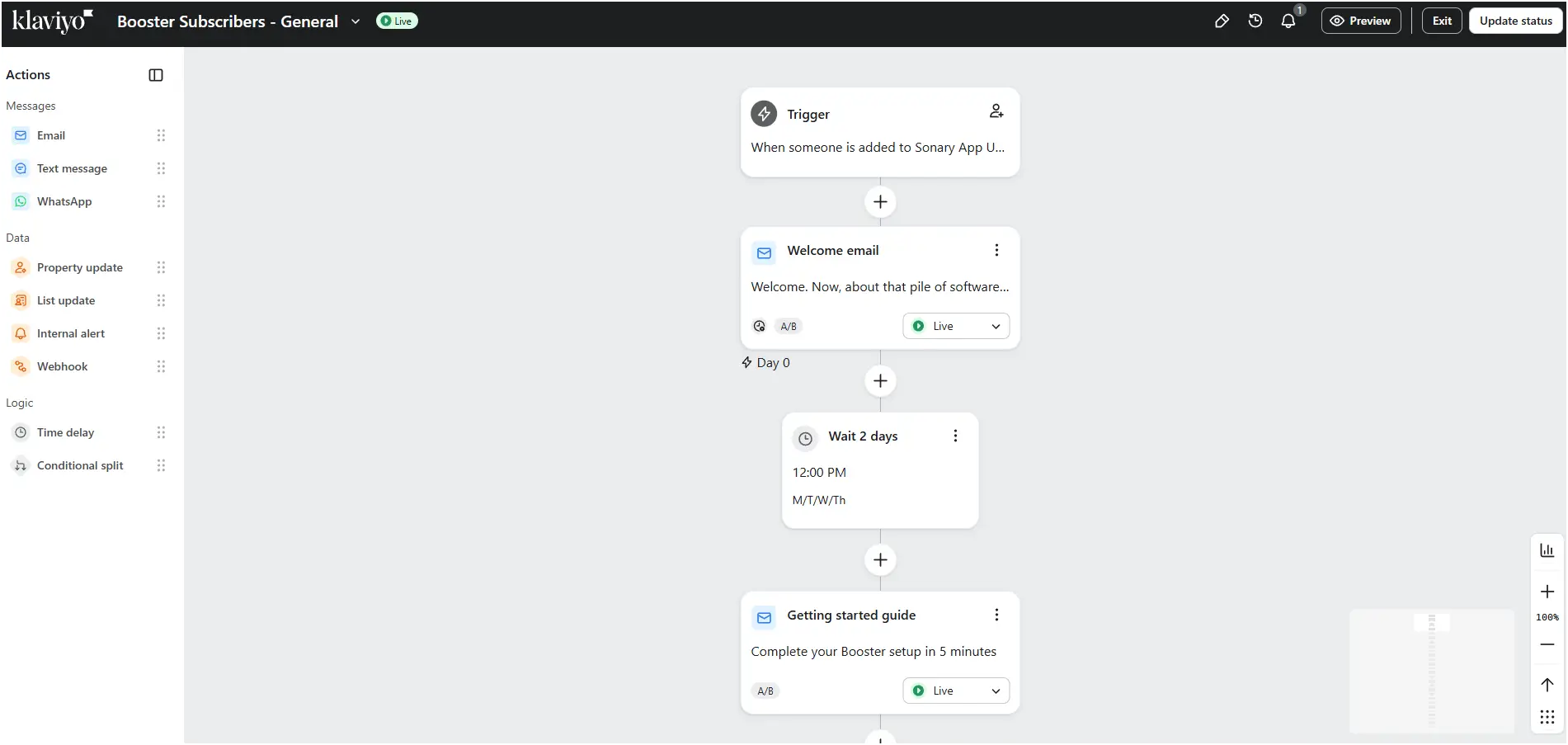
Klaviyo’s editor is powerful, but it’s part of a much more rigid system. While HubSpot lets you play with design, Klaviyo wants you to focus on the Flow Builder (see below). It’s designed to handle complex “If/Then” scenarios for checkout recovery.
Here, I set up a “TEST” flow. Notice the sidebar logic options—Klaviyo focuses heavily on timing and conditional splits right at the moment of creation.
Klaviyo: The professional specialist
Klaviyo Flow Builder is stronger for abandoned cart logic, and its segmentation is much deeper. That is why it works so well for online stores that care about customer retention and lifecycle revenue.
Klaviyo also handles email and SMS together in a more natural way. If your goal is to maximize ROI from email and SMS, this is one of its biggest advantages.
Why Klaviyo is powerful for e-commerce teams
- Stronger cart and checkout automation: Its setup is more specialized and more mature. It understands the “window” for recovery better than a generalist tool.
- Deeper segmentation: This is a major strength. You can build segments based on product affinity, customer value (CLV), and real-time behavior.
- Better retention logic: It is clearly designed for brands that want to squeeze every % of ROI from lifecycle flows.
- Integrated email + SMS: If your recovery strategy depends on both channels, Klaviyo is the better option.
Where Klaviyo is harder
Klaviyo’s power comes with more complexity. The platform can feel heavy when you are new. Conditional splits, profile filters, segment logic, and flow setup all require more attention. Support is also more limited on the free plan (email support for the first 60 days). So while Klaviyo is stronger for a pure store, it is the tool that asks more from the user.
HubSpot: Why it wins for small & micro businesses
The HubSpot Drag-and-Drop Email Editor is one of its best features. I found it easier to work in, easier to customize, and easier to use well without needing technical help.
HubSpot is also strong because email is connected to the rest of the platform. You are not just sending campaigns. You are also working with CRM data, forms, workflows, reporting, and the broader customer journey. That matters if your business needs more than one marketing function in one system.
Usability & deliverability tools
HubSpot makes the technical stuff feel light. For example, their advanced filters (as seen in my screen below) make it incredibly easy to see exactly which emails were “AI-generated or co-created.” This level of organization is vital as you scale your content production.
Why is it powerful for small and micro businesses
- Easier to build in: The drag-and-drop builder feels better. I could shape the email exactly how I wanted without feeling heavy.
- Beyond cart recovery: If your business needs lead gen, product marketing, and CRM visibility, HubSpot makes more sense.
- Simpler segmentation: Creating rule-based lists is simple. While the rules are more basic than Klaviyo’s, it keeps the system from getting messy.
- Team Confidence: HubSpot is less intimidating. A tool is only useful if your team actually feels confident using it month after month.
Where HubSpot falls short
It isn’t e-commerce native. Abandoned cart emails depend on Shopify data sync or the Carts API, and the feature is gated behind Marketing Hub Professional or Enterprise. For a micro-business, that “paywall” can be a hurdle if you only want cart recovery.
HubSpot vs. Klaviyo pricing: What you’ll actually pay in 2026
This is the section where you’ll want to pay close attention to the details, because pricing is a big deal when making this kind of choice.
| HubSpot Marketing Hub | Klaviyo | |
|
Entry point |
Free CRM; cart automation requires Professional (~$800/mo) |
Free up to 250 profiles |
|
Mid-tier |
Professional includes full workflow and cart tools |
Scales by contact count — check current pricing at Klaviyo pricing |
|
What you’re buying |
CRM + Email + Automation + Reporting as one suite |
Email + SMS retention engine |
|
Hidden cost risk |
Paying for features you don’t need at the Professional tier |
List growth can escalate costs faster than revenue |
Pricing changes frequently, and both platforms offer custom enterprise quotes.
- HubSpot’s gate: You can start cheap, but “Abandoned Cart” modules and automated workflows are generally gated at the Professional Tier (~$800+/mo). You aren’t just buying an email tool; you’re buying a CRM and Marketing Hub.
- Klaviyo’s curve: It’s easier to start for free (up to 250 profiles), but the long-term cost curve is steep. As your list grows, so does your bill—sometimes faster than your revenue if you aren’t careful.
Final verdict: My recommendation
After testing both platforms extensively, my recommendation is clear:
Go with HubSpot Marketing Hub if you want a better all-around platform. [Start with HubSpot Marketing Hub free here →] It’s the choice for businesses that value creative control, ease of use, and one single “source of truth” for their marketing and sales data.
Go with Klaviyo if you are a “retention specialist.” If your business is 100% e-commerce and you want to squeeze every possible dollar out of a hyper-granular abandoned cart flow, Klaviyo is the sharper tool.
The bottom line: HubSpot is the better all-around marketing platform. Klaviyo is the better abandoned cart specialist. Which one is right for you depends entirely on whether you need breadth or depth.
Frequently Asked Questions
Is Klaviyo better than HubSpot for Shopify abandoned cart emails?
For Shopify stores focused purely on cart recovery, yes. Klaviyo’s native Shopify integration, “Added to Cart” trigger, and deeper segmentation logic make it the stronger specialist tool. HubSpot is the better choice if you need Shopify cart recovery plus CRM, lead gen, and broader marketing in one platform.
What is HubSpot Marketing Hub Professional pricing in 2026?
Abandoned cart automation in HubSpot requires the Marketing Hub Professional tier, which starts at approximately $800/month. This includes the full workflow builder, CRM, and email tools — not just cart recovery. Check HubSpot pricing for the most current rates.
Can Klaviyo replace a CRM?
No. Klaviyo manages contact profiles and behavioral data for e-commerce, but it is not a full CRM. If you need pipeline management, deal tracking, or sales-marketing alignment, you’ll need a separate CRM or should consider HubSpot’s all-in-one suite.
Does HubSpot support SMS for abandoned cart recovery?
HubSpot does offer SMS capabilities, but they are less central to its cart recovery workflow than Klaviyo’s. If your recovery strategy depends heavily on SMS alongside email, Klaviyo is the stronger option.
How long does it take to set up an abandoned cart flow in each platform?
HubSpot’s drag-and-drop editor and visual workflow builder allow most teams to launch a basic abandoned cart sequence in a few hours. Klaviyo’s flow builder is more powerful but requires more setup time, particularly for conditional splits and segmentation rules. Expect a steeper learning curve of several days for a fully optimized Klaviyo flow.
Which platform has better email deliverability — HubSpot or Klaviyo?
Both platforms have strong deliverability reputations. HubSpot’s deliverability tools are integrated directly into the platform with clear reporting. Klaviyo’s deliverability performance is well-regarded in the e-commerce community, particularly for high-volume Shopify senders. Neither platform has a definitive edge here — deliverability depends heavily on your list hygiene and sending practices.