Square vs Toast POS: Which is better for small restaurant in 2026?
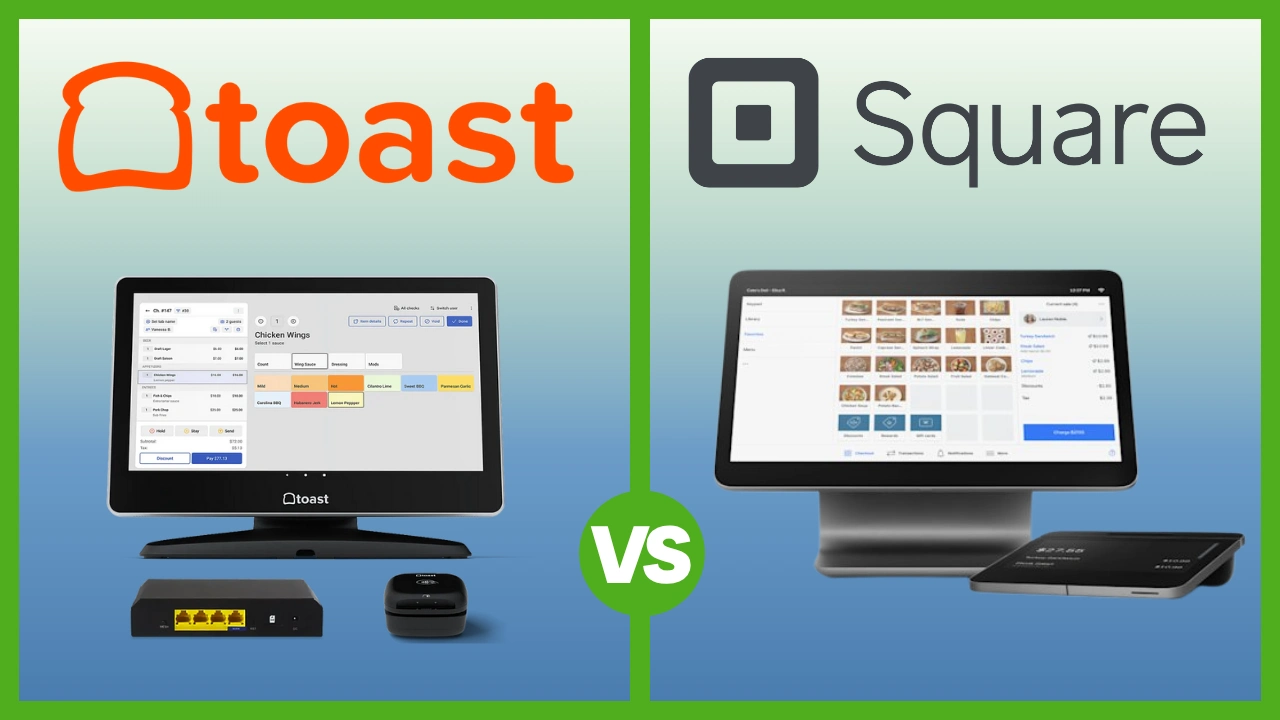


Choosing the right Point of Sale (POS) system is the single most important technology decision for a small restaurant owner. It serves as the digital heartbeat of your business, managing everything from the first appetizer ordered to the final end-of-day labor report. In the Square vs. Toast debate, business owners are choosing between two philosophies: a flexible, multi-industry ecosystem and a specialized, restaurant-only powerhouse.
The direct answer for small teams is that Square for Restaurants is the better choice for micro-businesses like cafes or food trucks, thanks to its $0/month plan, no long-term contracts, and support for existing iPads. Toast POS is the superior choice for full-service restaurants (FSR) with 1-5 staff that require advanced ordering, rugged handhelds for tableside ordering, and 24/7 phone support on all plans.
As you weigh your options, keep in mind that the right software can do more than just take payments; it can act as a silent partner. For broader business management insights, you might also find our review of monday CRM helpful for organizing your back-office tasks.
Key points (quick summary)
- Square Wins on Cost: Best for startups with a $0 monthly fee and transparent 2.6% + 10¢–15¢ processing.
- Toast Wins on Durability: Proprietary hardware is spill-resistant and drop-tested, unlike standard consumer iPads.
- Flexibility: Square offers month-to-month terms; Toast typically requires a 1-3 year commitment.
- Staff Efficiency: Toast handhelds (Toast Go 2) are highly optimized for tableside ordering in small, fast-paced teams.


Free
Pros
- No monthly payment
- Next-business-day transfers
- Inexpensive long-term option
Cons
- Not great for all industries
- Some performance issues

Starter Kit
Pros
- Streamlined back office operations
- Excellent integration between kitchen and service staff
- Multi-location menu management
Cons
- Only available on Android
- Early termination fee
Head-to-head comparison
Here is a high-level summary of the key differences between the two platforms.
|
Factor |
||
|
Primary focus |
All business types (with restaurant plan) |
Restaurants only |
|
Hardware |
Flexible (iPads, Square Register, Terminal) |
Proprietary, Android-based, durable |
|
Pricing model |
Tiered plans (incl. Free), transparent |
Custom quote-based, less transparent |
|
Contract length |
Usually month-to-month |
Typically 2-3 year contracts |
|
Ease of use |
Generally considered very user-friendly |
User-friendly, but deeper feature set |
|
Offline mode |
Yes, robust offline payment processing |
Yes, built-in offline mode |
|
Integrations |
Large app marketplace for various tools |
Strong restaurant-specific integrations |
|
Payment processing |
Built-in Square Payments |
Built-in Toast Payments (required) |
|
Ideal user |
Cafes, QSRs, food trucks, new ventures |
FSRs, bars, multi-location groups |
Which Tool Should I Pick? Scenario-Based Decisions
For a restaurant with 1-5 employees, each scenario can make the difference between profit and loss. Here is how to decide based on your specific setup:
The “Owner-Operator” Cafe or Bakery
If you have 1-2 employees and primarily serve customers over a counter, pick Square.
- Why: You likely don’t need complex coursing or specialized hardware. Square’s “Free” plan includes online ordering and basic inventory at no monthly cost.
- Hardware: You can use an iPad you already own, saving roughly $700-$1,000 in startup costs.
The Small Full-Service Bistro
If you have 3-5 employees and offer table service with a rotating menu, pick Toast.
- Why: Even with a small team, managing coursing (appetizers vs. entrees) is difficult. Toast offers advanced coursing on all plans, whereas Square gates this behind their $60/month “Plus” plan.
- Efficiency: One server with a Toast handheld can handle a 10-table section more efficiently than running back and forth to a central terminal.
The Seasonal Food Truck or Pop-Up
If your business only operates part of the year, pick Square.
- Why: Toast’s 2-3 year contracts mean you pay even when you aren’t open. Square allows you to pause or cancel anytime without penalty.
Pro Tip: For small teams, the “Information Gain” here is the Toast Go 2 handheld. While Square has a mobile terminal, the Toast device is specifically weighted and balanced for servers to hold for 8-hour shifts while balancing a tray.
Best Use Cases for Micro-Restaurants
Comparison Table: 1-5 Employee Setups
| Feature | Square for Restaurants | Toast POS |
| Best For | Coffee shops, Bakeries, Food Trucks | Small Diners, Bistros, Bars |
| Contract | Month-to-month | 1-3 Years |
| Support | Email/Chat (Free), 24/7 (Paid) | 24/7 Phone/Chat (All) |
| Offline Mode | Robust payment processing | Highly stable proprietary network |
| Integrations | 300+ (Very flexible) | 200+ (Restaurant focused) |
Core features & capabilities (Restaurant focus)
Both platforms cover the essentials, but Toast generally goes deeper on restaurant-specific needs out-of-the-box.
Reporting, analytics & insights
Both offer robust reporting, crucial for understanding your restaurant’s performance.
- Square: Provides clear, accessible reports on sales, items, categories, payments, and labor. The Square Dashboard (web and mobile) makes it easy to check key metrics anytime. Offers more advanced reporting on paid plans, including shift reports and close-of-day summaries.
- Toast: Offers incredibly detailed, restaurant-specific reporting. You can drill down into menu performance, labor costs vs. sales, server performance, table turn times, void/comp tracking, and multi-location comparisons. Its reporting is generally considered more comprehensive for granular restaurant analysis.
Integrations & connected tools
- Square: Has a large App Marketplace connecting to hundreds of third-party tools for accounting (QuickBooks, Xero), marketing, loyalty, scheduling, and more. This reflects its nature as a broader platform.
- Toast: Offers a curated list of Integration Partners (~180+) specifically relevant to restaurants, including major accounting software (QuickBooks, Sage Intacct), payroll providers (ADP, Paychex), reservation systems (Resy), and specialized inventory/analytics tools. Its focus is narrower but often deeper for restaurant needs. Toast also aims to provide many features (like payroll, marketing, scheduling) natively within its own platform.
AI, automation & smart features
- Square: Is increasingly incorporating AI, particularly in its marketing and customer relationship tools (e.g., automated email campaigns based on purchase history). Smart features also appear in inventory (suggested purchase orders) and scheduling.
- Toast: Leverages AI for sales forecasting, labor optimization suggestions, and fraud detection. Its platform uses automation extensively for things like triggering KDS alerts or sending scheduled reports.
Square vs Toast pricing for a small restaurant
Pricing is often the deciding factor for small businesses. While both companies offer competitive rates, their structures are fundamentally different.
| Feature | Square for Restaurants | Toast POS |
| Monthly Software Fee | $0 (Free plan) to $60+ | $0 (Starter) to $69+ |
| Contract Length | Month-to-month | 2-3 Years typically |
| Processing Fees | 2.6% + 10¢ (standard) | Custom Quote-based |
| Hardware Costs | Lower (iPad compatible) | Higher (Proprietary) |
| Support | 24/7 (Paid plans only) | 24/7 (All plans) |
Hidden Costs to Consider
Small restaurant owners must look beyond the monthly fee. Square is highly transparent; what you see on their website is typically what you pay. Toast uses a quote-based model, which can lead to lower processing rates if you have high volume, but often includes higher upfront costs for their specialized hardware screens and printers.
Square for Restaurants Pricing:
- Free Plan: $0/month for unlimited locations/terminals. Covers basic POS, table management, Square Online ordering. Higher processing fees apply.
- Plus Plan: ~$60/month per location. Adds advanced features like seat management, course management, auto-86ing, advanced reporting. Lower processing fees.
- Premium Plan: Custom pricing. For multi-location or complex operations needing dedicated support.
- Hardware: iPads extra, Square hardware purchased upfront or financed.
- Payment Processing: Built-in Square Payments. Standard rates are typically 2.6% + 10¢ for tapped/dipped/swiped, 2.9% + 30¢ for online/invoiced, 3.5% + 15¢ for keyed-in. Rates can be lower on Plus/Premium plans or with volume discounts.
- Contracts: Generally month-to-month.
(Source: Square official website)
Toast POS Pricing:
- Starter Kit: Sometimes offered at $0/month (often requires 2-year contract & Toast Payments). Basic POS features. Processing fees apply.
- Core Plan: ~$69/month per terminal. Includes core POS, reporting, support.
- Growth / Custom Plans: Quote-based. Add modules like online ordering, loyalty, inventory, payroll, marketing at additional costs per month.
- Hardware: Purchased upfront or financed through Toast, often proprietary. Can be a significant initial cost ($800+ per terminal is common).
- Payment Processing: Built-in Toast Payments required. Rates are custom-quoted based on volume and contract but are generally competitive with Square. Be sure to clarify all per-transaction fees.
- Contracts: Typically require 2-3 year contracts. Early termination fees can be substantial.
(Source: Toast official website – emphasizes custom quotes)
Summary: Square is more transparent and flexible with lower startup costs and no long-term commitment. Toast requires a custom quote and a longer commitment but aims to provide an all-inclusive, deeply integrated system.
Support, reliability & customer experience
- Square: Offers 24/7 phone and email support for Restaurant Plus/Premium subscribers. Free plan users rely on email, chat, and an extensive online knowledge base. Square is known for its reliable uptime and easy-to-use interface.
- Toast: Offers 24/7 US-based customer support via phone, email, and chat for all paying customers. Often praised for support staff knowledgeable about restaurant issues. Toast hardware is built for reliability in demanding environments. Its software also boasts strong offline capabilities.
Scalability & growth potential
- Square: Scales well from a single food truck to multiple locations using the Plus or Premium plans. Its integration marketplace allows you to add functionality as needed. The cost scales predictably per location.
- Toast: Built for scale. Its modular design allows restaurants to add features like advanced inventory, multi-location management, enterprise reporting, and integrated payroll as they grow. The hardware is designed for high-volume operations. It’s a strong choice for businesses planning significant expansion.
Real-world scenarios / use case analysis
Example 1: The new neighborhood cafe
- Need: An easy-to-use POS for counter service, basic inventory tracking for coffee beans and milk, online ordering for pickup, and the ability to take payments anywhere (e.g., sidewalk seating). Low startup budget.
- Better Choice: Square for Restaurants (Free or Plus)
- Reason: The free plan covers basics, or the Plus plan adds more features affordably. They can start with an iPad or Square Terminal, keeping hardware costs low. Square Online provides free online ordering, and the system is known for its ease of use, perfect for a new business. Month-to-month flexibility reduces risk.
Example 2: The established 3-location full-service restaurant group
- Need: Robust table management and floor plans, advanced KDS routing (e.g., sending specific items to different printers/screens), ingredient-level inventory tracking with food cost reporting, integrated loyalty program, detailed multi-location sales and labor analytics, and durable handhelds for servers.
- Better Choice: Toast POS (Custom Plan)
- Reason: Toast’s deep, restaurant-specific features are built for this complexity. Advanced KDS, inventory, multi-location reporting, and durable Toast Go 2 handhelds are significant advantages. The all-in-one platform approach simplifies managing multiple integrated features. The long-term contract is less of a concern for an established, growing business.
Conclusion
For most restaurants with 1-5 employees, Square is the logical starting point because of its lower barrier to entry and lack of long-term risk. However, if your small team is struggling to keep front-of-house and back-of-house in sync during a dinner rush, the investment in Toast’s specialized hardware and 24/7 support may pay for itself in saved labor and reduced order errors.
FAQ: Square vs Toast POS
- Is Toast or Square cheaper?
Square is generally cheaper, especially upfront and for smaller operations. Its Free plan is $0/month, and its hardware can be less expensive (especially using iPads). Toast’s custom pricing and longer contracts often mean higher overall costs, though potentially better value for complex needs. - What is the main disadvantage of Toast?
The main disadvantages are the long-term contracts (typically 2-3 years) with potentially high early termination fees, the custom quote-based pricing which lacks transparency, and being locked into their proprietary hardware. - What is the main disadvantage of Square for Restaurants?
While powerful, Square might lack the depth of some very specific high-end restaurant features that Toast offers natively (like complex modifier routing or advanced inventory costing). Its hardware, while flexible, may not be as durable as Toast’s purpose-built devices in demanding kitchens. - Can I use my own credit card processor with Square or Toast?
No. Both Square and Toast require you to use their built-in payment processing services (Square Payments and Toast Payments, respectively). This is a key part of their business model. - Which POS is better for a food truck?
Square is often preferred for food trucks due to its lower startup cost, flexible hardware (like the Square Terminal or using a phone/iPad), excellent offline mode, and month-to-month flexibility. - Does Toast work for cafes?
Yes, Toast works well for cafes and QSRs, offering features like KDS and online ordering. However, Square might be a more cost-effective and simpler option if the cafe doesn’t need Toast’s most advanced features. - Is Toast hardware better than Square?
“Better” depends on the need. Toast hardware is generally considered more durable and purpose-built for harsh restaurant environments. Square hardware is often seen as more flexible (iPad compatible) and potentially more aesthetically pleasing, with lower upfront costs. - How long are Toast POS contracts?
Toast contracts are typically 2 or 3 years long. Be sure to carefully review the contract length and any early termination fees before signing. Square is usually month-to-month.