
Market Research for Small Business in 2026: The Complete Step-By-Step Guide

Market research for a small or micro business isn't about producing a 50-page report or hiring a consultant. It's about answering one specific question: should I launch this product, charge this price, target this customer, and run this campaign?- well enough that you can act on the answer with confidence. That's it.
Free tools like Google SERP and Google Trends tell you what your market actually wants before you spend a dollar. AI tools cut what used to take days of synthesis down to hours. And five real customer conversations almost always reveal more than a 500-person survey.
The small businesses winning right now aren't the ones spending more on research. They're the ones asking sharper questions, using free and AI tools effectively, and turning every research project into one clear decision.
Effective market research for small businesses in 2026 follows a 7-step process you can complete in 1-2 weeks:
- Define one specific question,
- Check Google SERP and Google Trends first
- Analyze competitor keyword gaps in Ahrefs or SEMrush
- Use AI tools (ChatGPT, Gemini, Perplexity, Claude) to cut research time by 40-50%
- Talk to 5-10 real customers
- Synthesize into one decision
- Act and measure.
Total cost: $0-200 if you use free tools. Skip the consultant-grade 15-step frameworks - they're built for enterprise budgets.
This step-by-step market research guide for small businesses is the actual process I use weekly at Sonary. We're a micro business reviewing software for micro businesses, so we don't have time or budget for consultant-grade research either.
Key points: what every small business should know about market research
- Start with Google SERP, not SEO tools. The first thing to check on any market research project is the actual Google search results - who ranks, what content types appear, what user intent looks like. SEO tools come second.
- Google Trends is the most underused free market research tool for small businesses. It tells you if a topic is rising, dying, or seasonal. At Sonary, Google Trends caught the AI app builder boom early - which is why we wrote about Base44 vs Lovable before most competitors.
- 75% of small businesses search for categories or features when they should search for capabilities. This is a consistent pattern we see across every software category at Sonary. Searching for the best CRM features leads to the same brands every comparison site covers. Searching for what capabilities I need leads to a tool that fits your business.
- AI tools cut market research time by 40-50% - but verify everything. ChatGPT, Gemini, Perplexity, and Claude earn their spots in the workflow. They eliminate overthinking. They don't replace verification. AI hallucinates specific numbers confidently - always check sources.
- Defining competitors correctly saves 30% of research time. Most SMBs research the wrong competitors - usually the largest brands. Real competitors serve your specific audience size and segment. Get this right and skip half the wasted effort.
- The biggest small business research mistake is thinking too big. Comparing yourself to enterprises with 4x your headcount distorts every research decision. You don't need millions of users - you need customers actually relevant to your business.
- Keyword research is still essential - but for understanding intent, not stuffing keywords. Modern keyword research tells you what your audience asks, what they're confused about, what they need. It's market research, not just SEO.
How does Sonary actually do market research for small business?
At Sonary, market research for small businesses starts with two free tools before any paid platform: Google SERP (to map ranking competitors and user intent) and Google Trends (to confirm the topic is rising, not dying). Then we use Ahrefs to find competitor keyword gaps and rising pages. AI tools (ChatGPT, Gemini, Perplexity, Claude) cut 40-50% of research time. Customer perspective comes from being a micro business ourselves - Sonary's team has 45+ combined years of micro-business, marketing, and product experience.
We're a small team. We're a micro business reviewing software for micro businesses. We don't have time for consultant-grade research processes either. Here's the real workflow.
The first 30 minutes: Google SERP and Google Trends
Before any paid tool, before any AI prompt, I check two things:
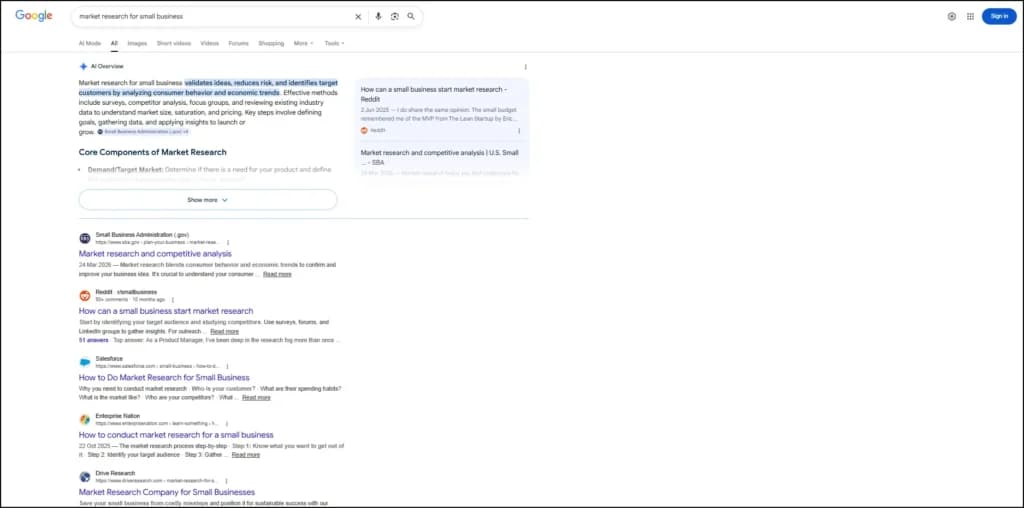
The Google SERP for the target topic. Who ranks? What content types appear (long-form articles, listicles, comparison pages, video, Reddit threads)? What's actually being asked in the People Also Ask section? This single 5-minute check tells me who my real ranking competitors are, what user intent looks like, what content gap exists, and whether Sonary can credibly compete in this space.
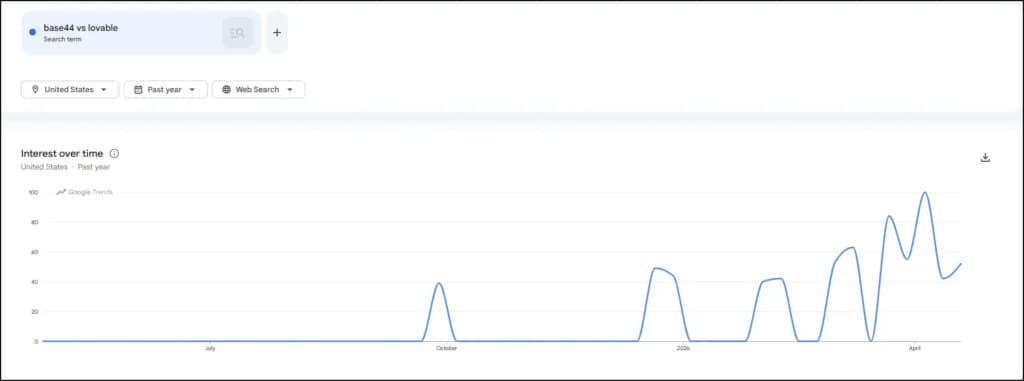
Google Trends for the target keywords. Is the topic rising, flat, or dying? Geographic concentration? Seasonality?
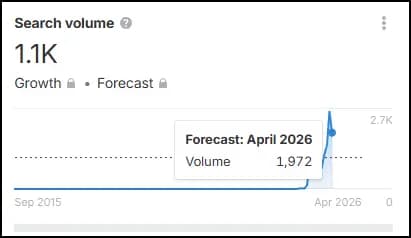
Real example: when researching whether to write about Base44 vs Lovable, I checked Google Trends and saw search volume of 1,100/month rising to 2,731 in March 2026. That's the signal I want before committing time. Rising volume means demand is increasing. Falling volume means I'm chasing yesterday's trend - a category mistake small businesses make constantly.
The next 1-2 hours: Ahrefs for competitor gaps
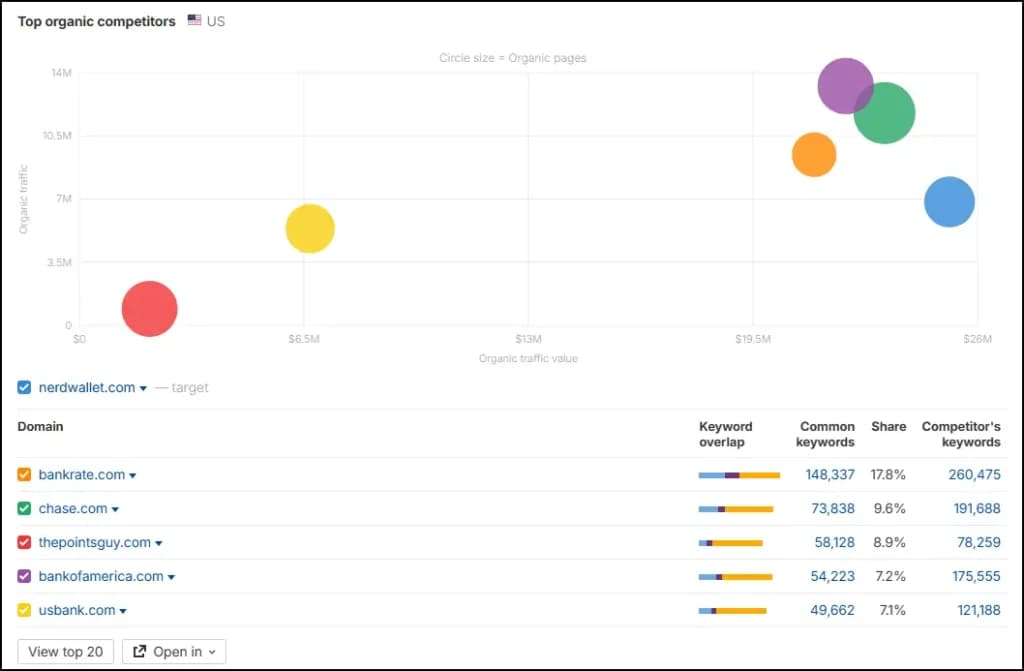
After Google Trends and SERP, I open Ahrefs (my primary SEO tool - for keyword gap analysis specifically, SEMrush is a useful secondary check).
What I'm looking for:
- Rising pages on competitors- what's gaining traffic for them right now? This is how I caught the AI app builder boom for Sonary.
- Top pages by traffic- what's working long-term?
- Keyword gaps- what competitors rank for that we don't yet
- Backlink patterns- where their authority comes from
This is the keep/skip decision point. If three competitors rank for the topic AND I don't have a clearly differentiated angle, I skip. If I have hands-on tool experience and a small/micro business perspective competitors lack - I commit.
The AI layer: ChatGPT, Gemini, Perplexity, Claude
AI tools cut research time by 40-50%. Not nice-to-have - must-have. Anyone doing market research for small business without AI in 2026 leaves half their productivity on the table.
How I actually use them:
- ChatGPT or Claude for topic exploration, content angle generation, draft outlines
- Gemini for industry trend summaries (Google integration helps)
- Perplexity for fact-checking - it cites sources, which makes verification possible

Starting from: $0/month
Free
$0
seat/month
Pros
- Runs on Anthropic's newest models (Opus 4.8, Sonnet 5, Haiku 4.5) with very large context windows
- Genuinely useful free plan; Pro is competitively priced at $20/mo (less billed annually)
- Strong at coding and agentic work via Claude Code and MCP connectors
- Web search with cited sources, vision, and extended reasoning built in
Cons
- Heaviest usage requires the Max plan (from $100/mo)
- Team plan requires a minimum of 5 seats
- Usage is capped by rolling session limits rather than a fixed message count, which can interrupt heavy sessions

Starting from: $0/month
Free
$0
seat/month
Pros
- Many features available in the free plan, strong value at $0
- Deepest integration with Google Workspace
- Capable of writing in multiple languages for global reach
- Clear, laddered pricing from $4.99 → $99.99
Cons
- Occasionally misinterprets the context or the nuances of the task
- Top features can be region-limited and roll out unevenly
- Data-privacy considerations when feeding sensitive business content into a consumer AI

My takeaway: AI tools aren't here to replace us. They're a tool. Use them to minimize time and effort and to assist in better, faster results.
The Sonary advantage: we ARE the audience
We don't have to imagine what micro businesses need - we're a micro business ourselves. Our team has 45+ combined years of micro-business, marketing, and product experience. The challenges we write about are the same challenges we face. This isn't positioning - it's operational reality.
What's the difference between primary research and secondary research for a small business?
Primary research is data you collect yourself directly from customers - surveys, interviews, observation. Secondary research is existing data from others - government statistics, SEO tool data, competitor websites, and AI summaries. For small business market research, the practical rule: start with secondary research because most of it is free and answers 60-70% of typical questions, then use primary research (5-10 deep customer conversations) to fill specific gaps.
This distinction matters because most small businesses do it backward - they jump to expensive primary research before exhausting free secondary sources.
When small businesses should use primary research
Primary research is data you collect firsthand. Use it when you need to understand WHY customers chose what they chose, when you're testing a specific product or price with prospective buyers, or when validating an assumption before a real commitment.
Practical primary research methods for small businesses:
- 5-10 customer conversations of 20-30 minutes - actual conversations, not surveys
- Quick surveys via Google Forms or Typeform
- Social media polls
- Single-question feedback on order confirmation pages
For most small businesses, the highest-value primary research is 5-10 in-depth customer interviews. They reveal more than a 500-person survey because you hear the why, not just the what.
When small businesses should use secondary research
Secondary research is existing data you find. Use it when sizing a market, benchmarking trends, analyzing competitors, or finding historical data.
Practical secondary research sources for small businesses:
- Google Trends (search interest over time)
- Google SERP analysis (actual ranking competitors)
- Ahrefs / SEMrush free tiers (keyword and competitor data)
- SimilarWeb free tier (competitor traffic estimates)
- Government statistics (BLS, census, industry reports)
- Statista (industry statistics)
- Sonary's microbusinesses managing software report
- AI research tools (ChatGPT, Gemini, Perplexity, Claude - verify specifics)
The honest order of operations for a 1-2 week SMB market research process: days 1-3 on secondary research and AI exploration, days 4-7 on customer conversations and pricing tests, days 8-10 on synthesis and decision. Most SMBs skip days 1-3 and go straight to surveys - that's why their research takes 6 weeks and produces no decision.
The 7-step market research process for small business
The simplest market research process for a small business is 7 practical steps over 1-2 weeks:
- Define one specific question worth answering
- Check Google SERP and Google Trends for a free signal
- Use Ahrefs or SEMrush to find competitor keyword gaps
- Run AI-powered topic exploration
- Talk to 5-10 real customers
- Synthesize findings into one decision
- Act and measure.
Total cost: $0-200 with the right free tools.
This step-by-step market research guide is the lean version of consultant-grade frameworks. For a small business, every step beyond these 7 is overhead.
Step 1: Define one specific question worth answering
Most small business research fails at step 1, not step 15. Bad questions are too vague: What do my customers want? Good questions have a decision attached:
- Should I add a $79/month tier above my current $29 plan?
- Are there enough small businesses searching for [my niche] in my city to support a local-only strategy?
- What's the #1 reason customers in my segment leave [main competitor]?
If your research question doesn't end with a decision you'll act on, rewrite it before continuing.
Step 2: Check Google SERP and Google Trends first
A 30-minute check gives you 60-70% of the strategic context for free, before any paid tool.
- Google SERP: Search the topic from your customer's perspective. Note who ranks, what content types appear, what's in People Also Ask, what intent the SERP serves.
- Google Trends: Is the keyword rising, flat, or dying? Geographic concentration? Seasonality?
Step 3: Use SEO tools for the keyword gap
Open Ahrefs or SEMrush (free tiers cover most small business needs):
- What keywords do competitors rank for that you don't?
- What pages are gaining traffic for them recently?
- What content gaps exist?
For step-by-step keyword research specifically, see our keyword research guide for small business.
Step 4: Run AI-powered exploration to cut research time
Drop your topic into ChatGPT, Gemini, Perplexity, or Claude. Ask:
- What are the 5 most important angles for a small business researching [topic]?
- What questions do small businesses typically ask about [topic]?
- What concerns do micro business owners have when evaluating [topic]?
Use Perplexity when you need source citations. Verify any specific number before citing it.
This step alone cuts research time by 40-50% by eliminating overthinking.
Step 5: Talk to 5-10 real customers
Most small businesses flinch here - and shouldn't. You don't need a research firm or 200-person survey. You need 5-10 conversations of 20-30 minutes.
Three questions that consistently produce gold:
- Walk me through the last time you bought [your category]. What made you choose what you chose?
- What's the most frustrating thing about how you solve [the problem your product solves] today?
- If you could change one thing about [competitor or current solution], what would it be?
Quality of conversation beats quantity of respondents at small business scale.
Step 6: Synthesize findings into one clear decision
The 1-page template:
- Question:[from Step 1]
- What secondary research showed: 3-5 bullets
- What competitors revealed: 3-5 bullets
- What customer conversations showed: 3-5 bullets with direct quotes
- The decision: one sentence - what we're doing differently
- How we'll measure success: the metric we'll track
If you can't fill in The decision, your research isn't done.
Step 7: Act and measure
Implement the decision. Set checkpoints at 30, 60, 90 days. Compare actual results to research predictions. The gap between prediction and reality tells you what your research process should improve next time.
Why do most small businesses pick the wrong topics? 3 Sonary patterns
The three most common market research mistakes we see at Sonary across small businesses: (1) thinking too big and comparing yourself to enterprises with 4x your headcount, (2) searching for features instead of capabilities - 75% of small businesses do this when buying software, (3) defining competitors wrong, which wastes 30% of research time before you start. Each mistake costs months of misdirected effort.
These aren't generic mistakes. These are patterns we see specifically because we do this work weekly for small business audiences.
Mistake 1: Thinking too big
This is the #1 small business market research mistake. Owners compare themselves to brands with millions of monthly users and 50+ employees, then design their research to match - and burn three months trying to do enterprise research with micro-business resources.
The reality: you don't need millions of users. You need customers actually relevant to your business. A small business with 1,000 highly-engaged customers in a specific niche outperforms a generic 50,000-user product every time.
The fix: think bigger than where you are now, but stop comparing to brands with 4x your headcount. In this era, with the tools available, a small business absolutely can compete against the biggest brand in its industry - for the right audience.
Mistake 2: Searching for features instead of capabilities
About 75% of small businesses we see at Sonary search software by category or features. The problem: features look identical in comparison tables. Capabilities reveal whether a tool actually fits how you work.
Managing customers via CRM is a feature description. It tells you nothing about whether the tool fits your workflow. See all your customers in one dashboard with table view, list view, or full-expanded data view. Now you know what to expect - and whether it matches how your team thinks.
Capabilities vs. features in small business software research
Features | Capabilities | |
|---|---|---|
List Style | Generic checkbox-style | Specific outcome descriptions |
Contact management | ✓ | See all 200 customers in one searchable dashboard |
Email integration | ✓ | Send emails directly from contact records without switching tabs |
Sales pipeline | ✓ | Drag deals between stages and trigger automated follow-ups |
For Sonary's editorial perspective on capabilities vs. features in software selection generally, see Daniel's piece on how to choose the right CRM for a small business.
Mistake 3: Defining competitors wrong
Most small businesses research the wrong competitors. The pattern: Google your category, see the biggest brands, assume those are competitors, start benchmarking. The problem: those brands serve enterprise customers with enterprise budgets. Their pricing, positioning, and content reflects an audience that isn't yours.
Define competitors correctly and you save 30% of research time before you start. Real competitors are 3-10 brands roughly your size, serving roughly your customer profile. Not the giants. Not startups smaller than you. The peer group.
A meaningful note: we derive from competitors, we don't copy them. We analyze what's working - keywords, content gaps, rising pages - and use that data to build something specifically for our audience. That's a strategy, not a shortcut.
What are the best market research tools for small businesses in 2026?
The best market research tools for small businesses in 2026, in actual usage order: Google SERP and Google Trends first (free, fastest signal), Ahrefs or SEMrush second (free tiers cover most needs), AI tools third (ChatGPT, Gemini, Perplexity, Claude for synthesis and exploration), customer conversations fourth (5-10 is enough). Total cost can stay $0-200 per month with the right free tiers.
This is the actual stack I use weekly at Sonary - no affiliate-driven recommendations.
Free tools that do most of the work
For demand signals:
- Google SERP (my first tool for every project)
- Google Trends (my second tool for every project)
- Google Keyword Planner (with a Google Ads account)
- AnswerThePublic (questions in your niche)
For competitor analysis:
- Ahrefs free tools(limited but useful for quick checks)
- SEMrush free tools(good for keyword gap analysis)
- Facebook Ad Library(exactly what competitors are advertising)
For surveys:
- Google Forms (free, reliable)
- Typeform (free up to small volumes)
- SurveyMonkey (free up to 10 questions, 40 responses)
AI tools: the 2026 game-changer
ChatGPT, Gemini, Perplexity, and Claude cut research time by 40-50%. How I actually use them:
- ChatGPT for topic exploration and content angle generation
- Gemini for industry trend summaries
- Perplexity for fact-checking with source citations
- Claude for longer-form synthesis and writing tasks
For a deeper analysis of which AI tool fits which job, see our ChatGPT vs Gemini comparison.
My honest 3-tool stack for small business research
If I had to pick three tools and use only those for the next year:
- Ahrefs(paid) - primary daily SEO tool, everything starts here after the SERP check
- ChatGPT or Claude(paid) - for the 40-50% research time cut
- Google Trends + Google SERP(free) - never expensive enough to abandon
These three cover 80%+ of my actual workflow.
For budget-realistic recommendations, see our breakdown on how much small businesses should spend on SEO software.
What's controversial about market research advice for small businesses?
Four market research opinions for small businesses that contradict mainstream advice:
- Keyword research is still essential - but for understanding intent, not stuffing keywords
- SEO/AEO is mandatory, not optional, for small businesses in 2026
- Don't run for trending topics - focus on serving your audience consistently
- Think of yourself as a brand from day one, even as a small business with no customers yet.
These are the positions I'd defend in a room of marketing experts who'd push back.
1. Keyword research is still essential - but for intent, not stuffing
Some commentators say keyword research is dead because of AI Overviews. They're half-right. Keyword research as stuff this keyword 7 times is dead. Keyword research, to understand what your audience is actually asking, is more important than ever.
For small business specifically, keyword research is also a market research tool. Search volume tells you where customer demand is real. Keyword gaps tell you what's underserved. Skipping this is leaving free intelligence on the table.
2. SEO/AEO is mandatory for small business in 2026
I see small businesses treat SEO as something they'll do later. That was viable in 2018. It's not viable in 2026.
Every small business now competes with AI-generated content for attention. The way search engines and AI Overviews distinguish quality from fluff is increasingly through SEO/AEO signals - clear structure, real expertise, citation-worthy answers. Small businesses without the basics produce content that looks identical to AI fluff to the algorithms.
For practical fundamentals, see our SEO best practices guide and our SEO for AI Search guide.
3. Don't run for trending topics
This contradicts a lot of growth marketing advice. The reality for small business: trend-chasing is an endless game you can't win against bigger competitors. By the time you've identified a trend, written content, and published, the giants have already saturated the space.
The opposite strategy wins: focus on your business and your goal - to serve your audience as well as possible. When you think about the user, not the trend, you're increasing your name. That attitude wins every time.
The OnlyFans article we published at Sonary is a good example. It wasn't trend-driven. It was audience-driven - a topic I knew would inspire micro business owners thinking about growth strategy. It performed well because it served the audience genuinely.
4. Think of yourself as a brand from day one
Most small businesses don't think of themselves as brands. We're too small or branding is for big companies. Wrong frame.
Even as a small business with no customers yet, brand thinking - strategy, tone, tactics - is what wins. Without brand thinking, small businesses become commodities competing on price. With brand thinking, they become businesses customers prefer for reasons beyond price.
What's the realistic market research budget for a small business?
The realistic market research budget for a small business in 2026 is $0-200 per month. Free tools (Google Trends, Google SERP, SEO free tiers, AI free tiers) cover 60-70% of typical research questions. Paid tools become worthwhile when you're doing weekly research - Ahrefs at $129/month is the most common upgrade. Consultant-grade $5,000 reports are almost never necessary for a small business.
The $0 budget option (most micro businesses)
Stack: Google SERP + Google Trends, Ahrefs/SEMrush/SimilarWeb free tiers, ChatGPT/Gemini/Claude/Perplexity free tiers, Google Forms, Reddit/LinkedIn for sentiment, government statistics. Covers 80% of micro business needs. Constraint is time, not budget.
The $50-200/month budget option (growing small business)
Add one paid tool used weekly:
- Ahrefs Lite($129/month) - my pick for serious research work
- OR SEMrush Pro($140/month) - pick one, not both
- ChatGPT Plus or Claude Pro($20/month) - for deeper AI capabilities
Don't pay for both Ahrefs and SEMrush. They overlap more than they differ.
What about $5,000 consultant reports?
Almost never necessary for small business. The data inside is usually available from cheaper sources. Exception: regulated industries (medical, financial, legal) where you need defensible market sizing for investors. Otherwise, save the money.
The bottom line: how should a small business actually do market research in 2026?
A small business in 2026 should do market research in 7 practical step-by-step steps over 1-2 weeks: define one specific question, check Google SERP and Google Trends first, find competitor keyword gaps in Ahrefs or SEMrush, run AI-powered exploration to cut 40-50% of research time, talk to 5-10 real customers, synthesize into one decision, then act and measure. Total cost: $0-200 with free tools and AI used effectively.
Market research for small businesses isn't a quarter-long initiative. It's a 1-2 week sprint that ends with one clear decision.
Start with Google SERP and Google Trends. Use free SEO tool tiers before paid ones. Use AI tools for the 40-50% time cut they deliver. Talk to real customers. Define your competitors correctly to save 30% of research time. Skip trend-chasing. Think of yourself as a brand from day one.
That's market research that fits a small business.
Ready to put this market research process to work?
If you're picking software for your small business as a result of this research, the next steps:
- Find the right software for your specific need: Browse Sonary's SMB software comparison categories- every category page is built using this exact research process.
- Get the SEO foundation right: Start with our keyword research guide for small business- keyword research is market research for SMBs.
- Use AI tools more effectively: See our practical guide to AI agents for SMBs and our ChatGPT vs Gemini comparison.
- Read Sonary's primary research: Our report on how microbusinesses are managing software is the kind of secondary research source competitors can't replicate.
FAQ: market research for small business
What's the first tool I should open for small business market research?
The Google SERP for your topic. Before any paid tool, see what's actually ranking, who's winning, what content types appear, and what user intent the SERP serves. This 5-minute check tells you 60-70% of strategic context for free. Google Trends comes second - to see if your topic is rising or dying.
How long should market research take for a small business?
For most small business research questions, 1-2 weeks is enough. Spend 2-3 days on secondary research (Google SERP, Trends, AI exploration, competitor analysis), 1 week on customer conversations and pricing tests, 2-3 days on synthesis. Anything longer than 2-3 weeks usually means you didn't define the question tightly enough.
Can a small business with no budget really do effective market research?
Yes - 2026 is the best year ever for free small business market research. Google SERP, Google Trends, SEO tool free tiers, AI tool free tiers, government statistics, and customer conversations cost nothing. The constraint is time, not budget. Most small businesses can answer their core research questions in 1-2 weeks of focused effort using only free tools.
What's the difference between primary and secondary market research?
Primary research is data you collect yourself - surveys, interviews, observation. Secondary research is data someone else collected - government statistics, SEO tool data, competitor websites, AI summaries. The practical small business rule: start with secondary research because most of it is free, then use primary research to fill specific gaps secondary data can't answer.
How many customers do I need to interview for small business market research?
5-10 in-depth conversations are enough to spot patterns. Each should be 20-30 minutes of open-ended questions about motivations and decisions. Beyond 15-20, you're confirming what you already heard. Quality of conversation beats quantity at small business scale.
Should small businesses use AI tools for market research?
Yes - AI is the genuine 2026 game-changer for small business research. ChatGPT, Gemini, Perplexity, and Claude cut research time by 40-50% by eliminating overthinking. They're not optional anymore. Honest caveat: they hallucinate confidently. Use them for synthesis and exploration. Verify any specific statistic before citing it.
What's the most common market research mistake at small businesses?
Thinking too big. Small businesses compare themselves to enterprises with 4x their headcount and millions of users - then design their research to match that level. The truth: you don't need millions of users. You need customers actually relevant to your business. Stop comparing to giants. Compete for the right audience instead.
Why do small businesses search for features when they should search for capabilities?
About 75% of small businesses we see at Sonary search software by category or features. Features look identical in comparison tables. Capabilities reveal whether a tool actually fits how you work. Manage customers via CRM is a feature. See all customers in one dashboard with table, list, or expanded views is a capability. Capabilities tell you what to expect; features tell you only what's possible.
How does Sonary actually do market research?
We start with Google SERP and Google Trends, move to Ahrefs for keyword gap analysis, layer in AI tools (ChatGPT, Gemini, Perplexity, Claude) for 40-50% time savings, and rely on our team's 45+ combined years of micro-business experience for audience perspective. We're a micro business reviewing software for micro businesses - we don't have to imagine what our audience needs.
Should I trust AI tools for accurate market data?
Trust AI tools for synthesis, exploration, and pattern recognition. Don't trust them for specific statistics, recent data, or niche market sizing - they hallucinate confidently. Use Perplexity when you need source citations. Verify any specific number before using it in a real business decision. AI cuts 40-50% of research time; it doesn't replace verification.
When should a small business hire a market research firm?
For most small businesses, never. Professional firms charge enterprise prices ($5,000-$50,000+ per study) for research a small business owner can do in 1-2 weeks. Exceptions: entering a regulated industry where you need defensible market sizing for investors, expanding to a market you don't understand at all, or working in a niche where customer access requires specialized recruiting.
Related reading from Sonary
- How to Do Keyword Research for Small Businesses (Step by Step)
- ChatGPT vs. Gemini: Which AI Is Best for Research, Content, and Coding
- How Much Should a Small Business Spend on SEO Software in 2026?
- What Is an AI Agent? A Practical Overview for SMBs
- How U.S. Microbusinesses Are Managing Their Software
- Base44 vs. Lovable: The Advanced Deep Dive
- How OnlyFans Became a Billion-Dollar Platform: Lessons for SMBs
- How to Choose the Right CRM for Your Small Business
- SEMrush vs. Ahrefs: Which Tool Wins for SEO Accuracy & Growth
- SEO For AI Search: How to Get Cited by ChatGPT and Gemini
About the author: Keidar Sharoni is an SEO Specialist with extensive experience in SEO & AEO, online marketing, and content strategy. With a proven track record of driving growth across industries like finance, B2B, and eCommerce, Keidar delivers data-driven solutions that enhance rankings, increase organic traffic, and accelerate business success. The market research process outlined in this step-by-step guide is the workflow he uses weekly to research topics for Sonary's small- and micro-business audience.