
What do small businesses actually want from payment processors and POS systems? (2026 Sonary data)

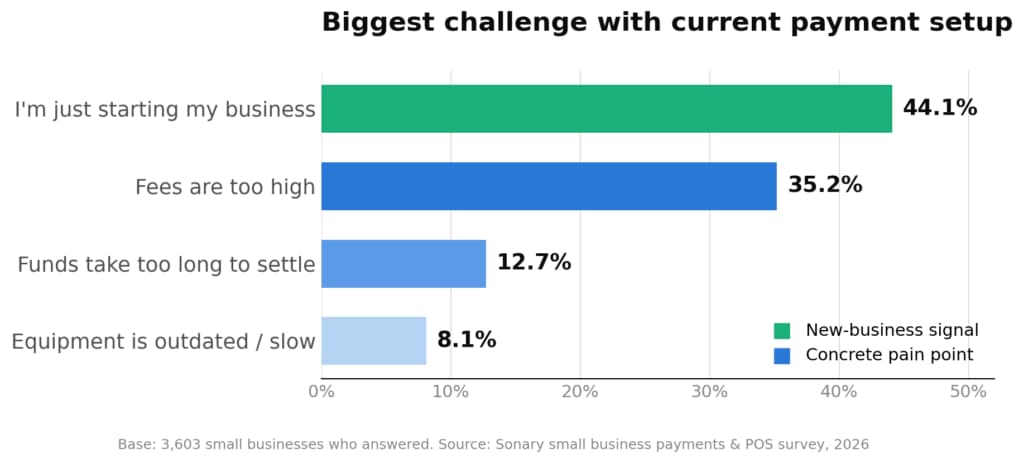
We asked 6,453 small businesses what they need from payment and POS tools. The biggest surprise: 44.1% of payment-processing shoppers are brand-new businesses just starting out— not unhappy switchers. Among those with an existing setup, high fees are the top complaint (35.2%). In POS, demand splits almost evenly between retail (44.2%) and restaurants (43.8%).
Key findings at a glance
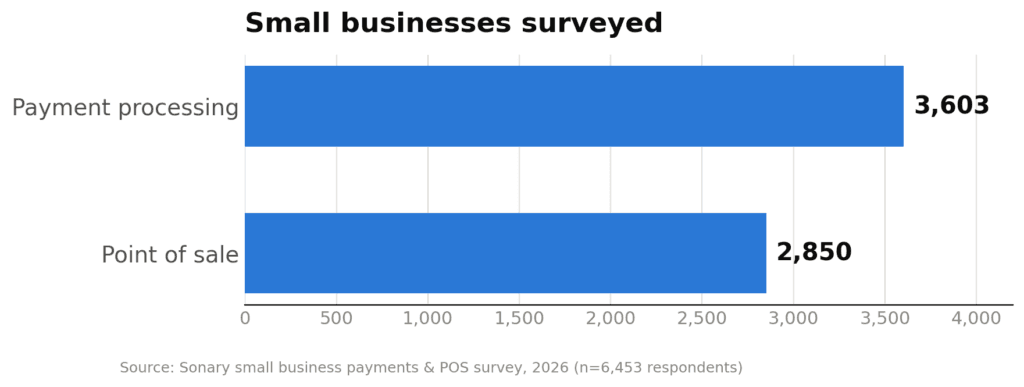
- 6,453 small businesses surveyed— 3,603 on payment processing, 2,850 on point of sale.
- 44.1%of payment shoppers are just starting their business — the single most common answer.
- 35.2%named high fees as their biggest challenge — the #1 concrete pain point, more than settlement speed and equipment combined.
- 12.7%said funds take too long to settle; 8.1%cited outdated or slow equipment.
- POS demand is a near-even split: retail (44.2%) vs. restaurants (43.8%), with services a distant third (12.0%).
How many small businesses did Sonary survey — and why does that matter?
In the last 3 months, we surveyed 6,453 small businesses as they actively shopped for payment and point-of-sale tools — 3,603 on payment processing and 2,850 on POS. These are real answers from real owners, not recycled vendor marketing, which is why the findings below differ from the standard "top 10 processors" advice you'll read everywhere else.
What's the biggest challenge small businesses have with payment processing?
The challenges that small businesses face depend on whether they're new or established — and most are new. When we asked small businesses about their biggest payment issue, the most common answer wasn't a complaint at all: 44.1% said they're just starting their business. Among businesses that already have a setup, fees are the runaway pain point at 35.2%.
The takeaway for owners: there are really two audiences in this market. If you're just getting started, you don't need switching help — you need the simplest possible setup. If you already accept payments, your biggest lever is almost certainly cost.
Why do fees matter more than any other complaint?
Fees matter most among established businesses, because they come straight out of your profits. At 35.2%, high fees were cited more often than slow settlement (12.7%) and outdated equipment (8.1%)combined. Cost — not features, not integrations — is what established small businesses want fixed.
That should change how you shop. The winner for most SMBs isn't decided by a feature checklist; it's decided by the effective rate— your total monthly fees divided by your total sales. Two processors with identical headline rates can differ by hundreds of dollars a month once monthly fees, PCI charges, and chargeback costs are counted. Ask every provider for your effective rate at your real volume, and treat "call us for a quote" pricing as a red flag.
Why are nearly half of payment shoppers brand-new businesses?
The moment you start your business is naturally when you first need to accept money — and 44.1% of the small businesses we surveyed were at exactly that point. This is the most overlooked segment in most payment-processing content, which is written for businesses looking to switch.
If you're in this group, the good news is you get to skip the pain of migrating off a legacy system. Prioritize:
- Transparent pricing you can understand without a sales call
- Fast approval and setup so you can take payments quickly
- Low or no monthly minimums while your volume is still ramping
- Simple onboarding and support, not enterprise features you won't use
Why is settlement speed still worth checking?
To put it simply, for micro businesses, cash flow is survival. It wasn't the loudest complaint —12.7%named slow fund settlement — but it's the second-biggest concrete pain point, and a two- or three-day delay can be the difference between covering payroll or not.
Before signing with any processor, ask three questions: When are funds deposited (next day, two days, same day)? Is there a daily cutoff time? Are there holds or rolling reserves on new accounts? For a cash-flow-sensitive business, faster settlement can be worth a slightly higher rate.
Which industries are shopping for POS systems right now?
It's essentially a tie between retail and restaurants in the POS system space right now. Among the small businesses we surveyed who were researching POS systems, 44.2% were retail and 43.8% were restaurants— a near-even split — with services a distant third at 12.0%.
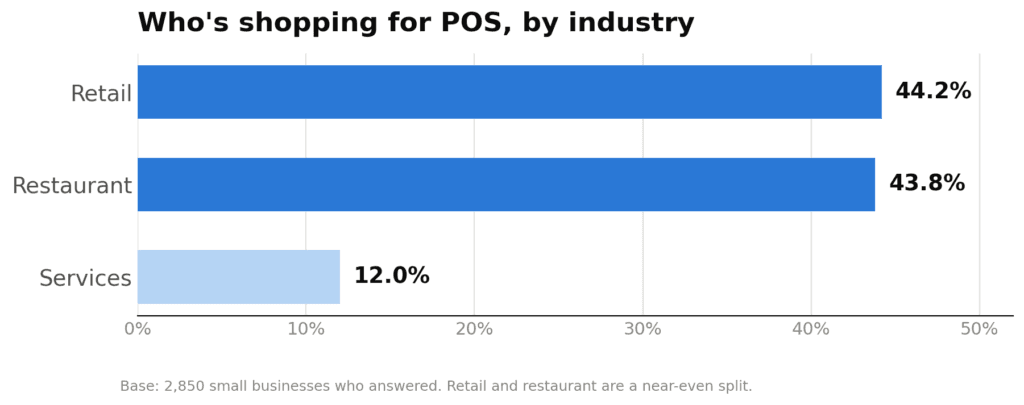
For a buyer, the lesson is that there's no single "best" POS— the right system depends entirely on your side of that split. A restaurant needs fast order-taking, tipping, and (for full-service) tab and table management. A retail shop needs inventory depth, barcode scanning, and returns handling. Buying a restaurant-first system for a retail store — or vice versa — is the most common and most expensive POS mistake a small business makes.
Fees or features — what should a small business prioritize?
For most small businesses, cost and simplicity first, features second. The data points the same way in both categories — established businesses want lower fees, and nearly half of payment shoppers just want a simple way to start. Run every option through these six questions:
- What's the true all-in monthly cost at my real sales volume?
- How fast do I get my money, and are there new-account holds?
- How quickly can I go live— days or weeks?
- Can I cancel easily, or am I locked into a long contract or hardware lease?
- Does it fit my industry and workflow(retail vs. restaurant), not just a generic "small business" label?
- Is pricing transparent, or do I need a sales call to learn what I'll pay?
Any provider that makes these hard to answer is telling you something.
Frequently asked questions
What's the most important factor when choosing a payment processor for a small business? Cost. Among small businesses with an existing setup, 35.2% named high fees as their biggest challenge — more than any other complaint, and more than slow settlement and old equipment combined. Compare providers on their effective rate, not the advertised rate.
Are most small businesses shopping for payment processing new or established? Newer than you'd think. In our survey of 3,603 small businesses, 44.1% said they're just starting their business — the single most common answer. Nearly half of this market needs simple setup and onboarding, not help switching providers.
How fast should a payment processor deposit my money? Many modern processors offer next-business-day settlement, and some offer same-day for a fee. Settlement speed was the second-biggest concrete pain point (12.7%), so ask about deposit timing and new-account holds before signing up.
What types of businesses shop for POS systems? It's nearly an even split: 44.2% of POS shoppers are retail businesses and 43.8% are restaurants, with services a distant third at 12.0%. Because retail and restaurant needs differ sharply, the right POS depends heavily on which side you're on.
What should I look for in a POS system as a small business? Match it to your industry and workflow first. Restaurants need order-taking, tipping, and table/tab management; retailers need inventory, scanning, and returns handling. Then weigh transparent all-in pricing, fast setup, and month-to-month terms.Not sure where to begin? Start with the basics of what a POS system is.
The bottom line
Across 6,453 real small businesses surveyed, two clear signals emerge. In payments, the market is split between new businesses that just want to get started (44.1%)and established businesses whose biggest gripe is fees (35.2%). In POS, demand is an even retail (44.2%) vs. restaurant (43.8%)split, so the right system depends on your industry. In every case, the winning choice for a small business is the one that's transparent, affordable at your real volume, and built for how you actually operate — not the one with the longest feature list.
Methodology: Based on responses from 6,453 U.S. small and micro businesses (3,603 on payment processing, 2,850 on point of sale) collected through Sonary's platform in 2026. Percentages reflect the share of respondents who answered each question.