
Ecommerce vs. Dropshipping: Uncover the Truth About Online Business Models

The online business world has expanded significantly, offering various models for entrepreneurs. Among these, Ecommerce and Dropshipping are two popular choices. Both have unique advantages and challenges, making them suitable for different types of businesses. In this article, we’ll explore e-commerce and Dropshipping, breaking down their differences, pros and cons, and how to choose the right model for your business.
Dropshipping vs. E-commerce: Why This Matters
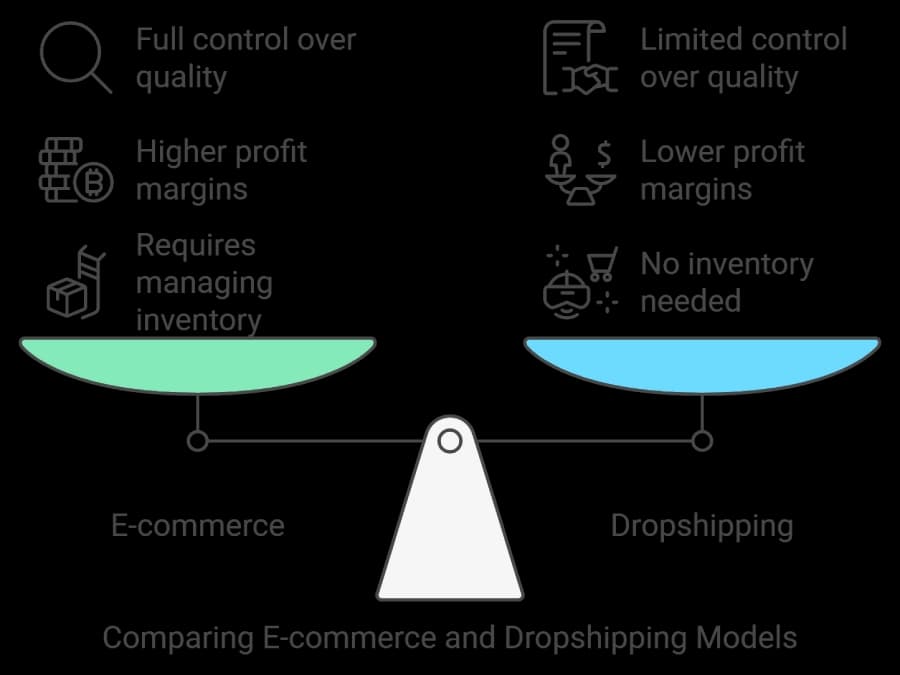
Understanding Dropshipping and e-commerce is crucial for choosing the right business model. Dropshipping offers low startup costs, flexibility, and easy scalability but comes with lower profit margins and less control over product quality and shipping. E-commerce, on the other hand, provides full control over inventory, branding, and customer experience, leading to higher profit margins but requiring more investment and logistical management. Selecting the right model impacts your operational complexity, profit potential, and overall business strategy, making it essential to align with your goals and resources.
What is e-commerce?
E-commerce refers to the buying and selling of goods or services through the Internet. It encompasses a wide range of business models, from traditional retail to subscription services. Running an e-commerce business involves setting up an online store, managing inventory, and handling the logistics of order fulfillment.
Definition of E-commerce
E-commerce, also known as electronic commerce, refers to the buying and selling of goods or services over the internet. This digital marketplace allows businesses to reach a global audience, offering convenience and accessibility to consumers. E-commerce encompasses various platforms, including online stores, marketplaces, and social media channels, facilitating seamless transactions between businesses and customers. By leveraging e-commerce, businesses can increase sales, enhance customer engagement, and expand their market reach.
Types of E-commerce Businesses
E-commerce businesses come in several forms, each catering to different market needs and customer bases. Here are the primary types:
- Business-to-Consumer (B2C) E-commerce: This model involves businesses selling products or services directly to consumers through online channels. Examples include online retailers like Amazon and clothing brands with their own e-commerce websites.
- Business-to-Business (B2B) E-commerce: In this model, businesses sell products or services to other businesses. This can include wholesale suppliers or manufacturers selling to retailers. Platforms like Alibaba are prime examples of B2B e-commerce.
- Consumer-to-Consumer (C2C) E-commerce: This type involves individuals selling products or services to other individuals, often through online marketplaces like eBay or peer-to-peer platforms like Craigslist.
- Mobile Commerce (M-commerce): This model leverages mobile devices, such as smartphones and tablets, to facilitate online transactions. With the rise of mobile shopping apps and responsive websites, m-commerce has become a significant segment of the e-commerce landscape.
Key Features of E-commerce:
- Inventory Management: The ecommerce business model requires businesses to stock products in a warehouse or at their premises.
- Order Fulfillment: The business is responsible for packaging and shipping the products to customers.
- Customer Experience: E-commerce allows full control over the branding, customer journey, and overall experience.
Advantages of E-commerce:
- Control Over Products: You have complete control over the product quality and customer experience.
- Branding Opportunities: Building a unique brand is easier when you manage every aspect of your business.
- Higher Profit Margins: By buying in bulk and storing inventory, you can reduce product costs and increase margins.
Challenges of E-commerce:
- Inventory Costs: You need to invest in inventory upfront, which ties up capital.
- Logistics Management: Handling storage, shipping, and returns can be complex and costly.
- Risk of Overstocking: Unsold inventory can lead to losses.
Related Articles


What is Dropshipping?
Dropshipping is a subset of e-commerce but with a significant difference: the dropshipping business model allows the seller to avoid keeping products in stock. Instead, when a customer orders a product, the seller purchases it from a third-party supplier, who then ships it directly to the customer.
Definition of Dropshipping
Dropshipping is a type of e-commerce business model that allows entrepreneurs to sell products without holding any inventory. Instead, the business partners with third-party suppliers who handle the storage, packaging, and shipping of products directly to the customer. This model enables business owners to focus on marketing and sales without the complexities of inventory management. Dropshipping is particularly appealing for those looking to start an online business with minimal upfront investment and operational overhead.
How Dropshipping Works
Here’s a step-by-step overview of how the dropshipping model operates:
- Setting Up an Online Store: The business owner creates an online store, selecting a platform like Shopify or WooCommerce, and adds products to the catalog.
- Customer Orders: A customer visits the online store and places an order for a product.
- Order Processing: The business owner forwards the order details and customer information to the third-party supplier.
- Supplier Fulfillment: The supplier packages and ships the product directly to the customer, handling all logistics.
- Customer Service: The business owner remains the point of contact for the customer, providing support and handling any inquiries or issues.
Key Features of Dropshipping:
- No Inventory Needed: The seller doesn’t need to stock or manage inventory.
- Third-Party Fulfillment: The supplier handles packaging and shipping.
- Lower Startup Costs: Without inventory, upfront costs are minimal.
Advantages of Dropshipping:
- Low Initial Investment: Since you don’t need to buy inventory upfront, starting with minimal capital is easy.
- Flexibility: You can quickly add or remove products without worrying about storage.
- Reduced Risk: No risk of holding unsold inventory, as you only purchase items when you make a sale.
Challenges of Dropshipping:
- Lower Profit Margins: Margins are typically lower for dropshipping businesses because you pay the supplier for fulfillment services.
- Limited Control: You have less control over product quality and shipping times, which can impact customer satisfaction.
- High Competition: Since the barrier to entry is low, the market can be saturated, making it harder to stand out.
Comparison Table: E-commerce vs. Dropshipping
Key Elements | E-commerce | Dropshipping |
|---|---|---|
Inventory Management | Requires managing and storing inventory | No inventory needed; supplier handles it |
Profit Margins | Higher margins due to bulk purchasing and direct control over pricing | Lower margins due to supplier fees |
Control Over Product Quality | Full control over product quality | Limited control, as supplier manages quality |
Shipping and Fulfillment | Managed by the business; customizable | Supplier handles shipping; less control |
Branding and Customization | High level of branding and product customization | Limited branding opportunities |
Customer Service | Full control, allowing a consistent customer experience | Challenging, as supplier issues can impact service |
Scalability | Requires significant investment in inventory and logistics | Easily scalable with minimal resources |
Competition | Easier to differentiate through branding | High competition due to low entry barriers |
Dropshipping vs. E-commerce Pros & Cons
Aspect | Dropshipping | E-commerce |
|---|---|---|
Startup Costs | Low startup costs, no need for inventory investment | Higher startup costs due to inventory purchase and storage |
Risk | Minimal risk, no unsold inventory | Higher risk with the potential for unsold inventory |
Profit Margins | Lower margins due to supplier fees | Higher margins with direct control over pricing |
Inventory Management | No need to manage or store inventory | Requires managing and storing inventory |
Control | Limited control over product quality, packaging, and shipping | Full control over product quality, shipping, and customer experience |
Flexibility | Highly flexible, easy to test and add new products | Less flexible due to need for inventory management |
Scalability | Easily scalable with minimal additional resources | Scalability requires increased investment in inventory and logistics |
Branding | Limited branding and customization options | Extensive branding and customization opportunities |
Competition | High competition due to low barriers to entry | Easier to differentiate with strong branding |
Customer Service | Challenging due to reliance on suppliers for product and shipping issues | Full control over customer service, allowing for a consistent experience |
Logistics | Supplier handles logistics (shipping, fulfillment) | You handle logistics, offering more control but added complexity |
Top Website Builders For Dropshipping

- Over 300 million sites were built on Wix
- 90K+ Sites created daily

- 240+ design templates
- Drag & drop product merchandising

- Trusted by millions of businesses globally
- Drag-and-drop store creator
Similarities Between E-commerce and Dropshipping
While ecommerce businesses and Dropshipping differ in several key areas, they also share some important similarities. Understanding these commonalities can help clarify why both models are popular choices for online businesses:
- Online Presence: Both Ecommerce and Dropshipping require an online store, typically through platforms like Shopify, WooCommerce, or Magento, where customers can browse and purchase products.
- Marketing and SEO: Both models rely heavily on digital strategies, including SEO, social media marketing, email marketing, and paid ads, to drive traffic and boost sales.
- Customer Service: Regardless of the model, providing excellent customer service is essential to maintaining customer satisfaction and loyalty. Both businesses need effective communication channels to handle inquiries, complaints, and feedback.
- Product Variety: Both E-Commerce and Dropshipping allow businesses to offer a wide range of products. Although the way inventory is managed differs, the potential to diversify product offerings is common to both.
- Revenue Generation: In both models, revenue is generated by selling products online. The difference lies in the profit margins and cost structure, but the fundamental goal of converting visitors into customers is shared.
- Scalability: Both Ecommerce and Dropshipping can be scaled as the business grows. Although Dropshipping is inherently easier to scale due to the lack of inventory management, e-commerce businesses can also expand by increasing inventory, diversifying product lines, and reaching new markets.
- Global Reach: Both business models enable entrepreneurs to sell products globally. With the right logistics and shipping arrangements, businesses can cater to an international audience, expanding their market reach.
- Technology Dependence: Both rely on technology for operations, including website management, payment processing, analytics, and customer relationship management (CRM) tools.
These similarities highlight the core aspects of running an online business, regardless of the chosen model. Whether you opt for e-commerce or Dropshipping, leveraging these common elements effectively is crucial for success.
Which Model is Right for You?
Choosing between e-commerce and Dropshipping depends on your business goals, resources, and the level of control you want over your business.
Opt for E-commerce if:
- You have the capital to invest in inventory and logistics.
- You want to build a strong, unique brand that controls customer experience.
- You aim for higher profit margins and can manage inventory and shipping complexities.
Opt for Dropshipping if:
- You’re starting with limited capital and want to test different products or markets with minimal risk.
- You prefer to focus on marketing and customer acquisition rather than logistics.
- You want a business model that is easier to scale without significant upfront investment.
Building an Online Store
Building an online store is a crucial step in launching an e-commerce business. Here are the essential steps to follow:
Setting Up an Online Store
- Choose an E-commerce Platform: Select a platform that suits your business needs, such as Shopify, WooCommerce, or BigCommerce. These platforms offer various features and integrations to help you manage your online store efficiently.
- Register a Domain Name: Choose a domain name that reflects your business and is easy for customers to remember. This will be your online store’s address.
- Set up Hosting: Choose a reliable web hosting service that will ensure your online store runs smoothly and can handle traffic.
- Design Your Store: Pick a theme or template that aligns with your brand identity. Ensure the design is user-friendly and easy to navigate.
- Add Products: To improve search engine visibility, populate your store with products, including detailed descriptions, high-quality images, and optimized keywords.
- Set Up Payment and Shipping Options: Configure payment gateways and convenient shipping methods for your customers. Offer multiple options to cater to different preferences.
- Test and Launch: Before going live, thoroughly test your store to ensure all functionalities work correctly. Once everything is set, launch your store to the public and start promoting it.
By following these steps, you can create a professional and effective online store that attracts customers and drives sales.
SEO Benefits of Both Models
E-commerce SEO Advantages:
- Product Pages: More detailed product pages help rank for long-tail keywords.
- Content Marketing: Easier to create rich content around your brand and products, improving SEO.
- User Experience: Full control over the site structure, navigation, and speed enhances SEO performance.
Dropshipping SEO Advantages:
- Quick Product Addition: Easily expand your catalog to target more keywords and attract varied audiences.
- Focus on Niche Markets: Dropshipping allows targeting niche keywords with less competition.
- Flexibility: Quickly adapt to trending keywords and products
Conclusion
Both Ecommerce and Dropshipping offer viable paths for starting and growing an online business. Each model has its unique strengths and challenges. If you prioritize control, branding, and higher profit margins, e-commerce might be the better choice. However, Dropshipping could be the way to go if you prefer lower risk, flexibility, and minimal upfront investment.
Understanding your goals, resources, and market can help you make an informed decision. Whichever model you choose, focusing on a strong SEO strategy will be crucial to driving traffic and growing your business.