
AI-visibility metrics explained: Share of voice, citations & sentiment

Every brand tracking its presence in ChatGPT, Perplexity, and Gemini eventually asks the same follow-up question: okay, we're showing up — but is that actually good? That's where most teams get stuck. They can see that an AI engine mentioned them once or twice, but they don't have a way to turn that into a number they can track over time, report to leadership, or compare against competitors.
This article breaks down the three metrics that show up across every AI-visibility tool worth using: HubSpot AEO, Semrush's AI Visibility toolkit, and Ahrefs' Brand Radar, so the rest of AI-visibility tracking gets a lot less confusing. I pulled real screenshots from these tools as I wrote this explainer, so you can see exactly what each metric looks like in practice, not just how it's defined on paper.
Key takeaways:
- Share of voice measures how often your brand shows up in AI answers relative to your competitors, across a cluster of related prompts, not one exact phrase repeated word for word.
- Citations measure whether AI answers are actually pulling from and naming your content as a source, which is what builds the credibility that turns an AI mention into traffic and trust.
- Sentiment gets used two different ways in this space, and mixing them up will make your reporting misleading: tone sentiment (the AI describing you positively or negatively) and momentum sentiment (your visibility growing or shrinking month over month).
- Showing up a lot matters, but it's not the finish line. The goal is for AI tools to actually recommend you and to describe you well when they do.
Share of voice: How much of the conversation is yours
Share of voice is the simplest of the three metrics to define and the easiest to get wrong in practice. The formula is straightforward: take the number of times your brand shows up across AI answers, and divide it by the total number of brand mentions in that same conversation — yours plus every competitor's.
Here's the part that trips people up. When AI-visibility tools talk about "the same prompt," they don't mean the literal, word-for-word string. Ask ChatGPT "best help desk software for small businesses" today and "what's the best help desk software for a small team" tomorrow, and you'll get two differently worded questions that are really the same underlying query. AI-visibility tools group prompts like this into a cluster — same intent, same topic, slightly different phrasing — because that's how people actually use these tools. Nobody types the identical sentence into ChatGPT twice. Share of voice is measured across that whole cluster of related prompts, not a single fixed string.
So say you sell help desk software, and you're tracking share of voice against Zendesk, Freshdesk, Help Scout, Front, and Gorgias across the "best help desk software for small business" prompt cluster. If AI engines mention a help desk brand 100 times total across that cluster of related prompts in a month, and 22 of those mentions are your brand, your share of voice is 22%. That's the number you watch move over time — not whether you showed up once on a single query, but whether your slice of the whole conversation is growing.
This is exactly the metric Ahrefs' Brand Radar is built around. Here's a real screenshot from their tool, showing how it surfaces share of voice as a headline number alongside a mentions-over-time trend line:
Ahrefs Brand Radar share-of-voice dashboard: the top-line percentage and category rank are the two numbers to watch here, with the trend line below showing whether that share is climbing or falling month to month.
In practice, the headline percentage is the number most teams report up, but the trend line is the one worth checking first. A single month's share of voice can swing with how AI engines happen to answer that week, so a steady climb over three or four months is a far more reliable signal than any one spike or dip.
Ahrefs tracks this as a percentage and ranks you against the competitors mentioned in the same prompt cluster, which is what makes the number useful: 22% doesn't mean much on its own, but 22% and ranked #1 in your category does.
HubSpot AEO tracks the same underlying concept under its brand visibility view, showing how often your brand is mentioned prompts relative to competitors:
HubSpot AEO brand visibility dashboard: the brand visibility
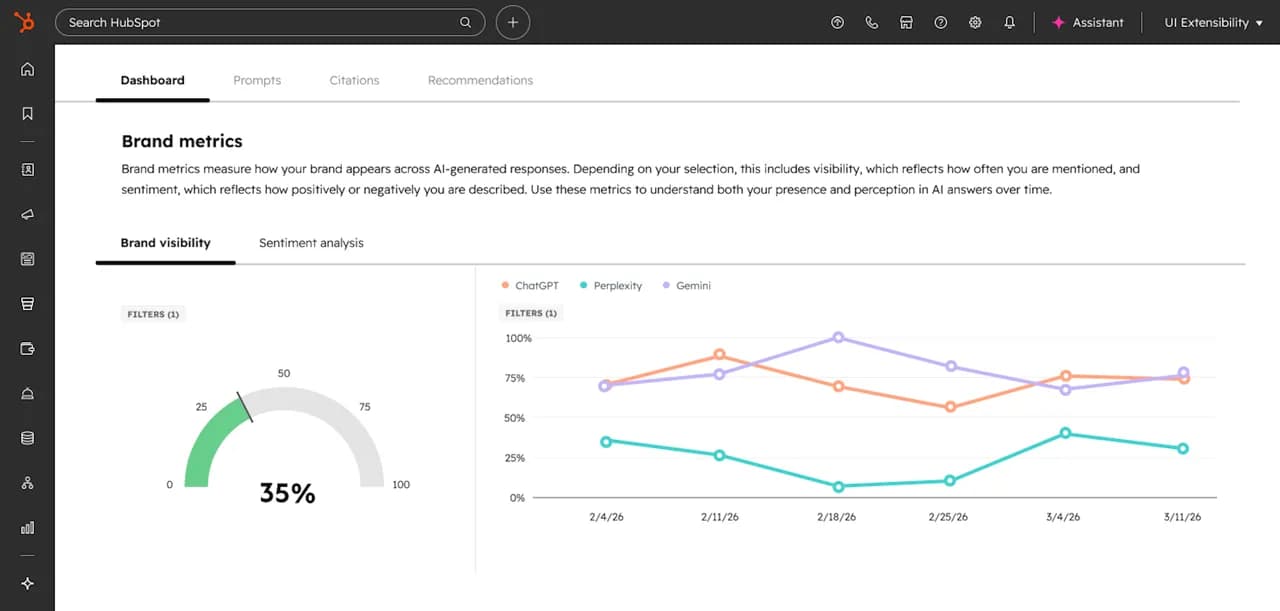
HubSpot AEO brand visibility dashboard — the brand visibility and sentiment analysis tabs sit side by side here, which is exactly the share-of-voice-plus-tone pairing this article is about.
The reason share of voice matters as a starting metric is that it's the closest thing AI visibility has to old-school search rankings. It tells you whether you're part of the conversation at all before you even get to the harder questions about how you're being talked about.
Citations: Where the AI is actually getting its answer
Citations answer a different question than share of voice. Share of voice tells you whether your brand got mentioned. Citations tell you whether the AI is actually pulling from your content to build its answer — quoting your article, linking to your page, or naming your site as the source behind a specific claim.
This matters because a citation is a much stronger signal than a mention. If an AI answer says "Sonary says X" and links back to the article that said it, that's the AI treating your content as a credible, checkable source — not just a name it recalled. That's the mechanism that turns AI visibility into actual trust, because the person reading the answer can click through and verify it came from you.
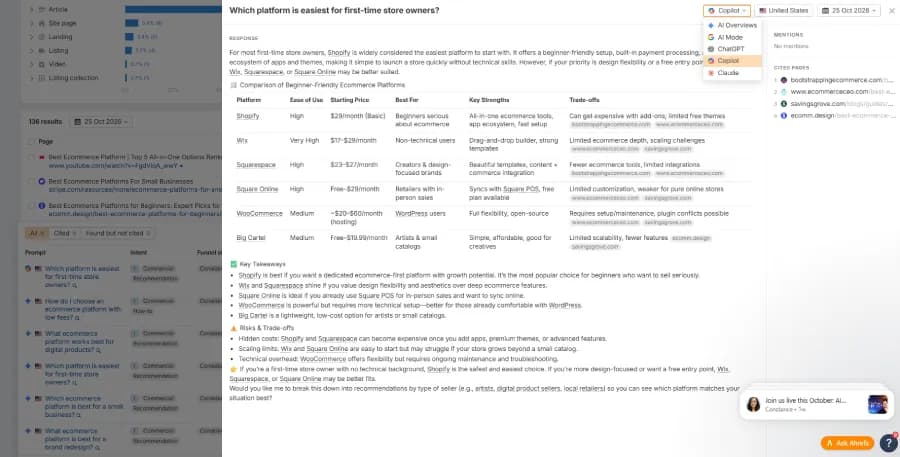
I ran a live query on ChatGPT to see this in action — "best help desk software for small businesses in 2026, with sources" — and the answer came back with inline citation pills attached to specific claims throughout the response, plus a "Sources" panel listing exactly where each claim came from. In this real answer, ChatGPT cited Intercom's own blog post ("10 Best Helpdesk Software Platforms in 2026"), a Help Scout support doc on billing and plans, a comparison piece from StackBriefly benchmarking Zendesk against Freshdesk, Help Scout, Front, and Gorgias, and a pricing comparison tool from Supp. Every specific number and claim in the answer — including a pricing comparison for a 5-person team handling 500 tickets a month — was tied back to one of those named sources. That's citation tracking working exactly as intended: you can see precisely which piece of content the AI leaned on for which claim.
This is why citation analysis has become its own line item in AEO tools rather than getting folded into share of voice. HubSpot AEO specifically tracks which of your pages are getting cited in AI answers and how often, because a brand can have a decent share of voice from being mentioned in passing while still getting zero citations — meaning the AI knows your name but isn't treating your content as a source worth pointing to. The brands that get cited most consistently tend to be the ones publishing the specific, well-sourced, checkable content that AI models can quote with confidence — pricing breakdowns, comparison tables, and documentation, not vague marketing copy.
Sentiment: Two different metrics with the same name
This is where most of the confusion in AI-visibility reporting comes from, because "sentiment" gets used to describe two genuinely different things, and AEO tools don't always make it obvious which one you're looking at.
Tone sentiment is what most people mean when they say "sentiment": is the AI describing your brand positively, negatively, or neutrally? This is what HubSpot AEO and Semrush's AI Visibility toolkit are measuring when they show you a sentiment score. It plots this as a "Share of Voice vs. Sentiment" view, pairing how often you show up with how favorably you're described, and surfacing the specific themes driving that sentiment in a "Key Sentiment Drivers" panel. Here's a real screenshot from Semrush showing that view:
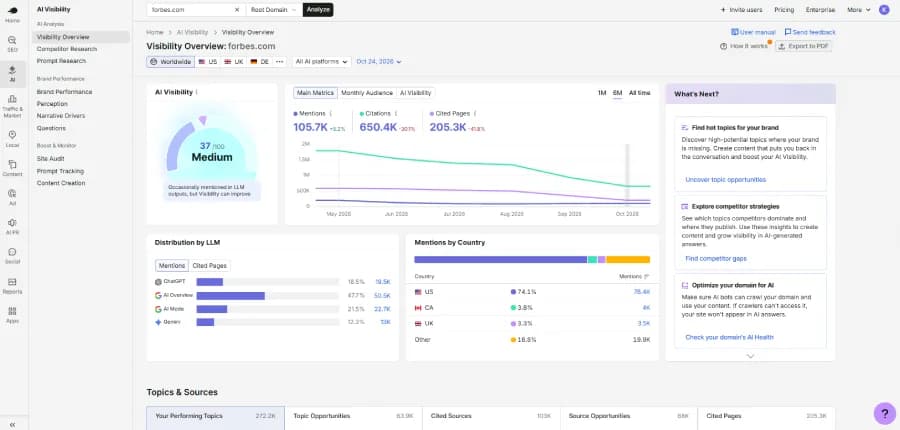
HubSpot AEO tracks this the same way, scoring brand sentiment from strongly negative to strongly positive based on the language AI models actually use when they describe you — whether they call you "reliable" and "easy to set up," or bury you next to complaints about pricing and support.
Momentum sentiment is the other sense of the word, and it's really a visibility trend dressed up in sentiment language. If your brand showed up in AI answers 1,000 times last month and only 700 times this month, some teams will call that "negative sentiment" — but it isn't measuring tone at all. It's measuring whether your raw visibility is growing or shrinking. That drop could happen even if every single one of those 700 mentions was glowingly positive. It's a real and useful number, but it's a visibility metric, not a tone metric, and treating it as the same thing as sentiment scoring will make your reporting misleading.
One more wrinkle worth knowing: not every AI-visibility tool tracks tone sentiment. Ahrefs' Brand Radar is built around share of voice and mention tracking, but as of this writing it doesn't include a sentiment-analysis feature the way HubSpot and Semrush do — which surprised me a little, given how central sentiment is to the rest of this conversation. So if you're comparing tools, don't assume sentiment is a universal column — check what each one actually measures before you build a dashboard around it.
Putting the three metrics together (and why none of them work alone)
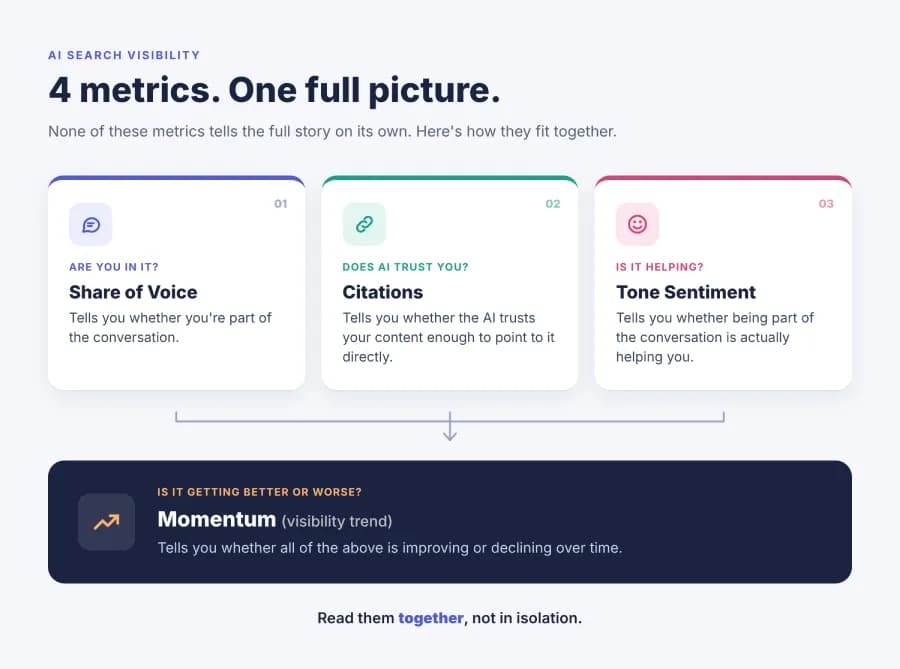
A brand with high share of voice, strong citations, positive tone sentiment, and positive momentum is in the best possible position: AI engines are recommending it, backing that recommendation with credible sourcing, describing it well when they do, and doing it more often over time. A brand with high share of voice but weak sentiment is a warning sign — you're showing up a lot, but the conversation isn't doing you any favors.
One practical note before you go looking for these numbers on your own brand: none of this is free. HubSpot AEO, Semrush's AI Visibility toolkit, and Ahrefs' Brand Radar all require an active paid subscription to pull a report like the ones in the screenshots above — there's no free tier where you can check your own share of voice or sentiment score the way you can with a manual ChatGPT query.
Tool | Plan | Price | What you get |
HubSpot AEO Grader | Free | $0 | One-time snapshot of your brand across ChatGPT, Perplexity, and Gemini |
HubSpot AEO | Standalone (beta) | $50/mo, or $45/mo billed annually | 25 prompts across ChatGPT, Gemini, and Perplexity, with visibility, sentiment, share of voice, and citation analysis; priced per brand |
HubSpot AEO | Marketing Hub Pro or Enterprise | Included with Marketing Hub | Larger prompt allotment and CRM-informed recommendations |
Semrush AI Visibility Toolkit | Standalone | $99/mo per domain | 25 prompts tracked daily across ChatGPT, Google AI, Gemini, and Perplexity |
Semrush One (SEO + AI) | Starter | $199/mo, or $165.17/mo billed annually | Full SEO toolkit plus AI visibility, 50 prompts |
Semrush One (SEO + AI) | Pro+ | $299/mo, or $248.17/mo billed annually | Full SEO toolkit plus AI visibility, 100 prompts |
Ahrefs Brand Radar | AI Visibility Index | From $199/mo | AI mention and share-of-voice data; $699/mo covers all AI platforms |
Ahrefs Brand Radar | Custom prompts | From $50/mo (2,500 checks) | Track your own prompts; free with paid Ahrefs Lite ($129/mo) and above |
Conclusions
Share of voice is your visibility baseline. It tells you whether you're in the conversation at all, measured across a cluster of related prompts rather than one exact phrase.
Citations are your credibility signal. They show whether AI models trust your content enough to name it and link to it, which is what turns a passing mention into something a reader can verify.
Sentiment needs to be split into two questions. Ask both: are AI models describing us well (tone), and is our visibility trending up or down (momentum)? Conflating the two will produce reporting that looks scary or reassuring for the wrong reasons.
Momentum ties the other three together. Track all three monthly and watch the direction, not just the snapshot. Rising share of voice with flat citations means you're getting mentioned but not trusted as a source. Rising citations with slipping tone means the AI is pointing to you while describing you less favorably. The trend across all three tells you whether your AI presence is actually improving.
The Bottom Line: Share of voice, citations, and sentiment aren't competing metrics. They're different angles on one question: are AI tools actually recommending you? Visibility gets you in the door, citations make that visibility credible, and sentiment tells you whether it's working in your favor. Measure them together, because a brand that's everywhere and disliked is worse off than a brand that's mentioned less often but recommended warmly every time it comes up.