
SEO vs AEO vs GEO: what are they, and what should small businesses actually do in 2026?

SEO gets you found on Google. AEO gets you quoted in the AI summary box above the results. GEO gets you named when someone asks ChatGPT or Perplexity a question directly. Here's what each one actually looks like, and what it does for a small business.
I'm Keidar Sharoni, SEO lead at Sonary. I manage our search strategy across all three of these at once, so I'll keep this simple.
What is SEO, and what does it look like?
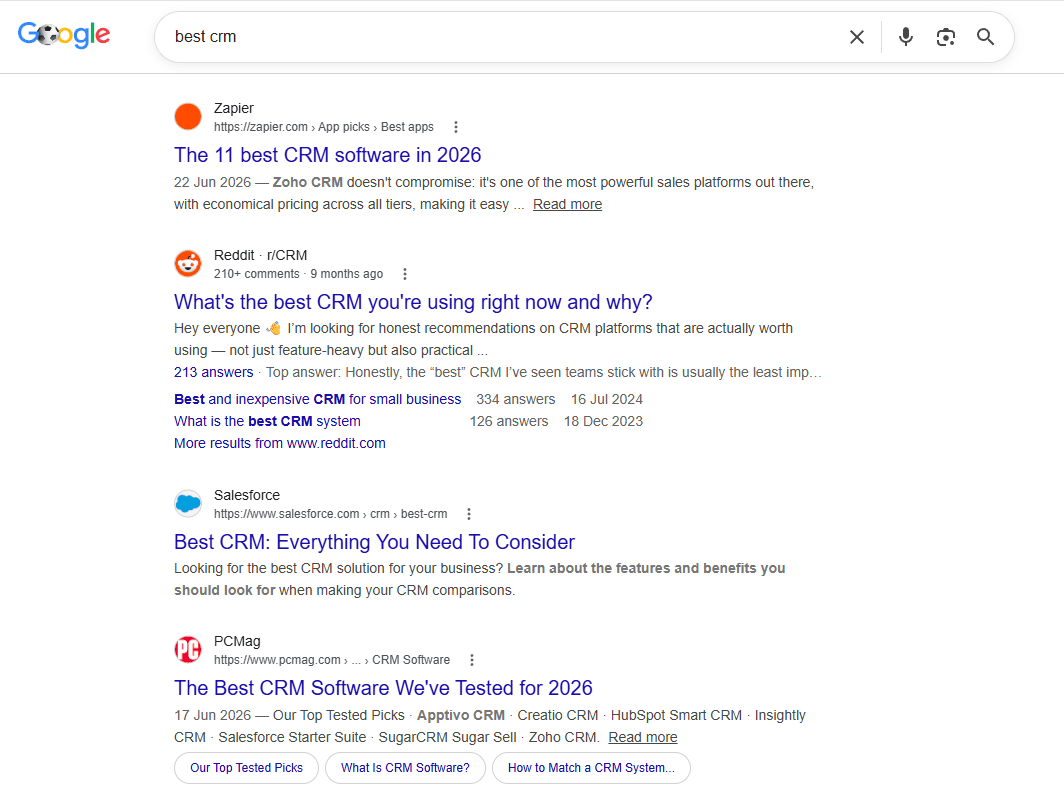
SEO, or Search Engine Optimization, is what gets your website into Google's regular results page. That results page is called the SERP, short for Search Engine Results Page. It's the list of blue links you scroll through after typing a search.
If you search "best accounting software for freelancers," the SERP is the page of ten website links that you used to see (more on that below). Getting your site onto that list, ideally near the top, is what SEO does.
What is AEO, and what does it look like?
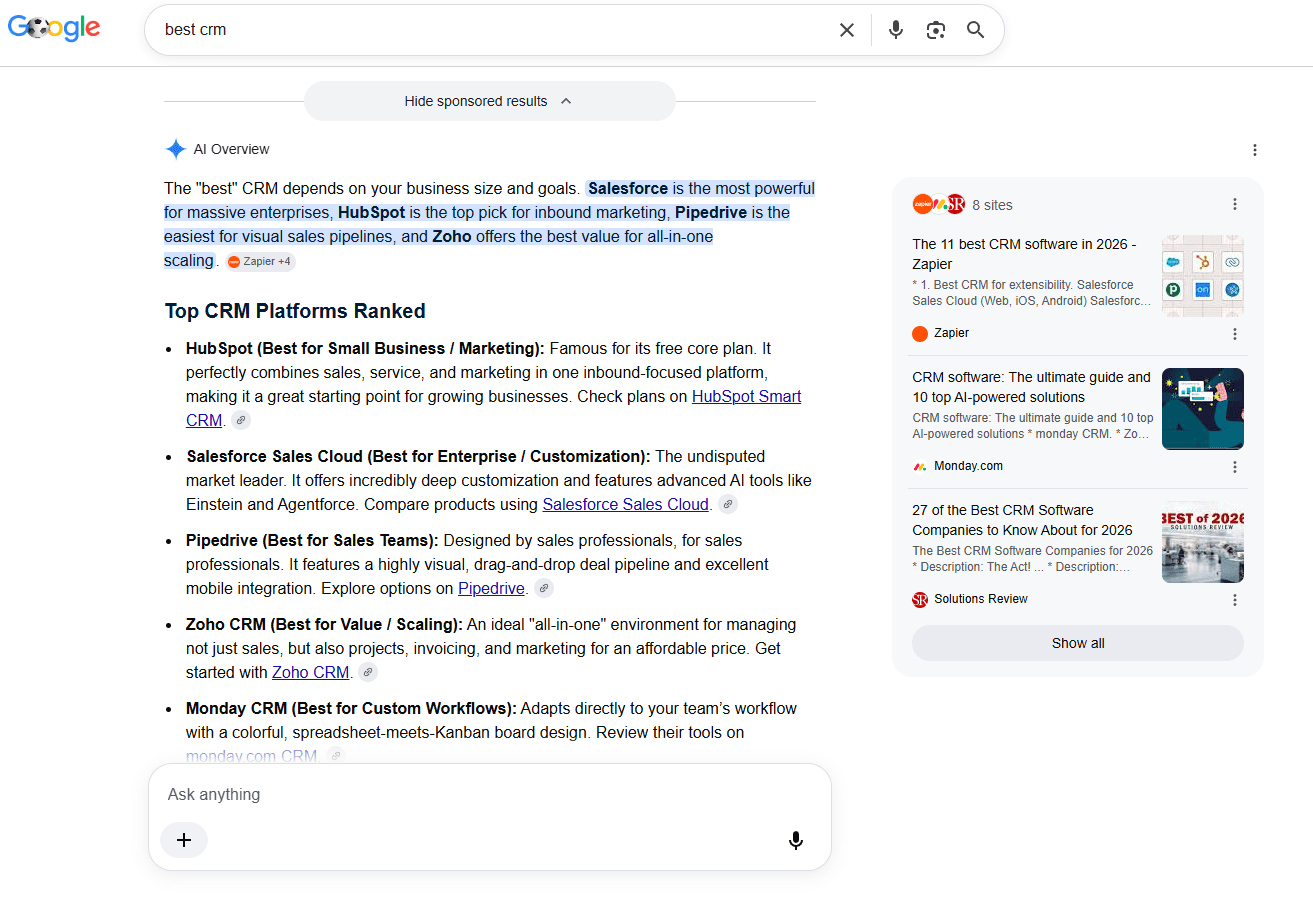
AEO, or Answer Engine Optimization, is what gets your content pulled into the AI summary box. This is the gray, AI-written answer that now appears at the top of many Google searches, above all those blue links.
Search "what is the best CRM for small business" and you'll usually see this summary box first, naming a few tools with a one-line explanation each. AEO is the work that gets your business named inside that text, and into the box of links beside it (or below, on mobile).
What is GEO, and what does it look like?
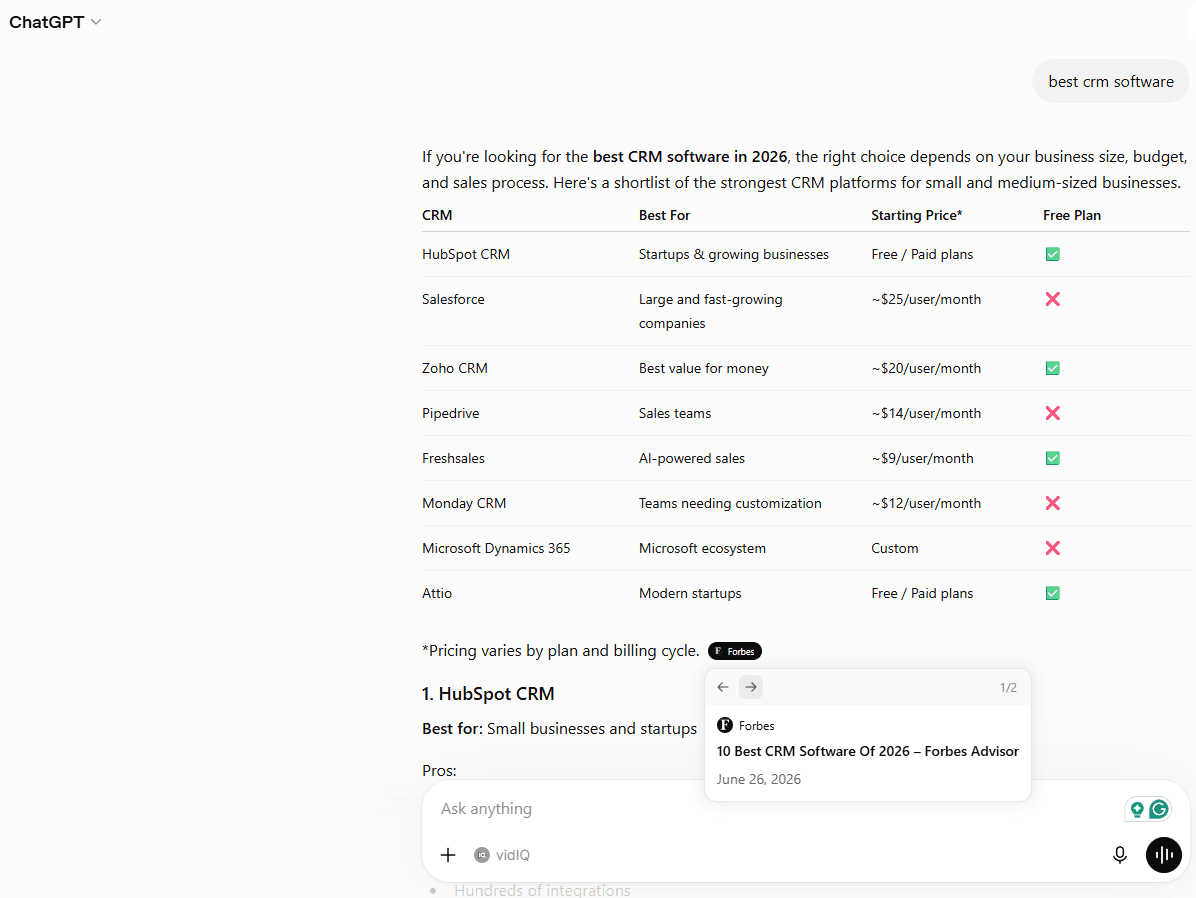
GEO, or Generative Engine Optimization, is what gets you cited inside an AI search engine's own answer, on tools like ChatGPT, Perplexity, or Gemini.
Here there's no results page at all. You ask a full question, and the AI writes a complete answer, then lists the sources it used at the bottom. GEO is what gets your business into that source list.
How do SEO, AEO, and GEO compare?
SEO | AEO | GEO | |
Where it shows up | Google's SERP (blue links) | The AI summary box above the SERP | ChatGPT, Perplexity, and Gemini answers |
What the user sees | A list of links to click | A direct answer, no click needed | A full written answer with sources listed |
What does it earn you | Traffic | Authority | Branding |
How long does it take | 3 to 6 months | 4 to 8 weeks on existing pages | 6 to 12 months |
How does each one affect your small business?
SEO drives your traffic
This is the channel that actually sends people to your website. Every click from the SERP is a visit, and for most small businesses this is still the largest source of website traffic overall.
How do you actually optimize for SEO?
These are the five moves that matter most for a small business site, in order of impact.
- Write a proper title tag for every page. This is the blue link text people see in Google. 50–60 characters, your primary keyword in the first 4 words. Bad: "Welcome to Our Website." Good: "Bookkeeping Services for Austin Freelancers | Maria Cruz CPA." This single change moves the needle faster than almost anything else for a new site.
- Write a meta description for every page. 150–160 characters. Explain what the page is about and include one specific benefit. This doesn't directly affect rankings, but it controls how many people click through. I've seen CTR improvements of 30–40% just from rewriting meta descriptions.
- Put one clear H1 on every page. The H1 is the main headline. Every page should have exactly one. Google and your reader both need it to understand what the page is about.
- Match content to search intent. If someone searches "how to register a business in Texas," they want step-by-step instructions, not a pitch for your legal services. I see mismatched intent constantly in audits. Google penalizes it. Write content that genuinely answers the query.
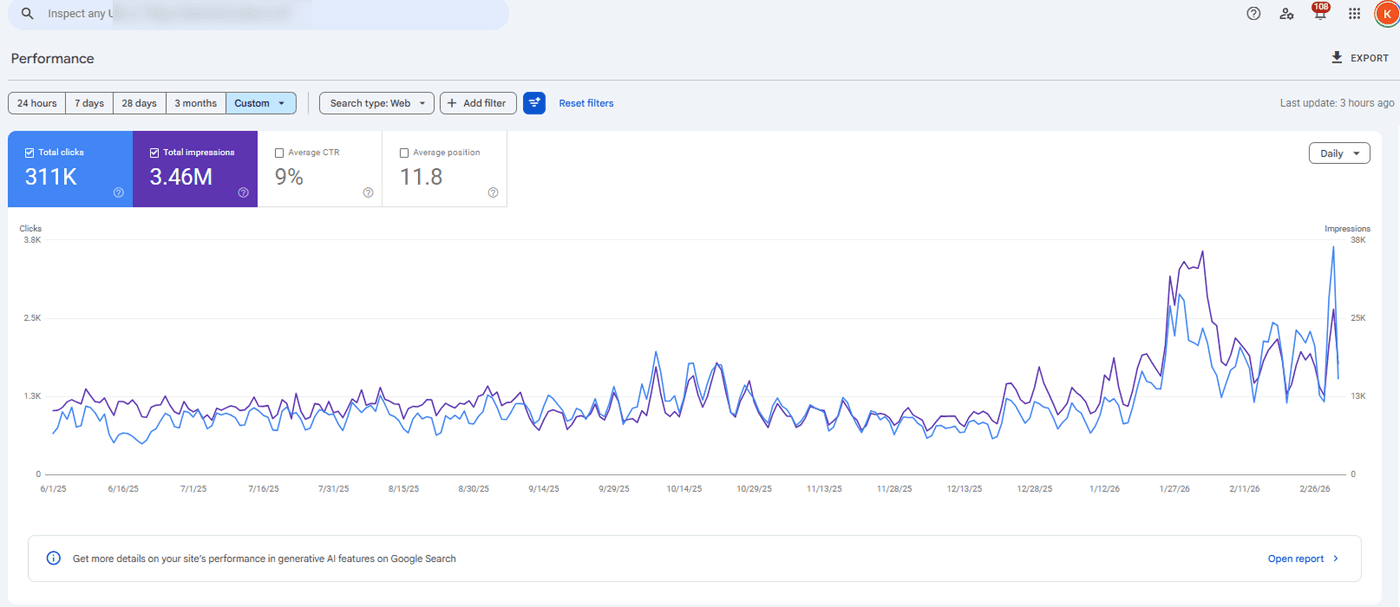
- Set up Google Search Console. It’s free, takes 20 minutes, and shows you which queries your site appears for, which pages are indexed, and what technical issues exist. I check this every Monday as part of my weekly SEO review.
AEO builds your authority
Getting quoted in the AI summary box puts you above every other result on the page. It signals to the searcher, before they've even clicked anything, that your business is the trusted answer.
How do you actually optimize for AEO?
AEO is a structural game. You're making it easy for Google and AI tools to pull a clean, quotable answer from your page.
- Rewrite every heading as a question. This is the change with the highest ROI per hour of work. "Our Services" becomes "What services do I offer?" "Pricing" becomes "How much does [your service] cost?" "About" becomes "Who am I and why does my background matter to you?" In my AEO audits, this single change accounts for about 40% of the improvement in featured snippet eligibility.
- Put a direct-answer sentence immediately under every question heading. The very first sentence after a question heading must completely answer that question. One sentence. Then expand with 2–3 sentences of context and detail. This is the pattern AI engines extract. Example: Under "How much does bookkeeping cost for a freelancer?" write "Most freelancers pay $150–$400/month for bookkeeping, depending on transaction volume and whether you need payroll included." Then explain.
- Add a FAQ section to your most important pages. 5–8 questions your clients actually ask. Answer each in 2–4 sentences. This content is the most extractable thing on your page, both for Google and for AI tools.
- Add FAQ schema markup. I use JSON-LD. On WordPress, Rank Math adds this in 2 clicks. On other platforms, paste a small snippet into your page's header. Without schema, Google doesn't know your FAQ is structured as Q&A, it just sees paragraph text.
- Add author information to every page. Your name, a 2–3 sentence bio with your relevant credentials, and a link to your About page. I added this to all my Sonary articles and saw measurable improvements in AIO citation rates within 6 weeks. AI engines weigh author expertise heavily when deciding what to cite.
GEO builds your branding
Being named inside a ChatGPT or Perplexity answer isn't really about the click. It's about your business name showing up as the recommended option when someone is actively deciding who to trust or buy from.
How do you actually optimize for GEO?
GEO requires the most sustained effort of the three, but every step also strengthens your AEO and SEO simultaneously. Here's what I do.
- Replace every vague claim with a specific, sourced fact. Go through your pages and flag every sentence that uses "many," "often," "some businesses," "a lot of," or "various." Replace each with a real statistic, a named product, or a dated claim. This is the single highest-impact GEO change I make on any page. AI engines cite specificity. They skip generalities entirely.
- Add your credentials to every page where you give advice. Not just a name, context. "Keidar Sharoni has audited over 3,000 small business websites across 12+ years in SEO" is citable. "Written by our content team" is not. AI engines are very good at distinguishing real expertise from anonymous content.
- Build your brand entity consistently. Your business name, logo, and description should be identical across your website, Google Business Profile, LinkedIn, and any other platform you use. Add Organization schema to your homepage declaring your name, logo URL, website URL, and social profile links. This is what I call the "entity graph", it tells AI engines who you are and confirms you're trustworthy enough to cite.
- Write content that leaves no questions unanswered. AI engines generate synthesized answers. If your page answers 80% of a question but leaves the hardest 20% vague, the AI will cite a different source for that part. In my GEO audits, I ask: does this page cover the what, the why, the how, the cost, the trade-offs, and the "skip this if..." scenarios? If any of those are missing, I fill them.
Is SEO, AEO, or GEO right for you?
SEO: skip it if, choose it if
Skip SEO as your top priority if you need leads in the next 2 to 4 weeks (paid ads move faster), or if you have no web presence yet, in which case set up a Google Business Profile first.
Choose SEO if you want to sell to people who've never heard of you, you depend on local discovery, or you're in a competitive market where ranking directly drives revenue.
Find the best SEO tools for small businesses
AEO: skip it if, choose it if
Skip AEO if your site has under 5 pages or has never seen real Google traffic. You need search visibility before you can earn a spot in the summary box.
Choose AEO if you already have some Google presence and want to appear in AI Overviews, or you run a knowledge-based business like consulting, accounting, or coaching.
GEO: skip it if, choose it if
Skip GEO if you're a local, in-person service business, or you're still building your first year of online presence. Don't skip the foundation to chase the future.
Choose GEO if you already rank well for your core keywords, you publish original research or data, or you're in B2B, where buyers increasingly use AI tools to vet vendors before reaching out.
Can a tool help you optimize for AEO and GEO? What HubSpot AEO actually does.
I've tested a lot of tools that claim to help with AEO and GEO optimization. One worth knowing about, especially if you're already a HubSpot user, is HubSpot AEO. Here's what it actually is, what it does well, and where it falls short.
What is HubSpot AEO?
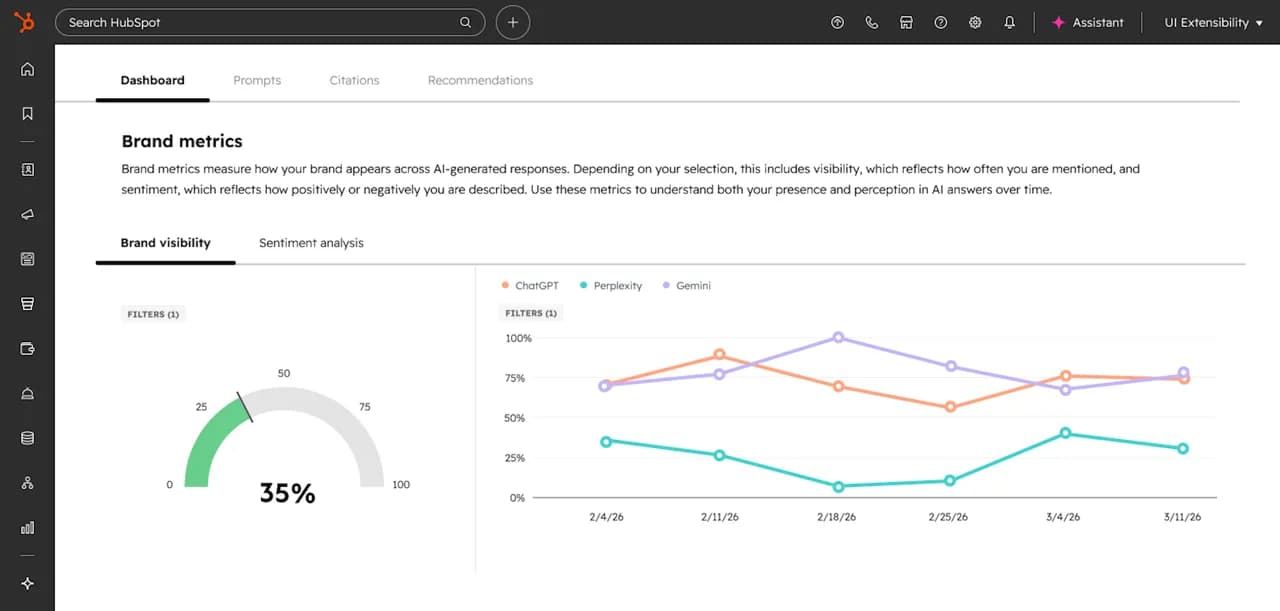
HubSpot AEO ($50/month, or free in Marketing Hub Pro/Enterprise) is a closed-loop AI visibility tracker built into HubSpot. You give it the buying questions you think your customers ask AI tools, "what's the best CRM for a 5-person team?", "which invoicing software works for freelancers?", and it sends each prompt roughly 10 times to ChatGPT, Gemini, and Perplexity. The dashboard then shows you whether your brand was mentioned, which pages were cited, and what content you should create to improve your visibility.
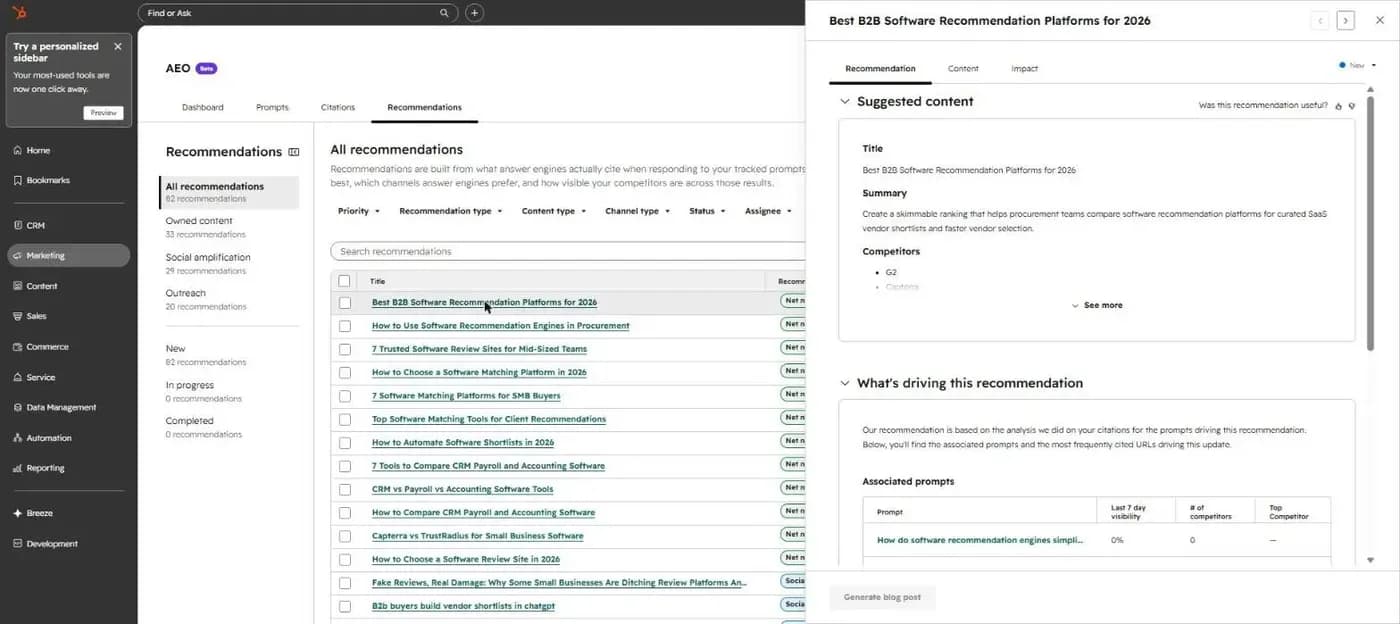
The tool works in four steps: you add prompts, it runs them, it analyzes the AI responses, and it generates a prioritized content and outreach backlog with in-tool draft generation.
What makes HubSpot AEO useful for small businesses:
If you're already on HubSpot, this is a legitimate AEO execution tool. It shows you the verbatim AI responses for your target queries, which means you can read exactly what ChatGPT or Gemini is saying when someone asks about your category, and see which competitor pages are being cited instead of yours. That competitive intelligence alone is worth the $50/month for many small businesses. The built-in content recommendation engine then tells you what to create to close those citation gaps, and the draft generation feature means you can act on recommendations without leaving the platform.
I tested this on a real Sonary account and found the citation intelligence genuinely useful, seeing which pages from competitors are being cited for specific prompts gives you a clear content brief.
The critical limitation you need to know:
HubSpot AEO does not show your real AI visibility across the open web. It only measures the specific prompts you load. If your brand is already being mentioned by ChatGPT and Google AI Overviews for queries you didn't add, HubSpot AEO will report 0% visibility, because it's blind to anything outside its closed prompt loop. I confirmed this on the Sonary account: HubSpot showed 0% while Ahrefs Brand Radar showed real, healthy AI presence for the same domain.
The honest one-liner: HubSpot AEO is a do-the-work tool, not a measure-the-work tool. Use Ahrefs Brand Radar or Semrush AI Visibility to measure your real AI footprint. Use HubSpot AEO to execute content actions against specific target queries.
How HubSpot AEO compares to the alternatives:
HubSpot AEO | Semrush AI Visibility | Ahrefs Brand Radar | |
|---|---|---|---|
Starting price | $50/mo ($45 annually) | Per domain pricing | $199/mo per index |
How it scans | Closed-loop, your prompts only | Open web, 90–239M real prompts | Open web, 90M+ real prompts |
Shows real AI footprint | No | Yes | Yes |
Content recommendations | Yes (with draft generation) | Limited | Limited |
AI engines covered | ChatGPT, Gemini, Perplexity | Multiple | Multiple |
Google AI Overviews | No | Yes | Yes |
Best for | HubSpot users who want to act | Measuring real AI visibility | Measuring real AI visibility |
My recommendation: If you're a small business starting with AEO/GEO, begin with Google Search Console (free) and Ahrefs or Semrush to measure where you actually appear. Add HubSpot AEO only if you're already on HubSpot and want a structured workflow for acting on content gaps, not as your primary measurement source.
How does AEO vs SEO vs GEO affect your small business visibility in 2026?
Google's traditional organic results still drive the majority of search-referred website traffic. But AI Overviews now appear on 47% of all US searches, and in B2B tech, my primary domain, that number is 82% (BrightEdge, July 2026). That means in my category, nearly 5 out of every 6 searches now show an AI-generated summary above the blue links. So if my content isn't cited in that summary, I'm invisible to most of my potential audience, even if I rank #1 below it.
This is the question I get asked more than any other. Here's my honest, data-backed answer.
My own AI performance report illustrates this clearly. Over the past 6 months, Sonary has been cited 563,500 times by AI engines across 215 different pages, up to 6,000–8,000 citations per day at our peak. These are two separate traffic streams, traditional search clicks and AI citation exposure, and a site that only optimizes for one is leaving real opportunity on the table.
Perplexity processes over 100 million queries per day. ChatGPT's built-in search is used by 200+ million active users. I track Sonary's citation rate weekly. These aren't niche channels anymore, your potential clients are using AI tools to research software, find experts, and make buying decisions.
The businesses that win over the next 3 years will have all three layers working: strong technical SEO so Google trusts and indexes them, clear AEO structure so AI engines can extract and quote them, and authoritative GEO signals so they get cited as credible experts, not just anonymous sources.
I'm building all three for Sonary right now. The sequence I'm following, and the one I recommend to every small business I work with, is SEO first, AEO second, GEO third. Build the foundation in order.