
Shopify vs Square: Which POS and e-commerce platform fits your business best in 2026?

Choosing between Shopify vs. Square for a small business is rarely about picking a "bad" or "good" option; it is about choosing between two fundamentally different philosophies of running a business. One prioritizes a unified, powerful e-commerce ecosystem, while the other champions simplicity, speed, and barrier-free entry. If you are a small business owner, the pressure to sell is everywhere, online, on social media, and in-store, is higher than ever. You need a system that acts as the central nervous system of your operations, not just a cash register.
Shopify POS and Square POS are two of the most recognized cloud-based point-of-sale platforms for small and mid-sized businesses. Both blend in-person and online selling, but their core strengths differ:
Square POS is built for ease of use, affordability, and speed for in-person transactions, while Shopify POS extends a full e-commerce ecosystem into brick-and-mortar operations.
In this guide, we will cut through the marketing noise. We will compare these two giants based on verifiable data, pricing structures, and real-world utility to help you decide exactly which platform deserves your business.
Shopify vs Square Key points
- Shopify POS is designed for omnichannel retailers who sell both online and in-store, integrating seamlessly with Shopify’s e-commerce engine.
- Square POS is ideal for small shops, cafés, and service providers that need fast setup, free plans, and transparent flat-rate processing.
- The main difference in pricing is that Square charges higher transaction fees but has no monthly subscription, whereas Shopify charges a monthly software fee but offers lower transaction rates.
- Shopify offers deep inventory, customer profiles, and multi-store analytics; Square focuses on simplicity, mobility, and built-in payment tools.
- Shopify suits multi-channel sellers ready to grow online; Square fits local businesses wanting cost transparency and quick activation.
- Long-term ROI: Shopify scales better for hybrid or online-first brands, while Square remains more cost-effective for single-location operations.
- The ideal audience for Shopify POS is growing retail brands that need advanced reporting and seamless e-commerce integration.
- The ideal audience for Square POS is solo entrepreneurs, food trucks, and local businesses that need to start selling immediately with zero upfront cost.

Starting from: $39/month
Basic
$39
seat/month
Pros
- Seamlessly integrate your online and in-person store. Keep inventory, payments, and customers in sync.
- Rich customer profiles & integrated loyalty programs
- Very cost-effective service fee
- Integrated payments: Accept payments in store with low rates, quick payouts, and fully integrated Shopify hardware.
Cons
- Shopify plan (for ecommerce) is required for POS i.e. not suited for retail only merchants
- POS Lite is included with Shopify plan but additional upgrade to POS Pro plan is required for more advanced features
- Not suitable for certain industries such as restaurants or grocery stores/supermarkets

Starting from: $0/month
Free
$0
seat/month
Pros
- No monthly payment
- Next-business-day transfers
- Inexpensive long-term option
- Comprehensive inventory management
Cons
- Not great for all industries
- Some performance issues
Square vs Shopify: Market position & use cases
Shopify POS
Shopify POS positions itself as the "omnichannel" leader. It is not just a point-of-sale system; it is an extension of one of the best e-commerce platforms on the market. Its philosophy is centralization. Whether you sell a shirt on Instagram, your website, or your brick-and-mortar floor, Shopify treats it as one unified transaction. It is built primarily for retail brands that want to scale.
- Built to unify online and in-person retail under one platform.
- Ideal for merchants already using Shopify’s online store who want centralized inventory, sales, and customer data.
- Core user base: boutique retailers, omnichannel sellers, and pop-up shops.
Square POS
Square POS, on the other hand, was born to democratize payments. Its philosophy is accessibility. It targets the "everyone else" of the business world—from the local coffee shop to the freelance hair stylist. While Square has moved upmarket with its "Retail" and "Restaurant" specific plans, its core DNA remains focused on helping micro-to-medium businesses get paid fast with minimal friction
- Built for small business simplicity.
- Core users include cafés, salons, food trucks, and small retail stores.
- Offers a free plan and easy setup through mobile or countertop hardware.
Fact-based takeaway:
If you sell online and in-person, Shopify POS provides full integration. If your business runs primarily offline and values simplicity, Square POS offers unbeatable accessibility.
Square or Shopify POS: Quick comparison table
Feature | Shopify POS | Square POS |
|---|---|---|
Primary focus | Omnichannel retail & e-commerce | In-person retail& quick-service businesses |
Best For | Retailers expanding online | Cafés, salons, local shops |
Hardware | iPad POS, card readers, barcode scanners | Square Stand, Register, Terminal, Reader |
E-commerce integration | Native Shopify store connection | Square Online store (simpler version) |
Inventory management | Advanced (multi-location, variants, transfers) | Basic item tracking & alerts |
Customer management | Profiles, loyalty, and email marketing | Basic customer list & email receipts |
Analytics & reporting | Advanced, multi-store analytics | Core sales and product reports |
Pricing model | $5–$89/month (Shopify plans) + 2.4%–2.7% | Free plan or Plus ($29–$79/mo) + 2.6% + 10¢ |
Processing fees | 2.4%–2.7% + 0¢ (Shopify Payments) | 2.6% + 10¢ (in-person) |
Scalability | Excellent for growing retailers | Best for microbusinesses or single stores |
Takeaway:
Shopify dominates omnichannel selling; Square wins for startups and local merchants wanting simple, predictable pricing.
Is Square or Shopify a better Platform & ecosystem
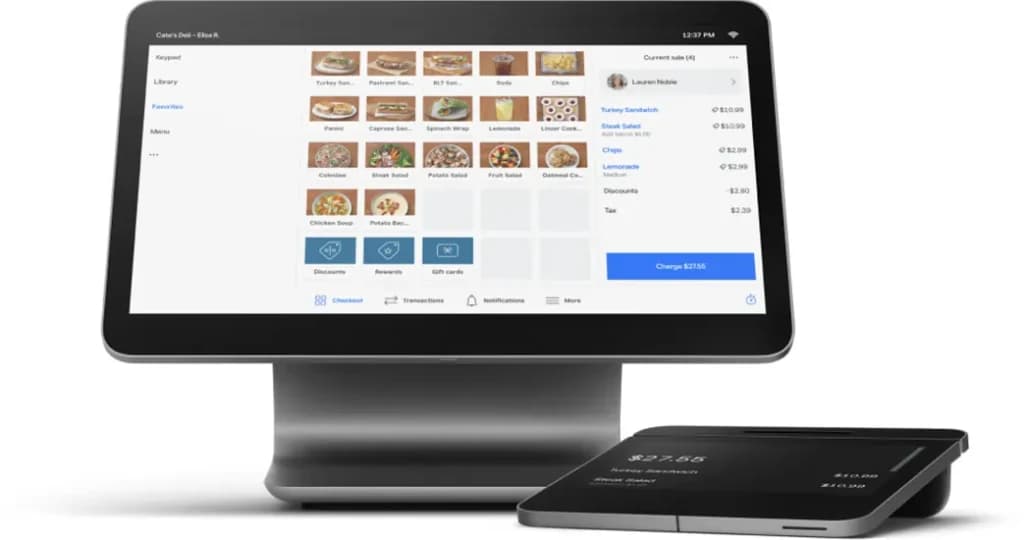
When it comes to hardware, Square POS is famous for its sleek, proprietary aesthetic. They offer the Square Terminal (an all-in-one handheld device), the Square Register (a dual-screen countertop station), and the iconic little white reader. Their hardware is plug-and-play and often visually stunning, designed to sit on a minimal counter.
Shopify POS historically relied heavily on iPad-based setups (using third-party stands). However, they have recently pushed harder into first-party hardware with "Shopify Go," a mobile handheld device similar to the Square Terminal.
- Square: Offers a wider range of proprietary, "ready-out-of-the-box" integrated hardware.
- Shopify: versatile but often requires an iPad for the full "POS Pro" experience, though Shopify Go is closing the mobility gap.
Hardware & device ecosystem
Category | Shopify POS | Square POS |
|---|---|---|
Hardware options | Shopify Go, POS terminal, iPad kits | Square Stand, Register, Terminal, Reader |
Mobile POS | Shopify Go all-in-one handheld | Square Reader / Terminal for contactless + chip |
Offline mode | Supports offline checkout and sync | Works offline for sales; syncs automatically |
Peripheral support | Barcode scanners, label printers, cash drawers | Card readers, cash drawers, printers |
Setup time | Moderate; syncs with Shopify store | Very fast; plug-and-play on mobile or tablet |
Verdict:
Shopify offers professional-grade retail hardware and unified stock control. Square prioritizes affordability and fast setup with flexible mobile devices.
shopify pos vs square: Core feature suite & depth
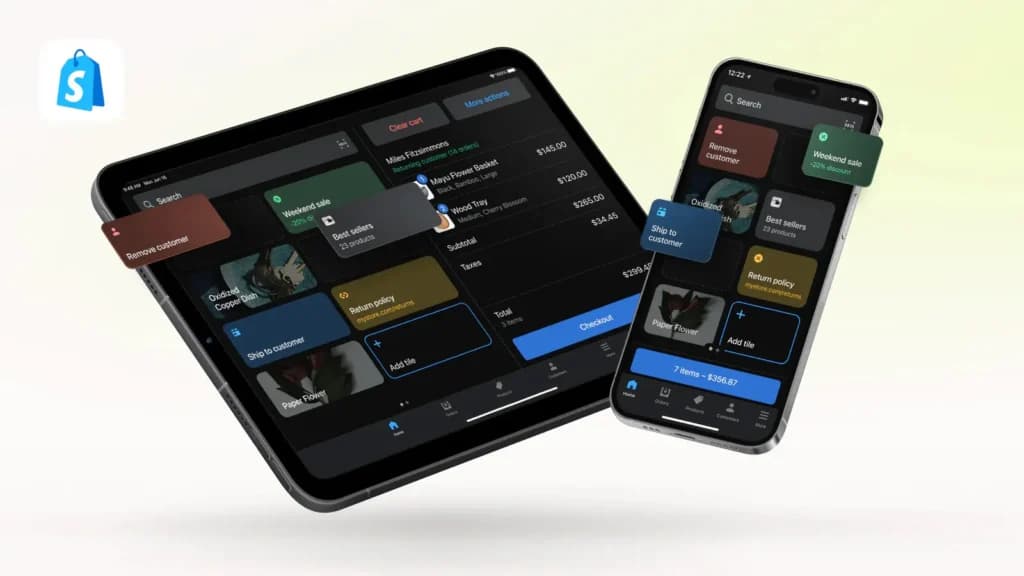
Shopify POS excels in inventory depth. Because it was built for e-commerce first, it handles product variants (sizes, colors, materials) and stock transfers between locations with enterprise-level precision. Features like "ship to customer" (buy in-store, ship from warehouse) are native and intuitive because the system already understands shipping logistics.
Square POS is a master of the checkout flow, ranking highly among the best credit card payment apps for speed and ease of use. Its core features include:
- Offline Mode: Square’s offline mode is legendary for reliability, allowing you to keep swiping cards even when the internet dies (syncing later).
- Service Features: Square has better native tools for tipping, open tickets, and appointment scheduling, making it the superior choice for the service industry.
Shopify POS
- Unified inventory for online and physical stores.
- Smart order routing (ship, pick up, or local delivery).
- Advanced staff permissions and role management.
- Centralized customer profiles and loyalty integrations.
- Automatic tax and discount syncing across channels.
Square POS
- Core sales and checkout tools with product catalog.
- Built-in customer directory and digital receipts.
- Optional add-ons: loyalty, payroll, appointments.
- Quick customization for tipping, taxes, and discounts.
- Instant funds through Square Payments.
Verdict:
Shopify is stronger for retail operations that span online and offline. Square focuses on straightforward in-person transactions with optional upgrades.
Reporting, analytics & insights
Shopify
- Centralized dashboard for online + in-store metrics.
- Product, customer, and location-based sales reporting.
- Advanced analytics available on Shopify POS Pro ($89/mo).
Square
- Core reporting on sales trends, product performance, and customer data.
- Real-time analytics on transactions and refunds.
- Advanced insights available in Square Plus plans.
Verdict:
Shopify provides deeper analytics for omnichannel performance. Square delivers fast, essential visibility for day-to-day operations.
Integration Options: Can You Use Shopify and Square Together?
Yes, you can run a Square Shopify integration, but the platforms do not integrate natively. Because Shopify and Square are direct POS competitors, Shopify does not allow Square as an online checkout gateway, and Square does not natively sync store data to Shopify POS.
To connect the two platforms, business owners use third-party sync applications (such as Digital Product Labs, QuickSync, or SKU IQ) to automatically bridge inventory levels, customer details, and sales orders across systems in real time.
How Do I Connect Square POS with My Shopify Store?
To set up a Shopify and Square integration without manual data entry, follow these four basic steps:
- Standardize Product SKUs: Ensure your product SKUs match identically in both Square and Shopify so the integration app links existing items rather than creating duplicate listings.
- Install a Bridge App: Visit the Shopify App Store and download a dedicated Square connector (e.g., Digital Product Labs Shopify-Square Integration, QuickSync, or SKU IQ).
- Authenticate Accounts: Authorize API permissions for both your active Shopify admin store and your Square account inside the app dashboard.
- Configure Sync Rules: Define which platform serves as your master inventory source and enable automated background syncing for orders, stock counts, and catalog edits.
AI / automation / smart tools
- Shopify POS leverages "Shopify Magic" and robust automation tools like Shopify Flow. For example, you can set up a workflow where a high-value in-store purchase automatically tags the customer as "VIP" in your database and triggers a personalized email thank you note. This bridges the gap between physical retail and digital marketing.
- Square POS uses automation to simplify the daily grind. Its "Square Messages" feature can automatically send receipts and appointment reminders. It also uses data to suggest tip amounts and remember customer preferences (if they opt-in to the network), speeding up checkout for repeat buyers across different Square merchants.
Verdict:
Shopify leads in e-commerce-driven automation; Square offers simpler task automation for small business owners.
Shopify vs Square Fees & Total Costs
This is the most critical comparison point. Square POS wins on low upfront costs, while Shopify POS wins on volume value.
Feature | Shopify POS | Square POS |
|---|---|---|
Monthly Fee | Basic:$29/mo Shopify:$79/mo Advanced:$299/mo | Standard:$0/mo Retail Plus:$60/mo (per location) |
POS Pro Upgrade | +$89/mo per location (for advanced staff/inventory) | Included in Retail Plus plan |
In-Person Transaction Fee | Basic: 2.7% + 0¢ Shopify: 2.6% + 0¢ Advanced: 2.5% + 0¢ | Standard: 2.6% + 10¢ Retail Plus: 2.5% + 10¢ |
Online Transaction Fee | 2.9% + 30¢ (varies by plan) | 2.9% + 30¢ |
Hardware Costs | Shopify Go: ~$299 | Square Terminal: ~$299 Square Reader: ~$49 |
The Value Calculation: Square charges a 10¢ flat fee per transaction on the standard plan. For a coffee shop selling $4 items, that 10¢ is a massive percentage (2.5%). Shopify charges 0¢ per transaction. Therefore, businesses with high transaction volume but low ticket value (cafés) might actually pay more in fees with Square, despite the "free" software. However, for most low-volume merchants, Square's lack of a monthly fee is cheaper.
Summary:
Square is cheaper upfront with no mandatory software cost. Shopify’s pricing rises with features but delivers more robust control and e-commerce value.
Support, reliability & uptime
Shopify support
Shopify POS includes 24/7 live chat and phone support with every subscription plan. Because you are a paying subscriber, the support ecosystem is robust, featuring the "Shopify Academy" and extensive help docs.
- 24/7 live chat and phone support across all plans.
- Extensive help center and POS Academy.
- Proven e-commerce infrastructure with >99.9% uptime.
Square support
Square POS support can be tricky. Live phone support is generally reserved for customers who have an active merchant code and are calling during business hours (unless you are on a paid Plus plan). The "free" model means support is often DIY via their (excellent) community forums.
- 24/7 phone and chat support for paid plans; business hours for free users.
- Easy-to-access community forums and video tutorials.
Verdict:
Shopify offers enterprise-level reliability and global support; Square provides excellent SMB-level service and fast troubleshooting.
Scalability & multi-location management
Shopify POS Scalability is designed to scale indefinitely. A small boutique can grow into a global enterprise using Shopify Plus without changing platforms. The centralized inventory means opening a second, tenth, or fiftieth location is a matter of logistics, not software capability.
Square POS scalability is excellent for scaling within a region or a specific vertical (like opening a second restaurant). However, if you plan to become a complex, multinational omnichannel brand, you may eventually outgrow Square's reporting structures. For larger retail inventories, you might want to compare Lightspeed vs Square POS to see if a dedicated enterprise POS is a better fit.
Verdict:
Shopify scales better for multi-store and multi-channel operations; Square works best for small-scale expansions.
Real-world use cases / examples
Example 1: The Boutique Clothing Brand
Scenario: A fashion designer sells custom apparel online and has just opened a flagship store in Austin, Texas.
- Best Choice: Shopify POS.
- Why: The designer needs inventory to sync perfectly. If the last "Medium Blue Shirt" sells in the store, it must instantly disappear from the website to prevent overselling. Shopify handles this natively. The cost of the subscription is offset by the marketing power of having one unified customer database.
Example 2: The Mobile Coffee Truck
Scenario: A barista starts a coffee truck that moves to different festivals and office parks. They sell high-volume, low-cost items ($5 lattes).
- Best Choice: Square POS.
- Why: The setup is instant. The Square POS offline mode ensures they can keep selling even when cell service at a festival is spotty. The visual menu allows for rapid-fire order entry. While the transaction fees are slightly higher, the lack of a monthly contract gives the business owner flexibility during off-seasons. (If you are looking for more dedicated restaurant hardware, you might also want to compare Clover vs Square).
Final verdict & recommendation table
Factor | Best choice | Why |
|---|---|---|
Online + In-Store Integration | Shopify POS | Unified e-commerce and retail control |
Cost Transparency | Square POS | Flat rates and free plan |
Inventory Management | Shopify POS | Advanced stock and multi-location control |
Ease of Setup | Square POS | Quick activation and free hardware options |
Analytics Depth | Shopify POS | Centralized omnichannel analytics |
Flexibility for Pop-Ups | Square POS | Lightweight, mobile-ready |
Long-Term Scalability | Shopify POS | Enterprise-grade omnichannel growth |
Summary:
Shopify POS powers connected retail across online and physical stores.
Square POS simplifies payment processing for smaller, service-focused businesses.
Choose Shopify for scalability and E-commerce integration; choose Square for simplicity and cost control.