
Is AI really taking over jobs? The definitive strategic guide for 2026-2030

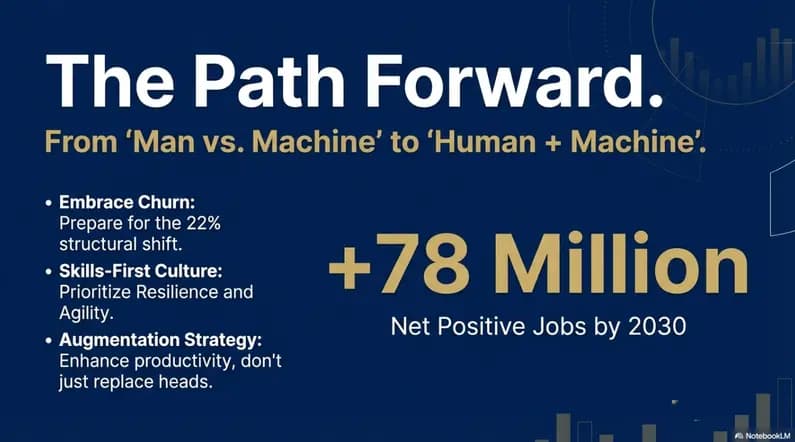
Is AI taking over jobs? The short answer is that while AI is automating specific repetitive tasks, it is not causing a total collapse of human employment; instead, it is driving a massive "structural churn" where 92 million jobs will be displaced by 2030, but 170 million new roles will be created, resulting in a net gain of 78 million jobs. For Small and Medium Businesses (SMBs), the future isn't about human obsolescence—it is about augmentation, where AI acts as a "co-pilot" to make human staff up to 10x more productive.
This transition represents a fundamental rotation of the labor market. While high-volume, routine data-processing roles are declining, the demand for human creativity, emotional intelligence, and strategic oversight is at record levels.
Key takeaways: The 2030 job market snapshot
- Net growth: AI is expected to create 78 million more jobs than it destroys globally by 2030.
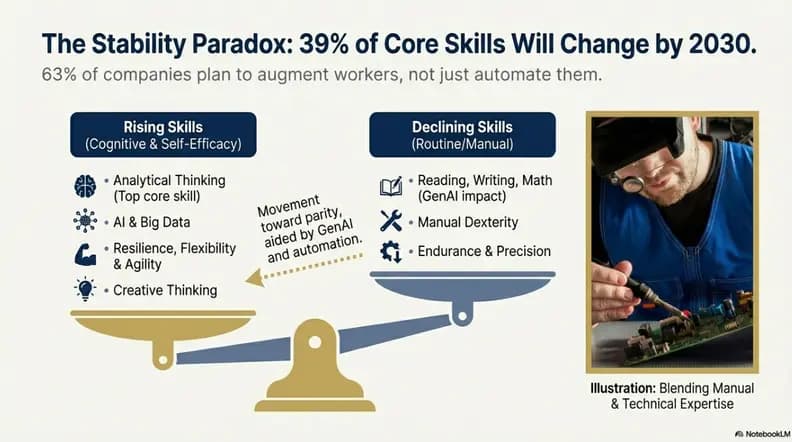
- Skill expiry: 40% of current worker skills will be outdated by 2030, making continuous upskilling a core business function.
- The wage premium: In 2026, roles requiring AI literacy pay 3% to 15% more than those that do not.
- Structural churn: Approximately 22% of all current job roles will either disappear or be reinvented entirely within five years.
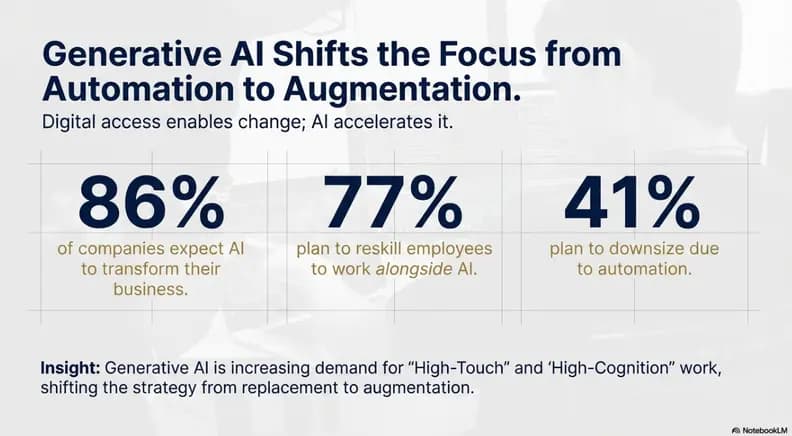
- The human advantage: 63% of companies are prioritizing "augmentation"—using AI to help humans—over total replacement.
Should AI replace human jobs?
The debate over whether we should AI replace human jobs has shifted from an ethical "maybe" to an economic reality. From a productivity standpoint, AI is being deployed primarily to handle "drudgery"—tasks that are dangerous, boring, or highly repetitive. For an SMB, automating these tasks isn't just about cutting costs; it's about survival.
In a tight 2026 labor market where global hiring has slowed by 20%, businesses are using AI to fill the gaps where human talent is scarce. However, experts argue that total replacement leads to a loss of institutional memory and creative spark. The most successful firms are those using HR software to manage a hybrid workforce where AI handles the data and humans handle the final judgment.
How many jobs will AI replace by 2030?
When analyzing how many jobs will AI replace by 2030, the data points to 92 million displaced roles globally. This AI job displacement is heavily concentrated in industries that rely on rule-based processing. For example, 80% of paralegal roles and 65% of retail checkout positions are expected to be automated within this window.
However, "replacement" rarely means the disappearance of a human from the building. It often means a reduction in headcount for a specific department. A legal firm that once needed 10 paralegals to scan documents might now need only one "Legal AI Supervisor" to manage the same volume of work using automated tools.
Will AI create more jobs than it destroys?
Yes. Despite the headlines about layoffs, will ai create more jobs than it destroys? According to the data, 170 million new roles are expected to emerge. Since 2024, LinkedIn has already seen the addition of 1.3 million new AI-centric roles, such as AI Engineers and Data Annotators.
The impact of AI on jobs is actually a net positive for the economy, contributing an estimated 1.2% to annual GDP growth. AI is creating an entirely new class of jobs that did not exist five years ago, such as "Prompt Engineers" and "Forward-Deployed AI Technicians".
Jobs that AI will replace vs. jobs AI will create
The shift is often a one-for-many exchange. A customer service center that once employed 500 people may transform into 50 "AI Oversight Specialists." Here is an in-depth look at 10 roles in each category.
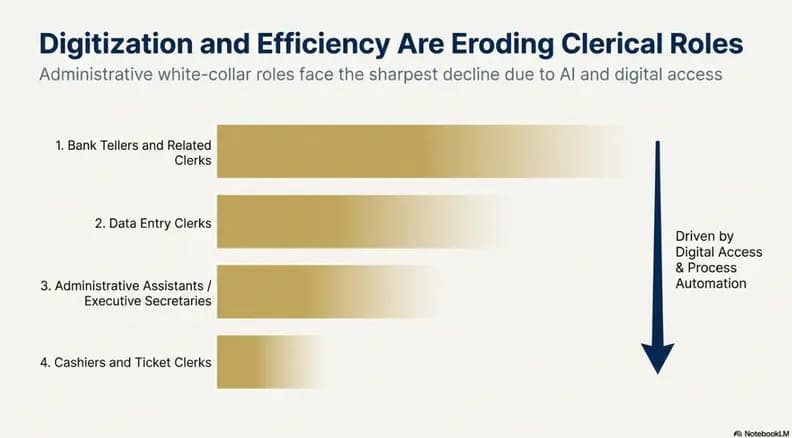
10 jobs AI will replace (high risk)
These roles rely on predictable, rule-based processing, where machines now offer higher accuracy and lower costs.
- Bank tellers: Automated by mobile banking and AI-driven ATMs that handle 99% of standard transactions.
- Data entry clerks: Modern AI can transcribe, categorize, and input data from any format with near-zero error.
- Telemarketers: Generative voice AI can now conduct high-quality sales calls, following scripts and handling rebuttals without fatigue.
- Tax preparers: Advanced accounting software uses 2026 financial algorithms to automate complex tax compliance for most individuals.
- Administrative assistants: AI agents now handle 90% of scheduling, email sorting, and meeting transcription.
- Retail cashiers: Computer vision and self-checkout technologies are rendering manual checkout obsolete in 65% of retail environments.
- Proofreaders: Generative AI is now superior to humans at spotting grammatical errors and stylistic inconsistencies across massive datasets.
- Insurance underwriters: AI analyzes thousands of risk variables in seconds to approve or deny policies, leaving only the most complex cases for humans.
- Payroll clerks: Most payroll functions are now a "click of a button" inside modern payroll software, reducing the need for manual oversight.
- Legal support staff (paralegals): 80% of standard legal research and document discovery is now automated by specialized AI models.
10 jobs AI will create (emerging opportunities)
These roles focus on designing, overseeing, and ethically managing the AI ecosystems that handle the "doing" of work.
- Agent operations specialists: These professionals manage "fleets" of autonomous AI agents, ensuring they complete complex workflows without error.
- Sustainability specialists: Driven by the "Green Transition," these workers use AI to optimize energy usage and climate mitigation strategies.
- Vocational teachers: Necessary to retrain the 67% of the workforce currently lacking modern technical skills.
- AI Ethics and Compliance Officers: Ensuring that AI decisions follow legal frameworks and do not exhibit bias or discrimination.
- AI solutions architects: Professionals who design end-to-end AI systems to solve specific business problems for SMBs.
- Prompt engineers / LLM specialists: Experts who fine-tune how large language models behave and interact with customers.
- AI content strategists: Using generative tools to produce high-volume, high-quality marketing materials that still feel human.
- Digital transformation specialists: Helping legacy businesses move their operations into AI-integrated environments.
- AI cybersecurity analysts: Using AI to defend against increasingly sophisticated, machine-powered cyberattacks.
- Human-AI collaboration managers: Leaders specialized in redesigning workflows so humans and machines work together efficiently.
What jobs will AI not replace?
When asking what jobs will ai not replace, the answer lies in three human superpowers: empathy, complex judgment, and physical dexterity in unpredictable environment s.
Healthcare and mental health
AI can analyze a scan or summarize a report, but it cannot sit with a patient in pain or build trust over months of therapy sessions. Roles like Nurse Practitioners and Mental Health Counselors are projected to grow by up to 45% because they require a "human touch" that data cannot replicate.
Skilled trades
How will automation affect jobs in the future for those who work with their hands? For electricians, plumbers, and HVAC technicians, the risk is minimal. AI struggles in unstructured environments. Every house is wired differently, and every plumbing leak is unique. These roles require real-time problem-solving that is not yet possible for robotics. Using project management software can help these tradespeople organize their teams, but the actual work remains human-led.
AI strengths (automation) | Human superpowers (safety)https://www.google.com/search?q=https://sonary.com/project-management-software/ |
|---|---|
High-volume data processing | Moral and ethical judgment |
Rule-based calculations | Empathy and emotional intelligence |
Pattern recognition | Complex physical dexterity |
24/7 repetitive execution | Negotiation in ambiguous situations |
How will automation affect jobs in the future?
The impact of AI on jobs will lead to a world where tasks are split roughly 50/50 between humans and machines by 2030. This doesn't mean you will be unemployed; it means your job description will move from "execution" to "curation."
For example, a sales team using CRM software won't spend time entering lead data. Instead, AI will generate the leads, draft the initial emails, and schedule the calls. The salesperson’s job will be to handle the actual conversation, build the relationship, and close the deal.
Conclusion
Is AI taking over jobs?
No. AI is taking over tasks. The businesses that thrive in 2026 will be those that embrace "structural churn" and view their employees not as costs to be cut, but as pilots to be equipped with the most powerful tools ever created. By focusing on augmentation, upskilling, and a "skills-first" culture, SMBs can turn the threat of AI taking over jobs into a once-in-a-generation growth opportunity.
Related Articles


FAQ: People also asked
Q: Will AI replace my job if I am a creative professional?
A: AI can generate drafts and remix styles, but it lacks "intent." Creative roles like Creative Directors and Choreographers are safe because they provide vision and meaning, which AI cannot produce.
Q: Is it true that AI will create more jobs than it destroys?
A: Yes. Projections indicate a net gain of 78 million jobs by 2030. While 92 million roles will be displaced, 170 million new roles in tech, green energy, and care will emerge.
Q: What are the safest jobs from AI in 2026?
A: The safest jobs are in healthcare (nursing, therapy), skilled trades (electricians, plumbers), and high-level leadership. These require empathy, physical agility, and moral judgment.
Q: How many jobs will AI replace in the US by 2030?
A: Research from Forrester suggests that approximately 6.1% of US jobs (about 10.4 million) will be permanently lost to AI and automation by 2030.
Q: Should I be worried about AI taking over my job?
A: Instead of worry, focus on "technological literacy." 77% of companies plan to reskill employees to work with AI. Learning how to prompt and manage AI tools is your best job security.