
Credit Card Processing Fees for Small Business in 2026: What You Actually Pay

How much are credit card processing fees? Average credit card processing fees for small businesses run between 1.5% and 3.5% of every card sale - so a $100 sale leaves you with $96.50 to $98.50, and every $1,000 in card sales costs you $15 to $35. Across all Visa and Mastercard transactions in 2024, US merchants paid a weighted average of 2.35%, according to the Nilson Report figures cited in the 2026 settlement ruling.
Credit card fees for merchants are not random, and where you land inside that range is not luck. It depends on the card your customer hands you, how you take the payment (tap, chip, swipe or typed in), your type of business, your monthly volume, and the pricing model your processor put you on. The pricing model is the one part you control, and it is the part most owners pick by accident. This guide explains what each fee is, when you pay more or less, and which plan - flat-rate, a monthly fee with lower rates, interchange plus or zero cost - is cheaper for your kind of business.
Key takeaways: credit card processing fees 2026
- Typical small business credit card processing fees: 1.5%-3.5% per transaction. Online and keyed payments sit at the top of that range, tapped and dipped cards at the bottom.
- Every fee has three parts: interchange (to the card-issuing bank), assessment (to Visa, Mastercard and the other networks) and markup (to your processor). Only the markup is negotiable.
- Flat-rate pricing (Square, Stripe, PayPal) is simple but costs more as volume grows. Interchange-plus (Helcim, Stax, Kurv on request) is cheaper past roughly $10,000 a month but needs you to read statements.
- You can pass fees to customers in most states, but not by surcharging debit cards, not above 3% on Visa, and not at all in Connecticut, Massachusetts or Maine.
- The number that matters is your effective rate: total fees divided by total card volume on last month's statement. In our experience, anything above 3% on mostly in-person sales is a sign you are overpaying.
What are credit card processing fees?
What is a credit card processing fee? It is what a business pays every time it accepts a card payment. It is usually a percentage of the sale plus a few cents per transaction - for example 2.6% + 15¢ - and it is taken out before the money reaches your bank account. You will also see them called payment processing fees, merchant fees, merchant service fees, merchant processing fees, credit card merchant fees or credit card service fees. It is all the same money.
So you do not get an invoice for them. You get a smaller deposit. That is exactly why many owners never add them up.
What are merchant fees?
Merchant fees is the wider term: everything a business pays to accept cards, not just the per-sale percentage. That includes the processing fee plus any monthly, hardware, gateway, chargeback and PCI fees on your account. Most people, and most processors, use merchant fees and credit card processing fees as the same thing.
Who pays credit card transaction fees?
The merchant pays credit card transaction fees - not the customer and not the card company. The customer pays the price on the tag, and the fee comes out of your side of the sale. That is why credit card fees for businesses show up as a smaller deposit, not as a line on the customer's receipt. The only way the customer ends up paying is if you choose to pass the cost on with a surcharge, a cash discount or dual pricing, and each of those has rules (see passing on credit card fees to customers, below).
How do credit card processing fees work? The 3 parts of every fee
Every card fee splits three ways, and only one of the three is up for negotiation:
- Interchange fee: goes to the bank that gave your customer the card. It is the biggest slice, and credit card interchange fees typically run from about 1% to over 3%. Nobody can negotiate it.
- Assessment fee: goes to the card brand itself - Visa, Mastercard, Discover or American Express. Small, usually around 0.14%, and also fixed.
- Processor markup: what your payment company (Square, Stripe, Kurv and so on) keeps for moving the money. This is the only part that changes between providers, and the only part you can push down.
Here is how that looks on a real sale. The split is an example - the bank's share moves with every card:
Where the fee goes on a $100 in-person sale at 2.6% + 15¢ | Amount |
|---|---|
Card-issuing bank (interchange, about 1.8% in this example) | ~$1.80 |
Card brand (assessment, about 0.14%) | ~$0.14 |
Your processor (markup - everything left) | ~$0.81 |
Total fee | $2.75 |
What are interchange fees?
Interchange fees are the part of every card fee that goes to the bank that issued your customer's card. Visa and Mastercard publish the rate lists, and the bank collects the money. The rate changes with three things: the type of card, your type of business, and how the card was taken.
How do interchange fees work?
When a customer pays, your processor sends the payment to the card brand, and the card brand sends it to the customer's bank. On the way back, each one takes its cut: the bank keeps interchange, the card brand keeps its assessment fee, and your processor keeps its markup. You get the rest, usually the next business day.
Who pays interchange fees?
The merchant does. Interchange is deducted from your side of every card sale, never charged to the cardholder. The only way a customer covers it is if you run a surcharge, cash discount or dual pricing program.
Why do interchange fees vary by card type?
Because the issuing bank is paying for the card's perks. A premium travel rewards card or a corporate card (business credit card fees are among the highest) carries a higher interchange rate than a basic debit card, since the bank funds the points and cash back from that fee. Debit cards issued by large banks are capped by federal rule, which is why debit card processing fees are almost always the lowest you will pay.
How you take the payment moves the rate too. A tapped or chip card is the safest for the bank, so it gets the lowest rate. A card number typed in or entered at an online checkout is riskier, because nobody checked the physical card, so it costs more. The industry calls this "card-not-present".
Do debit cards charge merchant fees?
Yes, but debit card processing fees are lower. Debit interchange is lower than credit, and debit cards from large banks are capped by federal rule. On interchange plus pricing you get that saving directly. On flat-rate pricing you pay the same rate for debit and credit, so the processor keeps the difference.
What are merchant account fees? The ones beyond the percentage
The percentage is the fee everyone compares. These are the ones that show up later on the statement:
- Per-transaction fee: the fixed cents on top of the percentage (15¢, 30¢). On a $5 coffee, 15¢ is an extra 3% by itself - this is what quietly hurts low-ticket businesses.
- Monthly or subscription fees: $0 at Square Free, Stripe, Helcim and Kurv, $99 and up at Stax.
- Hardware: PayPal's card reader starts at $29, and Kurv's terminals cost $199-$399 to buy or $24.95-$49.95 a month to rent.
- Payment gateway fees: a gateway is the software that connects your website checkout to your processor. If you use a separate one, such as Authorize.net, it can bill its own monthly and per-transaction fee.
- Chargeback fees: $15 to $25 each time a customer disputes a charge with their bank - and at many processors you pay it even if you win the dispute. Stripe charges $15, Kurv $25, and Helcim $15 only if you lose.
- PCI compliance and statement fees: PCI is the security standard for handling card data. Traditional merchant accounts often charge a yearly or monthly fee for it, most modern processors charge $0. Always ask.
- Early termination fees: the one that turns a bad contract into an expensive exit. Read the contract length and the auto-renewal clause before you sign, not after.
How much are credit card fees for merchants?
How much does it cost to accept credit cards? Usually 1.5%-3.5% of each sale, but how much credit card processors charge merchants depends on the pricing model more than the brand. You will be offered one of five, and you only need to seriously look at two: flat-rate and interchange plus.
Flat-rate vs interchange plus vs the rest: the 5 rate types compared
Read the table left to right: what you pay, a real example, who it fits, and the one thing to watch.
Rate type | What you pay | Example | Best for | Watch out for |
|---|---|---|---|---|
Flat-rate | One fixed rate on every card | Square: 2.6% + 15¢ in person | Low volume, new businesses, owners who want zero math | You pay the same on cheap debit cards as on expensive rewards cards |
Interchange plus | The real bank cost of each card, plus a small fixed markup | Helcim: interchange + 0.40% + 8¢ | Above roughly $10,000 a month, lots of debit cards | Your cost changes with every card, so you have to read statements |
Subscription | A monthly fee, then the bank cost with almost no markup | Stax: $99/month + interchange + 8¢ | High volume or large tickets, such as invoices over $500 | Below about $10,000 a month the fee eats the savings |
Tiered | Different rates for "qualified", "mid-qualified" and "non-qualified" cards | Common with traditional bank merchant accounts | Nobody - skip it | The processor decides which bucket each card lands in, so you cannot check it |
Zero cost (cash discount or dual pricing) | You pay 0%, the customer paying by card pays the fee | Kurv: 3.95% paid by the card customer | Thin-margin businesses whose customers accept a card price | Some customers will notice and some states restrict it |
Flat-rate pricing
You pay one fixed percentage plus a fixed cents amount, whatever card the customer uses. Square, Stripe, PayPal and Shopify Payments work this way, and Kurv offers it too.
It is simple and predictable, and there is no contract to negotiate. The catch: the processor sets the flat rate high enough to stay profitable on your most expensive cards, so on cheap debit transactions you overpay. That gap grows with your volume, and with your ticket size - on a $2,000 sale, a flat 2.9% is $58.
Best for: new businesses, low monthly volume, or owners who will never open a statement.
Interchange plus pricing
You pay the real interchange cost of each card, passed through at cost, plus a fixed markup from the processor, for example interchange + 0.40% + 8¢ at Helcim. You see exactly what went to the bank and what went to the processor.
It is almost always cheaper once volume grows, but your cost per transaction moves with every card, so you need to read your statements.
Best for: businesses processing more than about $10,000 a month, and anyone with a lot of debit card traffic.
Subscription (membership) pricing
A monthly fee in exchange for interchange at cost plus a small per-transaction fee and no percentage markup. Stax is the known example, with plans starting at $99 a month. It pays off only when your volume is high enough that the saved markup beats the subscription.
Tiered pricing - skip it
Some traditional merchant accounts sort your transactions into "qualified", "mid-qualified" and "non-qualified" buckets, each with its own rate. The processor decides which card lands in which bucket, so you cannot audit it. If a sales rep quotes you a low "qualified rate" without mentioning the other two, that is the reason. Ask for interchange-plus instead.
Credit card processing rates and fees in 2026, by processor
This payment processing fees comparison uses the published standard US credit card processing rates, checked in September 2026. Read In-person as tap, dip or swipe, and Online as an e-commerce checkout. Online credit card processing fees are higher than in-person ones because the card is never physically checked, and keyed-in cards usually cost more than both.
Processor | Pricing model | In-person rate | Online rate | Monthly fee |
|---|---|---|---|---|
Square (Free plan) | Flat-rate | 2.6% + 15¢ | 3.3% + 30¢ | $0 |
Flat-rate | 2.7% + 5¢ | 2.9% + 30¢ | $0 | |
Flat-rate | 2.29% + 9¢ | 2.99% + 49¢ | $0 | |
Flat-rate | 2.6% + 10¢ | 2.9% + 30¢ | Shopify plan fee | |
Flat-rate, zero-cost or interchange-plus | 2.5% + 10¢ | 2.9% + 25¢ | $0 | |
Interchange-plus | Interchange + 0.40% + 8¢ | Interchange + 0.50% + 25¢ | $0 | |
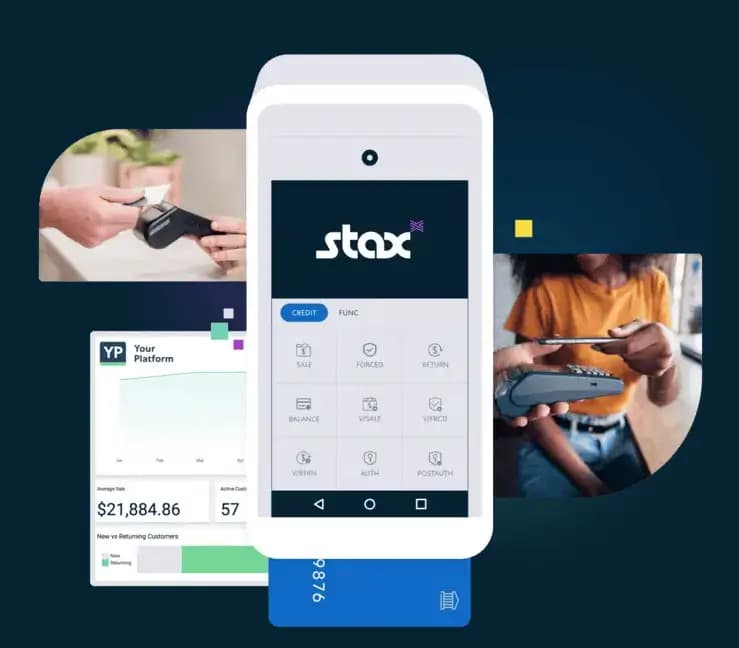
Subscription + interchange | $99/month + interchange + 8¢ | $99/month + interchange + 8¢ | From $99 |
If you are shopping for the best credit card processing rates at higher volume, note that Helcim's markup drops as you process more (down to 0.15% at $1M+ a month). Square's Plus and Premium plans lower the in-person and online percentage in exchange for a monthly subscription. Rates for high-risk businesses (CBD, travel, subscriptions with heavy chargebacks) run higher than anything in this table.
See Also:
- High-risk merchant account
- Best payment gateway providers
- Best merchant service providers
- Best credit card payment apps
Who has the lowest credit card processing fees?
Which credit card processor has the lowest fees depends on your volume and ticket size. Among flat-rate options, PayPal (2.29% + 9¢) and Kurv (2.5% + 10¢) have the lowest published in-person rates in the table. Above roughly $10,000 a month, interchange-plus from Helcim or a Stax subscription usually costs less than any flat rate - the scenarios below show where the line falls.
What does Kurv charge? One price sheet, three pricing models
Kurv charges 2.5% + 10¢ for in-person card payments and 2.9% + 25¢ for keyed and online payments on its flat-rate plan, with no monthly, setup, PCI or statement fees. It is a useful example for this guide because the same account can run on flat-rate, interchange-plus or zero-cost pricing, so you can see the trade-offs of each model on one price sheet instead of three.

- Secure, simple application—approved fast
- Clear, competitive pricing with no surprises
- Join the 30,000+ businesses leveraging Kurv
Here is what Kurv publishes:
Kurv fee | Amount |
|---|---|
In-person (swiped, dipped, tapped) | 2.50% + $0.10 |
Keyed and online | 2.90% + $0.25 |
Zero-cost processing | 0% for you, 3.95% paid by the card-paying customer |
Interchange-plus | Quoted on request, not published |
Monthly, annual, setup, PCI, statement fees | $0 |
Chargeback, or fighting one (representment) | $25 each |
Monthly minimum | $0-$25, waived above $25 of activity |
Handheld smart terminal | $199 or $24.95/month (one free per location) |
All-in-one terminal | $399 or $49.95/month |
Funding | Next business day |
Contract | 24 months, auto-renewing, $0 early termination fee |
What this means in practice:
- Against Square's Free plan, Kurv's flat rate is 0.1% and 5¢ lower in person. On $10,000 a month across 200 sales that is $270 in fees instead of $290 - about $240 a year.
- The zero-cost option is where the real difference sits. At 3.95%, it is above Visa's 3% surcharge cap, so in practice it has to run as a cash-discount-style program where the card price is the posted price, not as a surcharge added at the register. Ask Kurv exactly how it will be set up in your state before you switch it on - Connecticut, Massachusetts and Maine rules matter here.
- The 24-month auto-renewing contract is the part to read twice. There is no early termination fee, but unreturned rental equipment is billed at $395, so return the terminal if you leave.
Kurv fits in-person businesses that want flat-rate simplicity today with an easy switch to zero-cost or interchange-plus later - retail, restaurants, field services and gas stations are its main verticals. If you sell mostly online through a Shopify or WooCommerce store, compare it against the checkout your platform already includes before adding another account.
How to calculate credit card processing fees
Multiply the sale by the percentage, then add the fixed fee. That is the whole formula - or skip the math and plug your own numbers into our credit card processing fee calculator:

On a $100 in-person sale at Square's 2.6% + 15¢, that is $2.60 + $0.15 = $2.75, and you keep $97.25. The same sale online at 3.3% + 30¢ costs $3.60.
Here is the same formula on four everyday sales, using Square's, Stripe's and Kurv's published rates:
Sale | Rate used | Fee at Square | Fee at Stripe | Fee at Kurv |
|---|---|---|---|---|
Retail store, $100 tapped card | In-person | $2.75 | $2.75 | $2.60 |
Restaurant, $50 chip card | In-person | $1.45 | $1.40 | $1.35 |
Online store, $100 checkout | Online | $3.60 | $3.20 | $3.15 |
Subscription, $20 card on file | Keyed / online | $0.85 | $0.88 | $0.83 |
The subscription row is the one to notice: on a $20 charge, the fixed cents make up 18%-34% of the fee, depending on the processor. Small tickets feel the fixed cents most.
For a whole month, the more useful number is your effective rate:

Pull both numbers from last month's statement. It is the only figure that lets you compare a flat-rate quote with an interchange-plus quote honestly, because it includes every fixed fee, subscription and chargeback, not just the headline percentage.
When do you pay more in credit card fees, and when do you pay less?
Two businesses on the exact same processor can pay very different effective rates. Five things decide it, and once you know which ones apply to you, picking a plan gets much easier:
What drives your fees | You pay more when | You pay less when |
|---|---|---|
Ticket size (your average sale) | Sales are small - the fixed cents become a big share of each sale | Sales are large - the fixed cents almost disappear |
How you take the card | Cards are typed in, taken over the phone or paid online | Cards are tapped or dipped in person |
Your customers' cards | They use premium rewards or corporate cards | They use debit cards |
Monthly volume | Volume is low, so a monthly fee is spread over few sales | Volume is high, so a monthly fee becomes a tiny share |
Chargebacks and extras | You get disputes, rent hardware or pay PCI and statement fees | You buy hardware once and keep disputes rare |
The first one surprises most owners. On a $6 coffee, Square's 15¢ fixed fee is 2.5% of the sale on its own, so the real cost is about 5.1%. On a $600 invoice, the same 15¢ is about 0.03%. Same processor, same rate card, very different bill.
Which credit card processing plan should you choose?
There are really only three trade-offs hiding behind all the pricing pages. Answer them in order and you have your plan.
Trade-off 1: A lower percentage or a lower fixed fee?
Some processors charge a lower percentage with a higher fixed fee, others the opposite. Which one is cheaper depends only on your average ticket. Find the crossover point with this:

Stripe in person is 2.7% + 5¢, Square is 2.6% + 15¢. The crossover is $0.10 ÷ 0.1% = $100. Below a $100 average sale, Stripe is cheaper. Above it, Square is.
Here is what one sale costs at each in-person rate:
Average sale | Square 2.6% + 15¢ | Stripe 2.7% + 5¢ | Kurv 2.5% + 10¢ | PayPal 2.29% + 9¢ |
|---|---|---|---|---|
$6 (coffee shop) | $0.31 | $0.21 | $0.25 | $0.23 |
$25 (lunch, salon add-on) | $0.80 | $0.73 | $0.72 | $0.66 |
$100 (retail basket) | $2.75 | $2.75 | $2.60 | $2.38 |
$1,000 (furniture, repairs) | $26.15 | $27.05 | $25.10 | $22.99 |
The rule to remember: small tickets, chase the lowest fixed cents. Large tickets, chase the lowest percentage.

Trade-off 2: A monthly fee with lower rates, or $0 monthly with higher rates?
A monthly fee only makes sense when the money it saves on every sale is bigger than the fee itself. The break-even point:

Example: Stax charges $99 a month plus interchange + 8¢, against Square's $0 a month and 2.6% + 15¢. If your cards average about 1.8% interchange, you save roughly 0.8% plus 7¢ on every sale. At a $50 average sale that pays back the $99 at about $10,500 a month. At a $500 average sale, about $12,000.
So: below roughly $10,000 a month, take the $0 monthly plan even if the rate is higher. Above it, a monthly fee usually pays for itself. If your sales are seasonal, judge by your slow months, not your best ones - the fee does not take a break.
Trade-off 3: Flat-rate or interchange plus?
Interchange plus with no monthly fee (Helcim, or Kurv on request) is cheaper than flat-rate for most small businesses, because you pay the real bank cost instead of an average padded to cover the most expensive cards.
There is one exception, and it is worth checking. Against Square's 2.6% + 15¢, Helcim's interchange + 0.40% + 8¢ only wins while your average interchange stays below about 2.3%. If most of your customers pay with premium rewards or corporate cards - business-to-business sales, high-end restaurants, travel - your interchange can run above that, and a flat rate protects you from it. If you are not sure, ask a processor to price your last three statements both ways.
Is zero cost processing the right choice?
It is the right move when your margins are thin and your customers are used to seeing a card price - gas stations, auto repair, convenience stores, field services. It is the wrong move when your customers are price-sensitive about the total, or when you sell mostly online and a higher card price costs you the checkout. You also need a state that allows it (see passing fees to customers below).
Quick decision table
Your situation | Choose | Examples |
|---|---|---|
Under $10,000 a month, mixed sales | Flat-rate, $0 monthly | Square, Kurv, PayPal |
Mostly small sales under $25 | Lowest fixed fee per sale | Stripe (5¢), PayPal (9¢) |
Mostly large sales over $100 | Lowest percentage | PayPal in person, Kurv, or interchange plus |
Over $10,000 a month, lots of debit cards | Interchange plus, no monthly fee | Helcim, Kurv on request |
Over $10,000 a month, large invoices | Subscription pricing | Stax |
Many premium rewards or corporate cards | Flat-rate, or compare both on your real statements | Square, Stripe, Kurv |
Mostly online sales | Compare online rates, not in-person ones | Stripe, Shopify Payments, Kurv |
Thin margins, state allows it | Zero cost (cash discount or dual pricing) | Processors with a cash discount program, such as Kurv |
Seasonal sales | $0 monthly fee and $0 minimums | Square, Stripe, Helcim |
Not sure where you fall? Start on a $0 monthly flat-rate plan, pull your effective rate every quarter, and move once your numbers cross one of the break-even points above. Whatever you pick, do not assume you have the best deal; shop your statement around once a year.
Flat rate vs interchange plus: what three typical businesses would pay
The table runs merchant credit card processing fees for three typical small businesses through published rates. Interchange-plus and subscription rows assume an average interchange of 1.8% for in-person and 2.0% for online - that is an illustration, your real mix will differ, so treat those two rows as estimates.
Business | Monthly volume | Square | Kurv flat-rate | Helcim | Stax |
|---|---|---|---|---|---|
Boutique, 200 in-person sales | $10,000 | $290 | $270 | ~$236 | ~$295 |
Café, 1,000 in-person sales | $20,000 | $670 | $600 | ~$520 | ~$539 |
Consultant, 50 online invoices | $50,000 | $1,665 | $1,463 | ~$1,263 | ~$1,103 |
Three things stand out:
- Below about $10,000 a month, a subscription is the most expensive option - the $99 fee eats the savings. Flat-rate and interchange-plus sit within about $55 of each other, so pick on hardware, payouts and support.
- Small tickets punish fixed fees. The café pays 15¢ a sale at Square and 8¢ at Helcim, and at 1,000 sales that alone is a $70 difference.
- Large, infrequent payments are where subscriptions win. The consultant saves roughly $560 a month on Stax versus Square because almost nothing is lost to percentage markup.
Passing on credit card fees to customers: is it legal?
Is it legal to charge credit card fees? Yes, in most US states - but how you do it decides whether it is legal. Businesses can charge credit card fees in four ways, and people often use the terms interchangeably even though the rules differ. Here is how each one lets you pass credit card processing fees to customers:
Method | How it works | Main rules |
|---|---|---|
Surcharge | A percentage added at checkout when the customer pays by credit card | Credit cards only, never debit or prepaid. Capped at 3% on Visa and 4% on Mastercard, and never above your real cost of acceptance. Banned in Connecticut, Massachusetts, and Maine; capped at 2% in Colorado |
Cash discount | Your posted price is the card price, and cash payers get a discount | Allowed in all 50 states. The discount must be clearly shown before the sale |
Dual pricing | You show two prices side by side - cash and card - on the shelf, menu or invoice | A form of cash discount, same rules. Both prices must be visible up front |
Convenience fee | A flat fee for paying through an optional channel, for example online instead of in person | Must be a flat amount, not a percentage, and cannot apply to your normal way of taking payment |
Visa surcharge rules also require 30 days' written notice to your processor before you start, a sign at the entrance and the register, and the surcharge as its own line on the receipt. Skip any of those and the card network can fine you, even in a state where surcharging is legal.
Check credit card surcharge laws by state before you start. Rules change often (New York and California both added price-display rules in the last few years), and your processor should tell you what it supports where you operate. Surcharges and cash discounts do not remove your processing cost - they move it to the customer, and some of them will notice. That is a pricing decision, not a fee decision.
What is a credit card surcharge?
A credit card surcharge is an extra percentage added at checkout when the customer pays by credit card, to cover your processing cost. It is capped at 3% on Visa and 4% on Mastercard, and never above your real cost of acceptance. So can businesses charge credit card fees this way on every card? No - debit and prepaid cards cannot be surcharged.
Surcharge vs convenience fee: what is the difference?
A surcharge is a percentage added because the customer chose to pay by credit card. A convenience fee is a flat amount added because the customer chose an optional channel, such as paying online instead of in person. Visa and Mastercard both allow convenience fees, but only as a flat amount, disclosed before payment, and never on your standard way of taking payment.
What is zero cost credit card processing?
Zero-cost credit card processing means you pay 0%, and the customer who pays by card covers the fee, usually through a cash discount or a dual-pricing setup. Kurv's zero-cost option, for example, charges the card-paying customer 3.95%. Because that is above Visa's 3% surcharge cap, confirm with your processor how the program is set up and disclosed in your state before you switch it on.
How to reduce credit card processing fees
There is no way to avoid them completely while you accept cards. The realistic answer to how to avoid credit card fees is to shrink them, and here is how to lower credit card processing fees without changing your whole setup. You cannot negotiate interchange or assessment fees, so every one of these ways to cut merchant credit card fees works on the markup, the fixed fees, or the mix of cards you accept:
- Calculate your effective rate first. Without it you are negotiating blind. Total fees divided by total volume, from last month's statement.
- Ask for interchange-plus once you pass roughly $10,000 a month. Most processors that offer it (Helcim, Kurv, Stax) will quote it. The markup is the number to compare, not the total.
- Negotiate the markup and the fixed fees. Processors would rather lower your rate than lose you, and they expect the conversation, especially if you bring a competing quote with your effective rate on it. Monthly fees, PCI fees and statement fees are the easiest to get removed.
- Take cards in person whenever you can. A tapped card costs less than a keyed one — at Square, 2.6% + 15¢ versus 3.5% + 15¢. Send customers a payment link instead of typing their number.
- Push debit, ACH, and other payment methods for large invoices. ACH is a direct bank transfer, and ACH processing fees are a fraction of a card payment - Stripe charges 0.8% capped at $5 for ACH, against $29.30 for a $1,000 card payment. Peer-to-peer apps with business accounts, such as Venmo for Business, are another option for smaller sales.
- Stop chargebacks before they start. A clear refund policy, a business name customers recognize on their card statement, staff trained to check cards on large sales, and fraud tools such as address verification online all cut disputes, and every dispute avoided saves the $15-$25 fee plus the sale.
- Offset credit card processing fees with a cash discount program or dual pricing if your margins are thin and your state allows it.
What changes in 2026? The Visa and Mastercard settlement
On June 9, 2026, a federal judge in New York gave early (preliminary) approval to a settlement between Visa, Mastercard and roughly 12 million merchants. If it gets final approval, it will:
- Cut interchange by 10 basis points (0.10%) across rates for five years.
- Cap standard consumer credit card interchange at 1.25% for eight years.
- Let merchants decline some higher-cost premium and commercial credit cards, which today's "honor all cards" rule does not allow.
- Give merchants new rights to surcharge or discount by card type.
None of this is final yet - the court gives final approval only after the merchants in the case have had time to respond. And a lower interchange only reaches you automatically on interchange-plus or subscription pricing. On a flat rate, the processor keeps the difference unless it chooses to lower your rate, which is one more reason to know your pricing model.
Are credit card fees tax deductible?
Yes. If you are asking whether credit card processing fees are tax-deductible for every business, the answer is the same for all of them: they are an ordinary business expense, just like rent or software. Your processor's year-end statement and the 1099-K it sends you (the tax form that reports your card sales) list your sales and fees. Make sure your books record the full sale and the fee separately, not only the smaller deposit. Confirm the details with your accountant.
Are credit card fees taxable?
The processing fees you pay are not taxed - they are a deductible expense. A surcharge you collect from customers is a different story: many states treat it as part of the sale price and subject to sales tax, so check your state's rules before you add one.
Frequently asked questions about credit card processing fees
What are typical credit card processing fees?
A normal credit card processing fee is between 1.5% and 3.5% of the sale. In-person payments on flat-rate processors usually cost 2.3%-2.7% plus a few cents, and online payments 2.9%-3.3% plus about 30¢. The average credit card transaction fee US merchants paid on Visa and Mastercard in 2024 was 2.35%.
What are credit card fees?
For a business, credit card fees are the charges taken out of each card sale before the money reaches your account: interchange to the card-issuing bank, assessment to the card network and markup to your processor. Together they usually total 1.5%-3.5% of the sale.
Why are credit card processing fees so high?
Most of the fee is interchange, which funds the rewards, fraud protection and credit risk of the card-issuing bank. Premium rewards and corporate cards carry the highest interchange. The processor's markup on top is usually the smaller part, and it is the only part you can negotiate.
Why are businesses charging 3% to use a credit card?
Because 3% is roughly what card acceptance costs them, and it is the maximum surcharge Visa allows. The business is moving its processing cost to customers who pay by credit card, and more small businesses are doing it - J.D. Power's 2026 small business study found customer surcharges growing significantly. Debit cards cannot be surcharged.
Can merchants charge a 2% surcharge on credit card payments?
Yes, where surcharging is legal. A 2% surcharge is inside Visa's 3% cap and Colorado's 2% cap. It must apply to credit cards only, be disclosed before the sale and appear on the receipt, and you must notify your processor 30 days before you start.
Can you negotiate credit card processing fees?
Yes, the processor's part. You cannot change interchange or network fees, but you can negotiate the markup, per-transaction fee, monthly fees and contract terms. Bring your effective rate and a competing quote. The more you process, the more room there is to push.
How can customers avoid credit card fees at checkout?
Pay with a debit card, a bank transfer (ACH) or cash. Surcharges are only allowed on credit cards, and cash discount programs give the lower price to anyone not paying by credit card.